


When companies deploy AGV forklifts imported from China, reliability during unexpected situations becomes an important part of the evaluation process.
A complete power outage, network interruption or server failure may happen in any industrial facility. The key question is not whether an AGV system will experience downtime, but how safely and quickly the system can recover.
From an automation engineering perspective, a mature AGV solution should be designed around controlled failure rather than assuming perfect operating conditions.
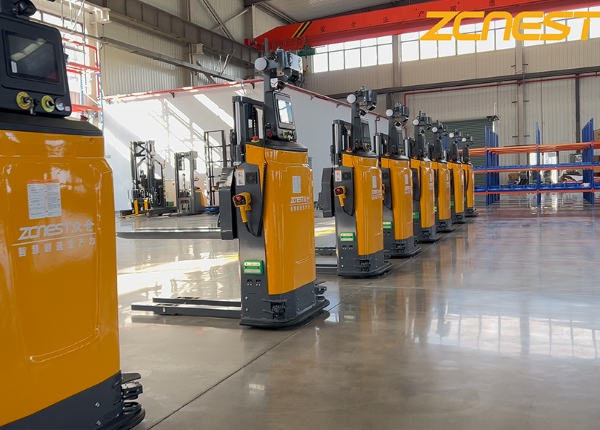
When a warehouse experiences a sudden power failure, autonomous forklifts should enter a predefined safety mode.
Typical responses include:
Controlled emergency stop
Brake activation to maintain vehicle position
Stopping movement in a safe location
Saving current operation status
Waiting for system recovery
A properly designed AGV should never continue uncontrolled movement after losing power or critical communication.
Most industrial AGV systems rely on a fleet management system or RCS (Robot Control System) to assign tasks and optimize traffic.
If the local server becomes unavailable, the AGV behavior depends on system architecture.
Common safety strategies include:
Completing the current safe movement
Stopping at the nearest safe position
Entering standby mode
Waiting for communication recovery
Before purchasing imported AGVs, companies should confirm the supplier's server failure handling logic.
Emergency manual operation capability is an important consideration for industrial AGV deployment.
Depending on the vehicle model, AGVs may provide manual control methods such as:
Manual driving mode
Maintenance control interface
Local operation panel
Service joystick control
However, manual control should normally be used only for maintenance, emergency handling or recovery operations rather than daily production.
Recovery time depends on the complexity of the AGV system, warehouse size and communication architecture.
A typical recovery process includes:
Power system restart
Network communication recovery
Vehicle status verification
Position confirmation
Task resumption
Advanced AGV systems can automatically restore vehicle positions using navigation sensors instead of requiring complete manual remapping.
A common concern from warehouse operators is whether a power outage will erase the AGV navigation environment.
Modern AGVs typically store navigation maps separately from temporary operation data.
After power recovery, the system normally performs:
Localization verification
Sensor matching
Position confirmation
Task synchronization
A normal power outage should not require rebuilding the entire warehouse map.
The amount of local data stored on each AGV depends on the supplier's software architecture.
Possible local information may include:
Vehicle configuration parameters
Navigation information
Sensor calibration data
Operating status information
Safety settings
For enterprise applications, customers should clearly define where operational data is stored and how backup recovery works.
A reliable AGV deployment should include a business continuity plan.
Recommended preparation includes:
UPS protection for critical servers
Backup network equipment
Emergency operation procedures
Spare communication devices
Operator recovery training
Supplier technical support process
| Evaluation Item | Key Question |
|---|---|
| Safety Response | Does the AGV stop safely during power loss? |
| Server Failure | How does the fleet system handle downtime? |
| Recovery | How quickly can operations restart? |
| Data Backup | Where is AGV system data stored? |
What happens if the warehouse loses power suddenly?
How does the AGV stop during server failure?
Can operators manually move the AGV in emergencies?
How long does recovery normally take?
Is navigation data stored locally?
What backup options are available?
The reliability of an AGV system is not measured only by normal operating speed. The real test is how the system behaves when unexpected events occur.
For companies importing AGV forklifts from China, evaluating emergency stop behavior, recovery procedures and data backup architecture is essential before deployment.
A well-designed autonomous warehouse should not only automate daily operations but also provide predictable recovery when problems happen.
FREE ENGINEERING SUPPORT Stop Gambling on Generic Platforms. Get an AGV/AMR Tailored to Your Warehouse.Buying automated guided vehicles involves complex safety standards (CE/ANSI), navigation setups (Laser SLAM), and ERP system integration. Don't risk your factory safety with middle-men. ✓ 100% Direct Factory: Customized payload up to 5 Tons. ✓ Free CAD Simulation: Send us your layout, and our engineers will simulate the optimal AGV routes. ✓ Global Support: Overseas installation guidance & local maintenance partners. |











 Chinese
 English




