


Before importing an AGV fleet from China, companies should conduct a detailed pre-feasibility study to determine whether their warehouse processes, infrastructure and operational requirements are suitable for automation.
A successful AGV project does not begin with selecting a robot model. It begins with understanding the warehouse workflow, collecting accurate operational data and validating the automation concept.
From our experience in warehouse automation projects, the biggest reason for AGV project delays is usually not the robot technology itself, but insufficient preparation before the engineering design stage.
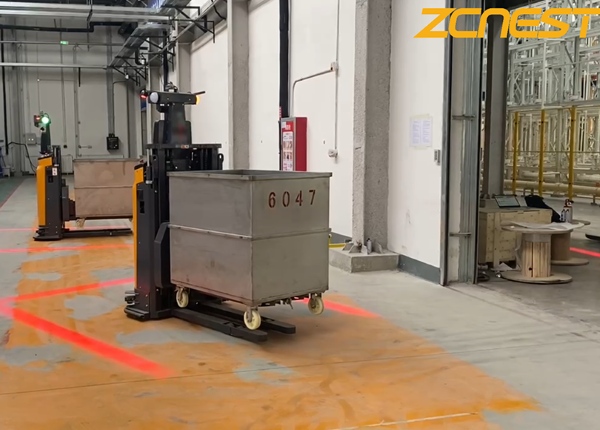
An AGV system is not a standalone machine. It is a complete logistics solution that connects vehicles, software, warehouse processes and existing systems.
A proper feasibility study helps companies answer:
Is my warehouse suitable for AGV automation?
How many AGVs are actually required?
Can the system achieve expected throughput?
What warehouse modifications are necessary?
What is the expected return on investment?
Chinese AGV engineering teams usually require detailed operational information before designing a solution.
The more accurate the input data, the more reliable the final automation design will be.
Common data requirements include:
Warehouse CAD drawings or layout files
Storage rack information
Pallet dimensions and weight
Material flow routes
Daily pallet movement volume
Peak hour transportation demand
Existing WMS or ERP information
Current forklift operation processes
One of the most important parts of feasibility analysis is understanding actual material movement requirements.
Many companies only provide daily volume data, but AGV capacity planning depends heavily on peak demand.
For example:
Average movement: 500 pallets per day
Peak period: 100 pallets within two hours
The second number is usually more important because it determines fleet size and traffic planning.
Professional AGV suppliers often use digital simulation tools to validate warehouse workflows before manufacturing equipment.
A simulation study may include:
AGV travel paths
Vehicle quantity calculation
Traffic analysis
Charging strategy
Waiting time analysis
Warehouse bottleneck identification
A digital simulation allows customers to identify problems before investing in physical equipment.
Accurate traffic data is critical for AGV system design.
Companies should record:
Pickup locations
Delivery locations
Movement frequency
Peak operating periods
Average travel distance
Priority transport tasks
Without accurate movement data, companies may purchase too many robots or create an undersized system that cannot handle peak operations.
Not every warehouse should immediately move to AGV automation.
Common warning signs include:
Unstable warehouse processes
Frequent layout changes
Non-standard pallet sizes
Poor floor conditions
Insufficient operational data
No clear automation objectives
High dependence on manual decision-making
In many cases, improving warehouse standardization before automation can significantly increase the success rate of an AGV project.
| Evaluation Area | Analysis Content |
|---|---|
| Warehouse Layout | Space, routes and rack configuration |
| Material Flow | Pickup and delivery requirements |
| AGV Quantity | Fleet size calculation |
| ROI Analysis | Investment and expected benefits |
Can you analyze my warehouse layout before quotation?
Can you provide a 3D simulation?
How do you calculate required AGV quantity?
What data do you need from my facility?
Can you estimate throughput before installation?
What warehouse conditions may prevent successful deployment?
A successful AGV project starts long before the first robot arrives at the warehouse.
Companies that invest time in feasibility analysis, data preparation and workflow simulation usually achieve better automation results and avoid expensive redesign after installation.
For businesses importing AGV fleets from China, the most important first step is not choosing a robot. It is proving that the warehouse process is ready for automation.
FREE ENGINEERING SUPPORT Stop Gambling on Generic Platforms. Get an AGV/AMR Tailored to Your Warehouse.Buying automated guided vehicles involves complex safety standards (CE/ANSI), navigation setups (Laser SLAM), and ERP system integration. Don't risk your factory safety with middle-men. ✓ 100% Direct Factory: Customized payload up to 5 Tons. ✓ Free CAD Simulation: Send us your layout, and our engineers will simulate the optimal AGV routes. ✓ Global Support: Overseas installation guidance & local maintenance partners. |





 Chinese
 English