

As warehouses continue to increase storage density and rack heights, pallet placement accuracy has become one of the most critical performance indicators for Reach AGVs. While many suppliers highlight maximum lifting height, experienced warehouse operators know that consistent positioning accuracy at full height is what determines long-term operational reliability.
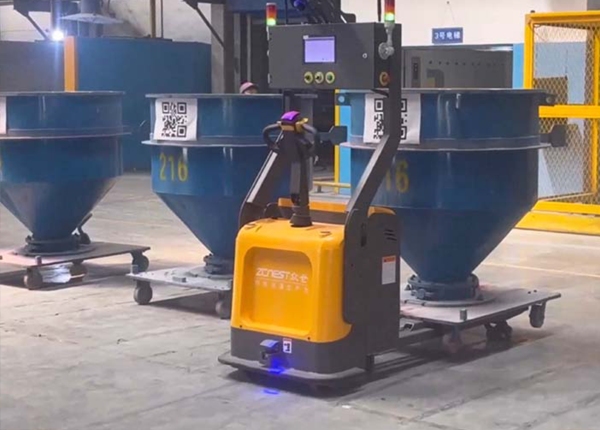
For companies importing Reach AGVs from China, the real evaluation should focus on repeatability, load stability and rack protection—not simply whether the vehicle can reach the highest storage location.
Every pallet placement affects warehouse efficiency, inventory safety and equipment lifespan. Small positioning errors that seem insignificant at ground level become much more critical when placing pallets at heights of 8 meters or above.
Accurate pallet positioning helps reduce:
Rack impacts
Pallet damage
Manual intervention
Product loss
Equipment downtime
Rather than focusing only on maximum lift height, engineers typically evaluate several factors that influence pallet placement quality:
Positioning repeatability
Fork alignment accuracy
Mast stability during lifting
Vehicle localization accuracy
Load stability at full height
The actual positioning performance depends on the complete system, including navigation technology, mast design, control algorithms and sensor calibration.
As lift height increases, the effects of mast deflection, vehicle vibration and load movement become more noticeable. Modern Reach AGVs are designed to monitor vehicle motion continuously and make positioning adjustments before pallet insertion.
Depending on the system configuration, compensation strategies may include:
Closed-loop lift control
Real-time mast position monitoring
Fork height correction
Vehicle posture compensation
Motion smoothing during final approach
Modern vision systems do much more than capture images. They can assist with identifying pallet openings, confirming pallet orientation and improving final positioning before the forks enter the load.
Depending on the application, onboard cameras may support:
Pallet pocket recognition
Fork alignment assistance
Pallet orientation verification
Detection of damaged pallets
Final positioning confirmation
The available vision capabilities vary by manufacturer and vehicle configuration and should be confirmed during technical evaluation.
High-value warehouse racking systems represent a significant investment. A reliable AGV should help reduce unnecessary contact with racks through a combination of navigation accuracy, vehicle control and operational safeguards.
Typical protection strategies include:
Controlled approach speed near racks
Automatic alignment before pallet insertion
Obstacle detection around the mast and forks
Position verification before completing the task
Automatic task interruption if abnormal conditions are detected
| Evaluation Area | Questions to Ask |
|---|---|
| Positioning Performance | How is repeatability measured at maximum operating height? |
| Vision Assistance | Does the system verify pallet alignment before insertion? |
| Load Handling | How is mast movement compensated under heavy loads? |
| Rack Protection | What functions reduce accidental rack contact? |
| Validation | Can the supplier provide performance data or demonstrations under similar operating conditions? |
After participating in multiple warehouse automation projects, one conclusion stands out: maximum lift height is rarely the factor that determines project success. Consistent, repeatable pallet placement is far more important than achieving the highest possible reach.
Many procurement teams compare AGVs based on specifications such as lift height or travel speed. However, experienced automation engineers pay closer attention to positioning consistency over thousands of operating cycles, especially in high-bay warehouses where even small alignment errors can increase maintenance costs and reduce productivity.
In our opinion, the best Reach AGV is not necessarily the one that lifts the highest. It is the one that can repeatedly place pallets accurately, protect warehouse infrastructure and maintain stable performance year after year. That level of consistency is what ultimately delivers the greatest return on investment for automated warehousing.
FREE ENGINEERING SUPPORT Stop Gambling on Generic Platforms. Get an AGV/AMR Tailored to Your Warehouse.Buying automated guided vehicles involves complex safety standards (CE/ANSI), navigation setups (Laser SLAM), and ERP system integration. Don't risk your factory safety with middle-men. ✓ 100% Direct Factory: Customized payload up to 5 Tons. ✓ Free CAD Simulation: Send us your layout, and our engineers will simulate the optimal AGV routes. ✓ Global Support: Overseas installation guidance & local maintenance partners. |





 Chinese
 English