


As AGV fleets continue to grow in size, traffic management has become one of the most important factors affecting warehouse efficiency. While obstacle avoidance is essential for individual vehicles, the real challenge begins when dozens of AGVs, manual forklifts and warehouse personnel share the same operating environment.
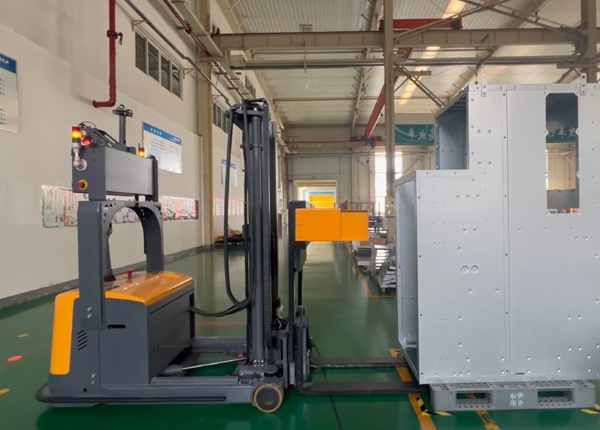
For companies importing AGVs from China, selecting a capable fleet management system is just as important as choosing the right vehicles. A well-designed traffic management strategy helps reduce congestion, improve productivity and maintain safe, predictable material flow throughout the facility.
A warehouse operating two or three AGVs rarely experiences serious traffic conflicts. However, as fleet size increases to dozens of vehicles, routing decisions become significantly more complex.
Without coordinated traffic control, companies may experience:
Vehicle congestion at intersections
Deadlock between multiple AGVs
Long waiting times
Reduced warehouse throughput
Higher energy consumption due to unnecessary travel
Modern AGV traffic management is designed to optimize the movement of the entire fleet rather than individual vehicles.
Most professional fleet management platforms allow traffic rules to be configured according to warehouse operations. Depending on the software capabilities, users may define:
One-way travel lanes
Restricted access zones
High-priority transport corridors
Temporary maintenance areas
No-entry locations during production
These configurable traffic rules help maintain organized vehicle movement while adapting to changing warehouse layouts and production requirements.
Warehouse intersections are among the busiest locations for AGV traffic. A fleet management system typically coordinates vehicle movement by evaluating traffic conditions before authorizing an AGV to enter an intersection.
Decision logic may consider factors such as:
Vehicle priority
Current task urgency
Traffic direction
Available route capacity
Intersection occupancy
The objective is to maintain smooth traffic flow while reducing unnecessary waiting and preventing congestion.
Many warehouses include shared spaces where AGVs and pedestrians operate in close proximity. Depending on the system design, traffic rules can be configured to improve safety in these areas.
Examples may include:
Reduced-speed zones
Controlled crossing points
Automatic stop areas
Restricted operating hours
Priority rules for pedestrian traffic
These configurations should always be implemented as part of a complete site-specific risk assessment and safety strategy.
Mixed fleets are common in modern warehouses, where AGVs operate alongside manually driven forklifts and other mobile equipment.
When an unexpected obstacle blocks a planned route, the fleet management system may respond by:
Pausing the affected AGV
Recalculating an alternative route when available
Assigning waiting priorities
Updating fleet task schedules
Notifying operators when intervention is required
The exact response depends on the software architecture and the operational rules configured for the facility.
| Feature | Why It Matters |
|---|---|
| Dynamic Route Planning | Helps reduce congestion and improve travel efficiency. |
| Intersection Control | Coordinates vehicle movement at shared crossings. |
| Priority Management | Ensures urgent transport tasks receive appropriate routing. |
| Zone Configuration | Supports speed limits, restricted access and operational flexibility. |
| Mixed Fleet Coordination | Improves cooperation between AGVs and manually operated vehicles. |
Can traffic rules be modified without changing the warehouse layout?
How does the software prevent AGV deadlocks?
Can priority rules be customized for different production tasks?
How does the system respond to blocked routes?
Can temporary traffic restrictions be created during maintenance?
Does the software support future fleet expansion without redesigning traffic rules?
One of the biggest misconceptions in warehouse automation is that AGV performance depends mainly on vehicle hardware. In practice, as fleet size grows, software becomes the primary factor influencing operational efficiency.
Across large-scale automation projects, we have found that traffic management software often determines whether a fleet can consistently deliver its expected throughput. Well-designed routing logic, intersection control and dynamic task scheduling have a greater impact on long-term productivity than simply increasing vehicle speed or adding more AGVs.
From our perspective, companies planning to deploy AGVs should evaluate the intelligence and scalability of the fleet management platform as carefully as they evaluate the vehicles themselves. The ability to coordinate traffic efficiently today—and adapt to future warehouse expansion—is what separates a successful automation project from one that struggles as operational complexity increases.
FREE ENGINEERING SUPPORT Stop Gambling on Generic Platforms. Get an AGV/AMR Tailored to Your Warehouse.Buying automated guided vehicles involves complex safety standards (CE/ANSI), navigation setups (Laser SLAM), and ERP system integration. Don't risk your factory safety with middle-men. ✓ 100% Direct Factory: Customized payload up to 5 Tons. ✓ Free CAD Simulation: Send us your layout, and our engineers will simulate the optimal AGV routes. ✓ Global Support: Overseas installation guidance & local maintenance partners. |





 Chinese
 English