


Many companies evaluating automated forklifts focus on payload capacity and navigation accuracy. However, real warehouse environments are rarely perfectly standardized. Different SKU sizes, packaging materials, pallet types and load conditions create additional challenges for autonomous forklift systems.
For businesses importing AGV forklifts from China, an important question is whether the system can reliably handle real-world warehouse variability instead of only operating under ideal test conditions.
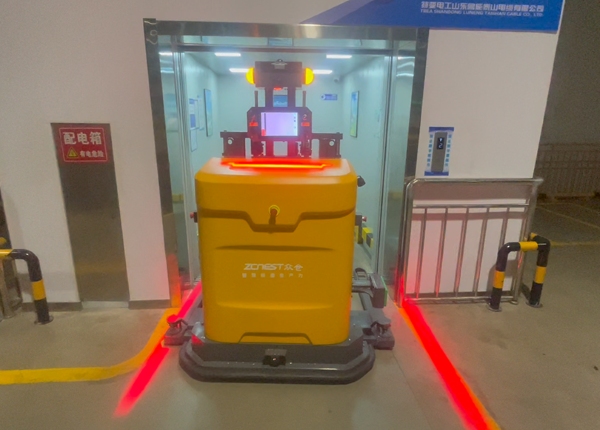
Traditional forklifts rely heavily on operator experience. Skilled drivers naturally adjust their speed, fork position and handling method based on the condition of each load.
An automated forklift must replace this human judgment with a combination of sensors, software logic and mechanical control.
Common warehouse challenges include:
Different pallet dimensions
Uneven load distribution
Fragile packaging materials
Plastic and metal pallets
Damaged or irregular pallet structures
Load stability is one of the most important factors when transporting heavy or uneven goods.
Advanced autonomous forklift systems may combine multiple technologies to improve load handling reliability, including:
3D vision cameras
Laser sensors
Load detection systems
Fork position monitoring
Motion control algorithms
These technologies help the AGV understand whether the pallet position is suitable before lifting and transporting the load.
Not every product should be transported using the same movement parameters.
For example:
| Load Type | Possible AGV Strategy |
|---|---|
| Fragile goods | Lower acceleration and smoother movement |
| Heavy industrial materials | Reduced speed and enhanced stability control |
| Standard cartons | Normal transport parameters |
A mature AGV system should allow different handling profiles to be configured according to warehouse requirements.
Modern warehouse automation often requires different operating rules for different product categories.
For example, companies may configure different parameters for:
Cardboard boxes
Wooden pallets
Plastic pallets
Metal containers
High-value products
These settings can include lifting height, travel speed, acceleration limits and task priority.
Many industrial warehouses use different pallet materials depending on their industry.
Plastic pallets and metal pallets may create different requirements because they can have different:
Surface characteristics
Weight distribution
Fork entry geometry
Reflective properties for sensors
Before deployment, engineering teams normally evaluate actual pallet samples to confirm reliable detection and handling performance.
Different SKU dimensions
Maximum and minimum load weights
Damaged pallet conditions
Uneven load distribution
Real warehouse floor conditions
Actual operating cycle requirements
Can the AGV recognize different pallet types?
Does the system support customized load profiles?
How does the vehicle detect abnormal pallet positions?
Can handling parameters be changed through software?
Can the supplier perform simulation using my warehouse data?
Based on our experience with warehouse automation projects, the biggest mistake companies make is evaluating AGVs only by maximum payload and travel speed.
In real operations, the difficult part is not moving a perfectly positioned standard pallet. The real challenge is handling thousands of daily variations in products, packaging and warehouse conditions.
The future direction of autonomous forklifts is not simply creating stronger machines. It is developing systems that can understand warehouse environments through sensors, software and intelligent decision-making.
From our perspective, the best AGV solution is not the one with the highest specification on paper. It is the system that can adapt to the customer's actual business conditions and continue operating reliably as warehouse complexity grows.
FREE ENGINEERING SUPPORT Stop Gambling on Generic Platforms. Get an AGV/AMR Tailored to Your Warehouse.Buying automated guided vehicles involves complex safety standards (CE/ANSI), navigation setups (Laser SLAM), and ERP system integration. Don't risk your factory safety with middle-men. ✓ 100% Direct Factory: Customized payload up to 5 Tons. ✓ Free CAD Simulation: Send us your layout, and our engineers will simulate the optimal AGV routes. ✓ Global Support: Overseas installation guidance & local maintenance partners. |











 Chinese
 English




