


When companies evaluate AGV forklifts for warehouse automation, floor conditions are often one of the most overlooked factors. Many warehouses were not originally designed for autonomous vehicles and may contain expansion joints, uneven concrete surfaces, dock transitions and different floor levels between operational areas.
For businesses importing AGVs from China, an important question is whether the equipment can adapt to real industrial environments without requiring expensive facility reconstruction.
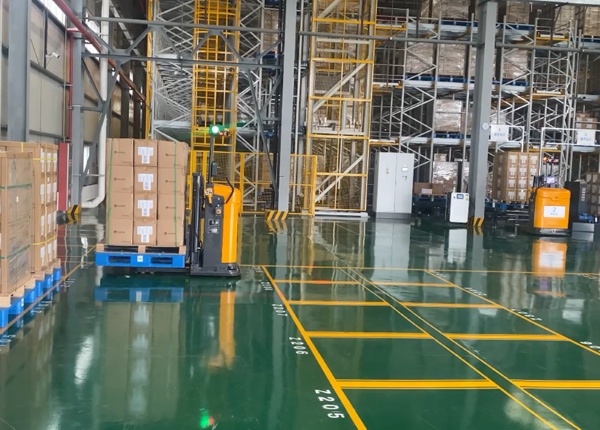
Autonomous forklifts depend on accurate movement, stable sensors and reliable mechanical control. Floor conditions can influence not only driving comfort but also navigation accuracy, load stability and equipment lifetime.
Common warehouse floor challenges include:
Concrete expansion joints
Small height differences between areas
Metal plates covering damaged sections
Dock leveler transition areas
Different floor surfaces between warehouse zones
The ability of an AGV to handle floor changes depends on multiple engineering factors, including vehicle design, wheel structure, chassis configuration and operating conditions.
Important evaluation factors include:
| Factor | Impact |
|---|---|
| Wheel diameter | Larger wheels generally improve the ability to pass small obstacles. |
| Chassis design | A stable chassis helps maintain load balance. |
| Suspension system | Helps reduce vibration impact on equipment and electronics. |
| Travel speed | Lower speed improves stability in challenging areas. |
A small floor height variation does not automatically mean an AGV will stop. The actual response depends on vehicle design, sensor configuration and safety logic.
AGV systems evaluate multiple conditions, including:
Vehicle stability
Navigation confidence
Load condition
Sensor feedback
Safety system status
During project planning, engineering teams normally review these areas through site surveys and route testing rather than relying only on theoretical specifications.
AGVs contain sensitive components such as industrial computers, controllers, sensors and communication modules. Excessive vibration may affect long-term reliability.
Industrial AGV designs may use:
Shock-absorbing structures
Robust industrial chassis
Suspension components
Protected electronic compartments
Industrial-grade connectors
The goal is not only to pass over uneven surfaces, but also to maintain stable operation throughout thousands of working cycles.
Many industrial facilities contain multiple operational areas connected through transition zones.
Examples include:
Production area to warehouse
Storage zone to shipping area
Indoor warehouse to loading dock
Different warehouse buildings
Successful deployment requires evaluating the entire travel path instead of only checking the main warehouse floor.
A professional AGV supplier normally performs a site evaluation before final system design.
Important checks include:
Floor flatness assessment
Route condition inspection
Dock transition evaluation
Obstacle identification
Traffic area planning
Navigation environment testing
What floor flatness requirements does the AGV have?
What maximum height difference can the vehicle cross?
How does the chassis handle vibration?
Can the AGV operate across warehouse transition zones?
Does the supplier perform onsite floor evaluation before production?
How does the navigation system handle imperfect environments?
From our experience with warehouse automation projects, floor conditions are one of the most underestimated factors during AGV planning.
Many companies focus on robot specifications but forget that the warehouse environment directly determines automation success. A high-performance AGV cannot compensate for unlimited infrastructure problems.
In our opinion, the best approach is not rebuilding every warehouse into a perfect environment. Instead, companies should work with experienced AGV engineers to identify critical areas, optimize routes and select equipment designed for real industrial conditions.
The future of warehouse automation will belong to systems that are not only intelligent, but also practical enough to operate reliably in existing facilities around the world.
FREE ENGINEERING SUPPORT Stop Gambling on Generic Platforms. Get an AGV/AMR Tailored to Your Warehouse.Buying automated guided vehicles involves complex safety standards (CE/ANSI), navigation setups (Laser SLAM), and ERP system integration. Don't risk your factory safety with middle-men. ✓ 100% Direct Factory: Customized payload up to 5 Tons. ✓ Free CAD Simulation: Send us your layout, and our engineers will simulate the optimal AGV routes. ✓ Global Support: Overseas installation guidance & local maintenance partners. |





 Chinese
 English