


When companies import AGV forklifts from China, many discussions focus on vehicle specifications, payload capacity and navigation technology. However, the success of an autonomous warehouse project also depends heavily on the local IT infrastructure supporting the fleet management software.
Before deployment, enterprise customers usually need to understand server requirements, software architecture, network configuration and compatibility with their existing IT environment.
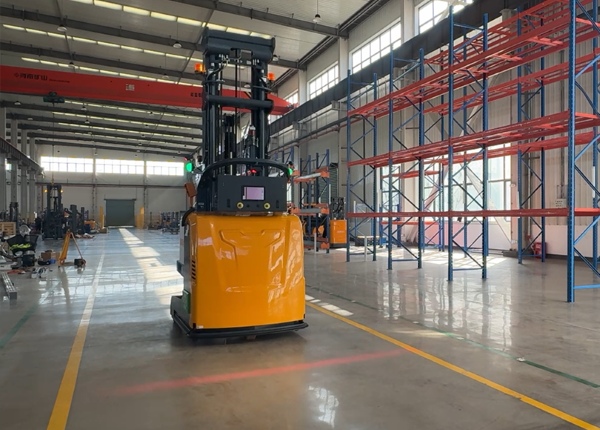
An AGV system is not only a vehicle. It is a complete automation platform including fleet scheduling software, warehouse maps, task management, communication services and data storage.
The local computing environment affects:
Vehicle response speed
Fleet scheduling performance
System reliability
Data security management
Future fleet expansion capability
Different companies may choose different deployment methods depending on their IT policies.
| Deployment Method | Typical Application |
|---|---|
| Local Server Deployment | Enterprise warehouses requiring internal data control. |
| Virtual Machine Deployment | Companies using VMware or Hyper-V infrastructure. |
| Private Cloud Deployment | Organizations requiring scalable computing resources. |
Enterprise customers usually ask about operating system compatibility before approving an automation project.
Common questions include:
Does the fleet management system support Windows Server?
Is the architecture based on Linux services?
Can the software run inside an enterprise virtual environment?
Are database services included or installed separately?
The final architecture depends on the AGV supplier's software design and the customer's IT policies.
Server requirements depend on more than the number of vehicles. The complexity of warehouse operations also affects computing demand.
| System Factor | Impact on Server Resources |
|---|---|
| Number of AGVs | More vehicles require more scheduling calculations. |
| Warehouse map complexity | Large facilities require more navigation data processing. |
| Historical data storage | Longer retention requires additional storage capacity. |
| System integrations | WMS, ERP and MES connections increase workload. |
A professional supplier should provide a recommended server configuration based on actual fleet size and application requirements.
Many enterprise IT departments prefer virtualized environments because they simplify backup, monitoring and resource management.
Before deployment, customers should confirm:
Supported virtualization platforms
CPU and memory allocation requirements
Database compatibility
Network configuration requirements
Backup and recovery methods
Network design is an important part of AGV deployment. Each vehicle needs stable communication with the fleet management system.
Typical network considerations include:
Vehicle communication method
Wireless coverage quality
IP address management
Network segmentation
Firewall configuration
Some projects use fixed IP management, while others use controlled DHCP environments depending on the customer's IT standards.
Can the software be deployed locally?
What operating systems are supported?
What server configuration is recommended for my fleet size?
Can the system run inside VMware or Hyper-V?
What network ports need to be opened?
How are software updates managed?
Can my IT team access system logs?
Before AGV installation, companies should involve both warehouse engineering teams and IT departments.
A complete preparation checklist should include:
Server resource planning
Network coverage testing
Cybersecurity review
Software installation testing
WMS integration preparation
Backup strategy confirmation
From our experience with warehouse automation projects, many companies underestimate the importance of IT preparation before installing AGVs.
An autonomous forklift is not simply replacing a manual forklift. It introduces a complete digital operation system into the warehouse.
In our view, the future competitiveness of AGV suppliers will depend not only on hardware performance but also on software architecture, deployment flexibility and enterprise IT compatibility.
For overseas companies importing AGVs from China, choosing a system that can integrate smoothly with existing IT infrastructure is one of the most important decisions for long-term automation success.
FREE ENGINEERING SUPPORT Stop Gambling on Generic Platforms. Get an AGV/AMR Tailored to Your Warehouse.Buying automated guided vehicles involves complex safety standards (CE/ANSI), navigation setups (Laser SLAM), and ERP system integration. Don't risk your factory safety with middle-men. ✓ 100% Direct Factory: Customized payload up to 5 Tons. ✓ Free CAD Simulation: Send us your layout, and our engineers will simulate the optimal AGV routes. ✓ Global Support: Overseas installation guidance & local maintenance partners. |





 Chinese
 English