

When companies import AGV forklifts from China, hardware performance is only one part of the evaluation process. For complex warehouses, the ability of the software platform to adapt to unique workflows often determines the long-term success of automation projects.
Every warehouse has different operational rules, including pallet movement logic, quality inspection steps, inventory processes and system integration requirements. Therefore, customers need to understand how flexible the AGV software can be before deployment.
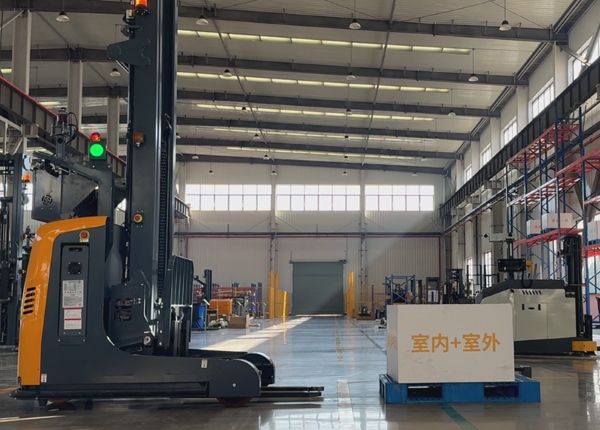
A standard AGV system can complete basic transportation tasks, but enterprise warehouses often require more advanced workflow logic.
Examples include:
Multi-stage pallet verification
Quality inspection confirmation
Special storage rules
Priority order handling
MES and WMS communication requirements
The question is not only whether an AGV can move goods, but whether the system can understand and execute the company's business logic.
Advanced AGV platforms normally separate basic vehicle control from business workflow management.
This allows companies to customize:
Task assignment rules
Pallet validation processes
Transport priorities
Exception handling logic
Warehouse operation sequences
Before purchasing, customers should confirm whether customization is achieved through configuration tools, APIs or software development.
Many large companies already operate existing MES, WMS or ERP systems. The AGV platform must communicate with these systems reliably.
Common integration requirements include:
Receiving transport tasks from MES
Sending completion status back to WMS
Updating inventory information
Reporting vehicle status
Managing production logistics requests
A capable supplier should provide technical documentation, interface definitions and engineering support during integration.
Customers should clearly define the difference between standard support and customized development before signing a contract.
| Service Type | Typical Handling |
|---|---|
| Software bug fixes | Usually included in technical support. |
| Parameter adjustment | Often included depending on agreement. |
| New workflow development | Usually treated as customized engineering work. |
| New system integration | Requires technical evaluation. |
Professional AGV suppliers should not directly modify production systems without validation.
A safer development process usually includes:
Requirement confirmation
Software development
Simulation testing
Factory validation
Customer acceptance testing
Production deployment
This process reduces the risk of software changes affecting live warehouse operations.
Can the system support custom workflow rules?
Does the supplier provide API documentation?
Can the software integrate with my MES or WMS?
Who owns customized software functions?
How are software updates managed?
Is there a testing environment before deployment?
Can previous customization examples be provided?
Companies should not only ask whether customization is possible. They should evaluate how quickly and safely the supplier can adapt the system to future business changes.
Important evaluation factors include:
Software architecture flexibility
API openness
Development capability
Testing process
Long-term support capability
From our experience with warehouse automation projects, software flexibility is often more important than hardware specifications after deployment.
A warehouse is a living business environment. Processes change, product categories change and system requirements continue to evolve.
In our opinion, the future winners in the AGV market will not only manufacture reliable robots. They will provide intelligent platforms that can continuously adapt to customer operations.
For companies importing AGVs from China, choosing a supplier with strong software customization capability can significantly reduce future automation risks and improve long-term investment value.
FREE ENGINEERING SUPPORT Stop Gambling on Generic Platforms. Get an AGV/AMR Tailored to Your Warehouse.Buying automated guided vehicles involves complex safety standards (CE/ANSI), navigation setups (Laser SLAM), and ERP system integration. Don't risk your factory safety with middle-men. ✓ 100% Direct Factory: Customized payload up to 5 Tons. ✓ Free CAD Simulation: Send us your layout, and our engineers will simulate the optimal AGV routes. ✓ Global Support: Overseas installation guidance & local maintenance partners. |





 Chinese
 English