


When companies evaluate industrial AGVs imported from China, energy efficiency is becoming an increasingly important factor alongside automation capability, safety and return on investment.
Modern warehouses are not only looking for labor reduction. They are also looking for lower operating costs, improved energy management and measurable sustainability improvements.
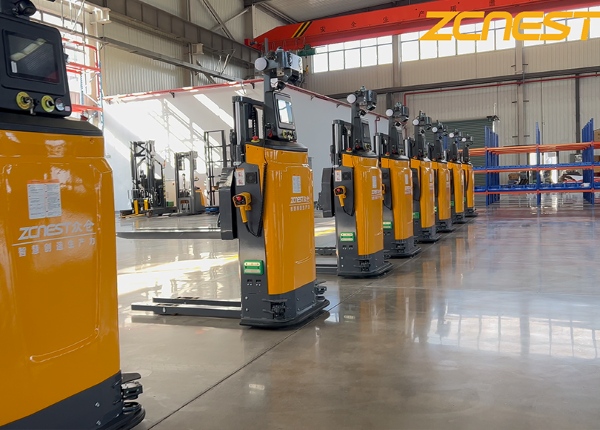
An AGV fleet operates continuously throughout the day. Even small improvements in energy consumption can create significant savings over a five-year operating period.
Energy costs in automated warehouses usually include:
Battery charging electricity consumption
Charging station operation
Battery replacement costs
Maintenance energy requirements
Warehouse supporting systems
Energy efficiency is not only determined by the battery capacity. The intelligence of the fleet management software also plays an important role.
Advanced AGV scheduling systems can reduce unnecessary energy usage through:
Optimized route planning
Reduced empty travel distance
Task combination strategies
Dynamic traffic management
Intelligent charging scheduling
A well-designed dispatch system allows each vehicle to spend more time performing productive transportation tasks instead of unnecessary movement.
Some advanced electric AGV platforms use regenerative braking technology to improve energy efficiency.
During deceleration, part of the kinetic energy can be converted back into electrical energy and returned to the battery system.
Customers should confirm with suppliers:
Whether regenerative braking is supported
How the energy recovery system works
How battery health is protected
Whether performance changes under heavy loads
The energy benefits of automation are not limited to the vehicles themselves.
A highly automated warehouse may reduce energy consumption through:
Reduced employee traffic areas
Optimized warehouse operation schedules
Lower unnecessary lighting usage
Improved material flow efficiency
Better space utilization
For high-density warehouses, especially high-bay storage facilities, automation can improve operational efficiency while supporting energy management goals.
Many international companies now include carbon reduction targets in supply chain decisions.
Replacing traditional material handling equipment with electric autonomous forklifts may reduce emissions by:
Replacing LPG or diesel forklift operations
Reducing unnecessary vehicle movement
Improving electricity utilization efficiency
Supporting renewable energy adoption
| Evaluation Item | Key Data |
|---|---|
| Daily operating hours | Number of shifts and working time. |
| Battery consumption | Energy used per transportation cycle. |
| Charging efficiency | Charging losses and battery performance. |
| Carbon reduction | Emission reduction compared with previous equipment. |
What is the average electricity consumption per shift?
Does the system optimize routes automatically?
Does the vehicle support regenerative braking?
How does the charging system protect battery life?
Can the software provide energy usage reports?
Can carbon reduction data be calculated?
From our experience with warehouse automation projects, energy savings from AGVs should not be evaluated only by comparing battery capacity.
The biggest efficiency improvement usually comes from optimizing the entire material handling process: reducing empty movement, improving scheduling and creating a more predictable workflow.
In our opinion, future AGV competition will move beyond hardware specifications. Suppliers that can help customers build energy-efficient and sustainable logistics operations will have stronger long-term value.
For companies importing AGVs from China, evaluating energy efficiency together with total operating cost and carbon reduction goals provides a more complete automation investment analysis.
FREE ENGINEERING SUPPORT Stop Gambling on Generic Platforms. Get an AGV/AMR Tailored to Your Warehouse.Buying automated guided vehicles involves complex safety standards (CE/ANSI), navigation setups (Laser SLAM), and ERP system integration. Don't risk your factory safety with middle-men. ✓ 100% Direct Factory: Customized payload up to 5 Tons. ✓ Free CAD Simulation: Send us your layout, and our engineers will simulate the optimal AGV routes. ✓ Global Support: Overseas installation guidance & local maintenance partners. |





 Chinese
 English