


Many overseas warehouses do not operate with one standardized pallet. They may use wooden pallets, plastic pallets, steel skids, wire-mesh containers, export pallets, or custom industrial carriers.
For an autonomous forklift, pallet compatibility is not determined by material alone. The vehicle must reliably recognize, approach, enter, lift, transport, and place the actual load geometry used by the warehouse.
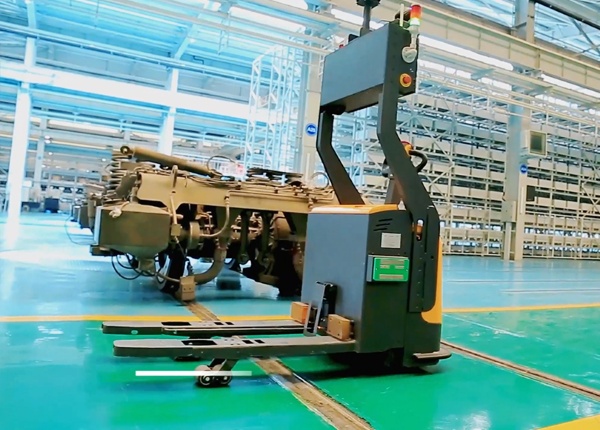
A plastic pallet and wooden pallet can both be compatible with an AGV, while two wooden pallets can behave very differently if their dimensions or runner configurations are different.
The supplier should therefore collect dimensions, runner positions, entry openings, overall height, maximum weight, and load center.
Fork entry is one of the most important factors in automated pallet handling.
The vehicle needs sufficient clearance to insert the forks without contacting the pallet structure or surrounding objects.
Small variations can become important when pallets are damaged, warped, loaded unevenly, or placed slightly outside their expected position.
The same pallet can produce different operating conditions depending on how the load is distributed.
The supplier should know the expected load center and maximum payload rather than evaluating the pallet only by its total weight.
A warehouse should not test only new, perfectly positioned pallets if damaged pallets are part of normal operations.
Representative tests can include slightly warped boards, damaged runners, missing boards, uneven loads, and pallet deformation within the warehouse's actual operating range.
The objective is to determine the boundary between an acceptable pallet and a pallet that should be rejected or sent to manual handling.
Some plastic, metal, or painted surfaces can behave differently with optical sensors.
The supplier should test the actual pallet materials rather than assuming that all surfaces will produce identical sensor performance.
This is particularly relevant when cameras, LiDAR, depth sensors, or optical pallet-detection systems are used for alignment or detection.
Different pallet types may require different fork spacing.
If multiple pallet profiles are used, determine whether the AGV can automatically adjust fork spacing, whether adjustment is manual, or whether separate vehicle configurations are required.
The adjustment range and actual positioning performance should be verified using representative pallets.
Successful pallet pickup does not automatically prove successful pallet placement.
The test should cover both directions and include rack locations, staging areas, conveyors, and other interfaces used in production.
The buyer should create a pallet-quality window.
For example, define acceptable dimensions, maximum deformation, entry clearance, load distribution, and identification conditions.
This gives both the warehouse team and AGV supplier a common definition of which pallets the automated system is expected to handle.
If possible, representative pallets should be available during acceptance testing.
Test normal pallets and the non-standard conditions that the warehouse expects to encounter regularly.
The results should document successful pickup, transport, placement, and recovery behavior.
No autonomous system should be expected to handle every physically damaged pallet.
The important question is how the system responds when the pallet is outside its defined operating range.
The fleet system may report an exception, stop the mission, request manual intervention, or apply another configured recovery procedure.
The exact behavior should be tested and documented before production deployment.
| Pallet Type | Items to Validate |
|---|---|
| Wooden pallet | Runner, deformation, entry clearance |
| Plastic pallet | Surface, runner, sensor response |
| Steel skid | Weight, clearance, sensor response |
| Wire container | Geometry and fork entry |
| Damaged pallet | Acceptable deformation limits |
For overseas buyers, pallet compatibility should therefore be treated as a measurable engineering requirement rather than a simple statement that the AGV “supports standard pallets.”





 Chinese
 English