


Buying an autonomous forklift fleet from China does not mean every maintenance task must be performed by Chinese engineers. A well-planned overseas deployment normally divides maintenance responsibilities between the local warehouse team and the equipment manufacturer.
The key is to decide which problems can be handled locally and which require supplier engineering support before the fleet enters production.
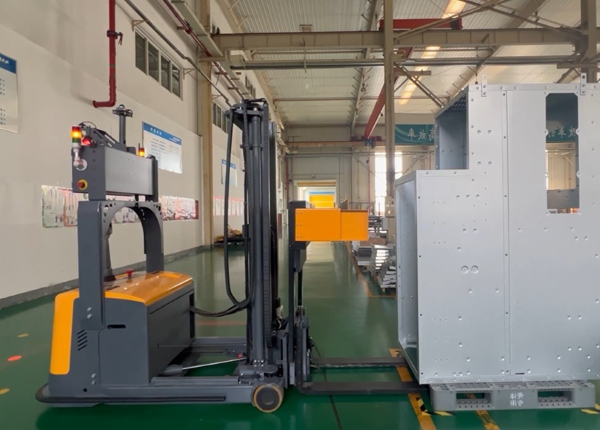
Warehouse technicians can often perform routine inspection tasks such as checking wheels, forks, visible damage, sensors, charging connections, warning devices, and cleanliness.
More complex work involving safety parameters, core navigation, control software, or major electronic components may require supplier authorization or specialist training.
Local technicians should receive practical training before the commissioning team leaves.
Training can cover:
Daily inspection
Battery and charging checks
Fault-code interpretation
Sensor cleaning
Basic mechanical inspection
Wheel and tire inspection
Emergency-stop reset
Basic software operation
Spare-parts replacement procedures
Escalation procedures
The exact spare-parts list depends on the vehicle model and operating environment.
Potential categories include drive wheels, sensors, connectors, fuses, filters, hydraulic components, charging components, and other wear or failure-prone parts.
The supplier should provide recommended part numbers, replacement procedures, lead times, and storage conditions.
Remote support can significantly reduce the need for immediate international travel when a software or diagnostic issue occurs.
The service agreement should define how remote access works, who authorizes it, how sessions are logged, and whether the connection can be enabled only when support is required.
A practical maintenance structure can separate problems into several levels.
| Level | Typical Responsibility |
|---|---|
| Level 1 | Operator checks and basic recovery |
| Level 2 | Local technician diagnosis and component replacement |
| Level 3 | Supplier engineering and software support |
| Level 4 | On-site manufacturer engineering when required |
Fleet-management software may contain settings that can affect routes, traffic, vehicle parameters, or other operational functions.
Use role-based permissions where supported.
Routine operators should not automatically receive access to configuration functions that can affect safety, localization, or fleet behavior.
Every significant software, map, route, parameter, or hardware change should be documented.
The record should identify what changed, why it changed, who approved it, when it was implemented, and how the system was tested afterward.
This becomes particularly important when the fleet operates for several years and different technicians become involved in maintenance.
Fleet software can provide useful information for maintenance planning, depending on the system architecture.
Potential information includes fault history, vehicle utilization, battery status, charging records, mission failures, manual interventions, and component alarms.
The buyer should clarify which data is available, how long it is retained, and whether it can be exported for independent analysis.
The maintenance plan should address what happens if a major component fails.
Examples include drive motors, controllers, industrial computers, safety scanners, hydraulic components, batteries, or charging equipment.
Ask how the failed component is diagnosed, whether the replacement requires software configuration, whether calibration is required, and whether the supplier must approve the repair before the vehicle returns to service.
For serious failures, Chinese engineering support may still be necessary.
The service agreement should define the conditions under which on-site support is provided, expected response procedures, travel costs, engineering-day rates, spare-parts responsibility, and the information the customer must provide before an engineer travels.
Before production handover, the warehouse should have:
Maintenance manuals
Spare-parts list
Part numbers
Fault-code guide
Training records
Inspection checklist
Remote-support procedure
Escalation contacts
Software access permissions
Change-control procedure
The goal is not to eliminate the supplier from the maintenance process. The goal is to ensure that routine issues can be handled locally while specialist problems can be escalated quickly.
For an overseas buyer, local maintenance capability should be part of the purchase plan rather than something created after the first failure.
Define training, spare parts, software access, remote diagnostics, escalation, documentation, and on-site engineering responsibilities before the fleet enters production.
This gives the warehouse a practical service structure for operating Chinese unmanned forklifts over the long term.





 Chinese
 English