


Laser scanners are one of the most important components in modern autonomous forklifts. They directly affect navigation accuracy, safety protection and long-term operating stability.
When companies import AGV forklifts from China, many buyers want to understand one key question: how long can the laser scanning system reliably operate in a real warehouse environment?
The answer directly affects maintenance planning, operating costs and the long-term return on automation investment.
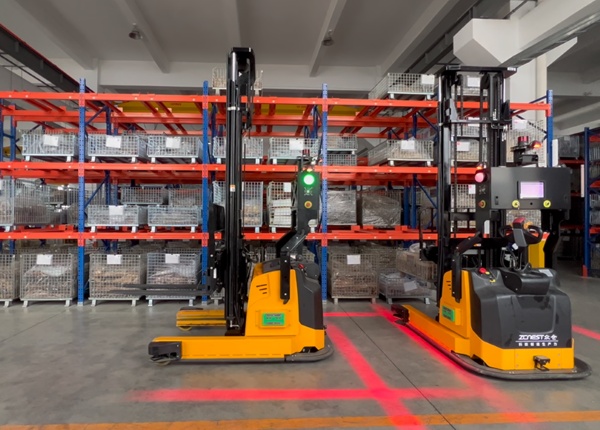
An autonomous forklift depends on sensors to understand its environment, avoid obstacles and maintain accurate positioning.
If the laser system becomes unstable, possible problems include:
Navigation deviation
Unexpected emergency stops
Reduced transportation efficiency
Increased maintenance requirements
Industrial laser scanners used in AGV applications are designed for continuous operation in factories and warehouses.
Under normal indoor conditions, many industrial-grade laser scanners can support several years of continuous operation.
Actual service life depends on:
Operating hours per day
Dust and environmental conditions
Temperature changes
Mechanical vibration
Maintenance frequency
Different AGV manufacturers select sensors according to application requirements, cost targets and customer standards.
Common industrial laser sensor suppliers used in automation applications include:
SICK
Hokuyo
Keyence
Industrial-grade LiDAR manufacturers
For international projects, customers should confirm the exact sensor model and technical specifications before production.
Laser scanners usually do not fail suddenly. In many cases, performance degradation appears gradually.
Warning signs may include:
More frequent positioning corrections
Repeated navigation errors
Unexpected vehicle stops
Reduced detection accuracy
Communication warnings
Professional maintenance teams normally evaluate laser scanner performance through multiple methods.
| Inspection Item | Purpose |
|---|---|
| Sensor Status Monitoring | Check communication and operating condition. |
| Navigation Accuracy Test | Verify positioning performance. |
| Error Log Analysis | Identify abnormal operating patterns. |
| Physical Inspection | Check contamination or damage. |
Replacement cost depends on the sensor brand, model and project requirements.
The total replacement expense may include:
Sensor hardware cost
International shipping
Installation labor
Calibration service
Production downtime cost
Request complete component lists before purchase
Understand sensor replacement cycles
Keep critical spare parts available
Create preventive maintenance schedules
Confirm supplier technical support capability
From practical AGV deployment experience, the sensor system is one of the most important factors determining long-term automation reliability.
Many companies focus heavily on AGV purchase price but underestimate the importance of lifecycle maintenance.
A reliable AGV supplier should provide not only autonomous vehicles but also clear information about sensors, replacement procedures and long-term service capability.
For companies importing AGV forklifts from China, evaluating laser scanner reliability before purchase can significantly reduce future operational risks.
FREE ENGINEERING SUPPORT Stop Gambling on Generic Platforms. Get an AGV/AMR Tailored to Your Warehouse.Buying automated guided vehicles involves complex safety standards (CE/ANSI), navigation setups (Laser SLAM), and ERP system integration. Don't risk your factory safety with middle-men. ✓ 100% Direct Factory: Customized payload up to 5 Tons. ✓ Free CAD Simulation: Send us your layout, and our engineers will simulate the optimal AGV routes. ✓ Global Support: Overseas installation guidance & local maintenance partners. |





 Chinese
 English