


Industrial warehouses are not always completely flat. Many facilities include loading dock ramps, production area transitions, underground connections and elevated storage areas.
For companies importing automated forklifts from China, ramp performance is an important factor when evaluating whether an AGV system can operate safely in their existing facility.
The key question is not simply whether an autonomous forklift can climb a slope, but whether it can maintain stability, positioning accuracy and safety control under real working conditions.
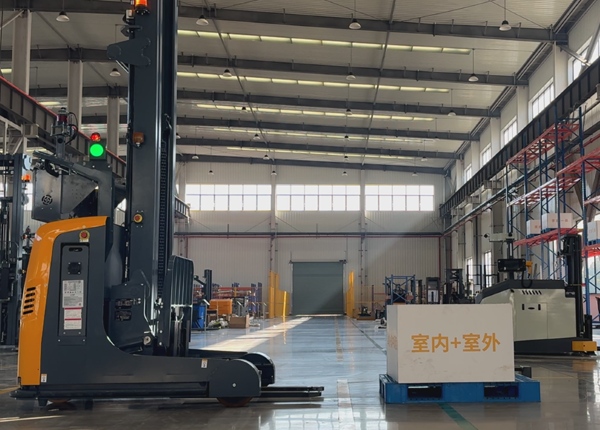
The maximum slope capability of an automated forklift depends on multiple engineering factors rather than a single specification.
Vehicle drive system
Payload weight
Wheel material and traction
Floor surface condition
Ramp length
Load center position
Battery power level
A professional AGV supplier should evaluate ramp performance under actual operating conditions, not only empty vehicle tests.
When carrying maximum loads, factors such as increased vehicle weight and changed center of gravity can reduce climbing capability.
For this reason, buyers should request load-and-ramp validation testing before final deployment.
Safety on ramps requires more than motor power. Automated forklifts normally combine multiple control methods to maintain position.
Motor holding torque
Mechanical braking system
Speed monitoring
Position feedback sensors
Emergency stop protection
Descending a ramp can be more challenging than climbing because gravity increases vehicle acceleration.
A mature AGV control system adjusts movement parameters according to operating conditions.
| Condition | Control Strategy |
|---|---|
| Flat Floor | Normal travel speed |
| Ramp Area | Reduced speed and controlled acceleration |
| Heavy Load | Additional stability control |
When multiple AGVs operate in the same warehouse, the dispatch system should understand special operating zones.
Ramp restricted areas
Speed limitation zones
Priority routes
Vehicle scheduling rules
Pedestrian safety zones
Maximum safe ramp angle under rated load
Ramp stopping capability
Emergency braking performance
Speed control strategy on slopes
Testing records from the manufacturer
Recommended floor conditions
From practical warehouse automation projects, ramp capability is often overlooked during the early planning stage. Many companies focus on payload and lifting height but forget that floor conditions and elevation changes directly affect daily reliability.
A reliable AGV solution should not only demonstrate that the vehicle can climb a slope. It should prove stable operation under real conditions including maximum loads, repeated cycles and emergency situations.
When selecting a Chinese automated forklift supplier, buyers should evaluate engineering validation capabilities rather than only comparing technical specifications. The best suppliers understand the entire warehouse environment and design the system around actual operational risks.
FREE ENGINEERING SUPPORT Stop Gambling on Generic Platforms. Get an AGV/AMR Tailored to Your Warehouse.Buying automated guided vehicles involves complex safety standards (CE/ANSI), navigation setups (Laser SLAM), and ERP system integration. Don't risk your factory safety with middle-men. ✓ 100% Direct Factory: Customized payload up to 5 Tons. ✓ Free CAD Simulation: Send us your layout, and our engineers will simulate the optimal AGV routes. ✓ Global Support: Overseas installation guidance & local maintenance partners. |





 Chinese
 English