


Many warehouses already use automatic barcode scanners, RFID systems, WMS software and industrial sensors before introducing autonomous forklifts.
For companies importing Chinese AGV fleets, the key question is not only whether the robots can move pallets, but whether they can communicate with existing warehouse data systems.
A successful AGV deployment requires smooth data flow between scanners, warehouse software and robot fleet management systems.
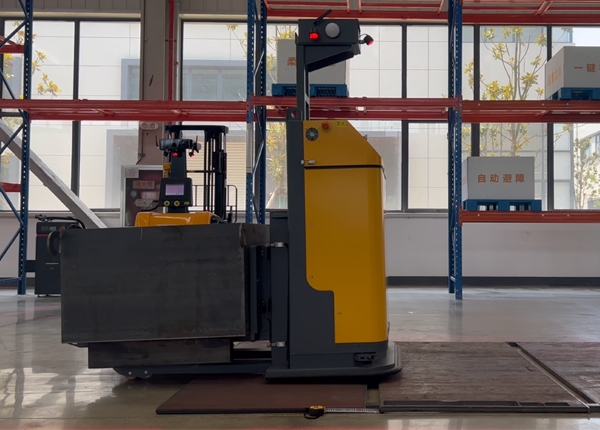
There are two common methods for connecting barcode systems with AGV operations.
A fixed industrial scanner reads pallet information at warehouse gates or storage points. The data is then transferred to the WMS and AGV dispatch system.
Some autonomous forklifts can use onboard scanners or vision systems to identify pallets during operation.
A typical warehouse automation workflow looks like this:
Barcode Scanner → WMS → AGV Fleet Management System → Robot Controller → AGV Execution
| Protocol | Application |
|---|---|
| MQTT | IoT sensors and real-time data communication |
| HTTP / REST API | WMS and ERP integration |
| OPC UA | Industrial automation communication |
| TCP/IP | Basic industrial networking |
In many cases, existing barcode scanners can continue operating if they support standard industrial communication interfaces.
Before integration, engineers should confirm communication protocols, data formats, trigger methods and system permissions.
Warehouse network stability
WMS processing speed
Fleet scheduling algorithm
Number of active AGVs
Database response performance
Does the AGV system provide open API interfaces?
Can my existing scanners communicate with the fleet software?
Does the system support MQTT, HTTP or OPC UA?
How are failed barcode reads handled?
Can my WMS automatically create AGV transport tasks?
From real warehouse automation projects, the biggest challenge is often not robot movement but system communication.
A traditional forklift driver naturally understands pallet labels, locations and transport instructions. After automation, these decisions must be transferred into digital communication between scanners, software and robots.
For overseas companies importing AGVs from China, the most important evaluation is not only vehicle performance, but also integration capability. A successful project requires reliable hardware, open communication interfaces and professional engineering support.
FREE ENGINEERING SUPPORT Stop Gambling on Generic Platforms. Get an AGV/AMR Tailored to Your Warehouse.Buying automated guided vehicles involves complex safety standards (CE/ANSI), navigation setups (Laser SLAM), and ERP system integration. Don't risk your factory safety with middle-men. ✓ 100% Direct Factory: Customized payload up to 5 Tons. ✓ Free CAD Simulation: Send us your layout, and our engineers will simulate the optimal AGV routes. ✓ Global Support: Overseas installation guidance & local maintenance partners. |





 Chinese
 English