


Drive-in racking systems are designed to maximize warehouse storage density, but automating these environments requires extremely accurate navigation and pallet handling.
For companies importing Reach AGVs from China, the key question is not only whether the vehicle can enter the rack channel, but whether it can operate safely and consistently in a narrow environment.
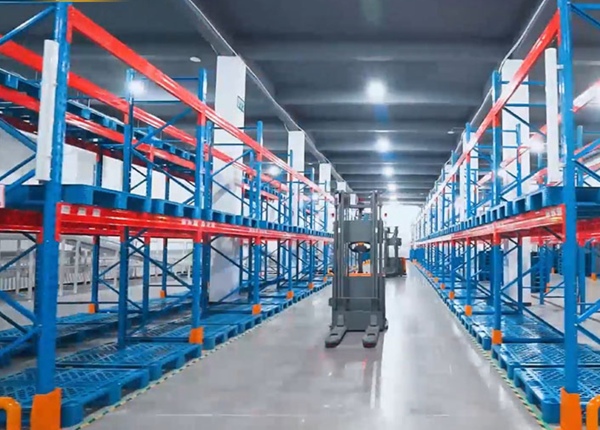
A modern Reach AGV can be designed for narrow aisle and deep storage applications by combining accurate navigation, safety sensors and intelligent fleet software.
The operating process normally includes:
Entering the rack channel
Positioning at the target location
Adjusting fork height and alignment
Picking or placing pallets
Safely exiting the channel
Drive-in racks create challenging operating conditions because both sides of the vehicle are surrounded by metal structures.
Laser safety scanners
Side collision detection sensors
Distance monitoring systems
Low-speed operation zones
Automatic emergency stopping
Automated storage requires accurate information about pallet locations before every retrieval operation.
WMS inventory information
Vision-based pallet detection
Laser distance measurement
Rack location mapping
Existing warehouses may have rack deformation caused by years of forklift operation.
A professional AGV system evaluates safety distance, sensor feedback and navigation conditions before deciding whether to continue operation or request human assistance.
Rack channel width measurement
Rack vertical alignment inspection
Floor flatness evaluation
Pallet size confirmation
Storage location mapping
Can the AGV operate inside my existing drive-in racks?
What is the minimum aisle requirement?
How does the system prevent rack collisions?
Can the AGV detect abnormal pallet positions?
Can engineers perform warehouse simulation before delivery?
From practical warehouse automation projects, the success of AGV deployment depends on the combination of vehicle capability, warehouse conditions and system integration.
A common mistake is purchasing an AGV first and expecting it to adapt to any warehouse environment.
For high-density storage projects, the correct approach is to evaluate rack structure, pallet standards, floor conditions and automation requirements before selecting the AGV model.
The future of warehouse automation will rely on the combination of Reach AGVs, intelligent scheduling software and optimized storage design to achieve higher storage efficiency per square meter.
FREE ENGINEERING SUPPORT Stop Gambling on Generic Platforms. Get an AGV/AMR Tailored to Your Warehouse.Buying automated guided vehicles involves complex safety standards (CE/ANSI), navigation setups (Laser SLAM), and ERP system integration. Don't risk your factory safety with middle-men. ✓ 100% Direct Factory: Customized payload up to 5 Tons. ✓ Free CAD Simulation: Send us your layout, and our engineers will simulate the optimal AGV routes. ✓ Global Support: Overseas installation guidance & local maintenance partners. |





 Chinese
 English