


When importing autonomous forklifts from China, many warehouse operators focus on the vehicle itself and overlook the charging infrastructure.
This can create an important project risk. The AGV may be technically suitable for the warehouse, but the charging equipment still needs to be evaluated against the electrical requirements of the destination country and the actual installation environment.
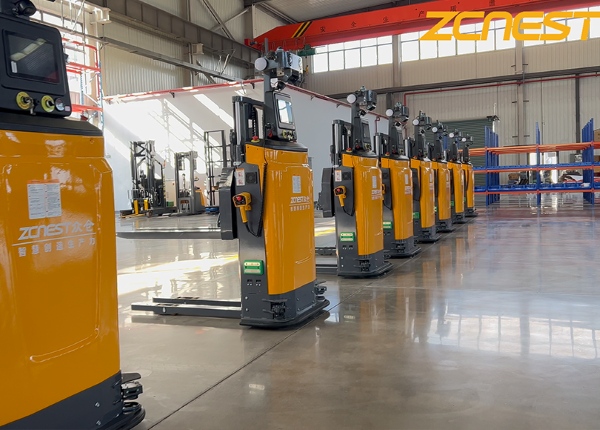
The key question is therefore not simply whether a Chinese charging station is safe. The more important question is whether the exact charger, battery, protection system and installation configuration are suitable for the customer's local electrical requirements.
No. A charger manufactured in China should not automatically be assumed to comply with every requirement in the destination market.
Different countries and regions may have different requirements covering electrical equipment, wiring, grounding, overcurrent protection, installation methods and workplace safety.
For a U.S. warehouse project, for example, the customer may need to consider applicable electrical codes, local authority requirements and whether the specific equipment requires evaluation or certification by an appropriately recognized testing organization.
This is why buyers should request the exact charger model, electrical specifications and applicable certification documentation before shipment rather than assuming that a general statement such as "CE certified" means the equipment is automatically approved for every country.
This depends on the specific charging system and destination market.
A fast-charging system may include several separate components:
AC or DC charging equipment
Charging contacts or charging pads
Power conversion electronics
Control circuitry
Communication interfaces
Protective devices
The buyer should ask the supplier to identify exactly which components are covered by each certification or evaluation document.
Do not assume that certification of the AGV automatically covers the charging station. The vehicle, battery and charger may have different technical documentation and compliance requirements.
A high-current charging system should be designed with appropriate protection against abnormal electrical and thermal conditions.
Depending on the equipment design, protection may include:
Overcurrent protection
Short-circuit protection
Overvoltage protection
Undervoltage protection
Overtemperature protection
Ground-fault or leakage protection where applicable
Charging communication monitoring
Emergency shutdown functions
The exact protection architecture should be confirmed from the manufacturer's electrical documentation rather than assumed from the product description.
For high-current charging, the protection system is part of the overall warehouse safety design. The charger should not be evaluated as an isolated box.
A properly engineered lithium battery charging system should monitor battery conditions and respond to abnormal conditions according to its design.
The battery management system, or BMS, can monitor parameters such as:
Battery voltage
Cell voltage
Battery temperature
Charging current
State of charge
Fault conditions
Depending on the system architecture, the BMS can communicate with the charger and request charging current reduction or charging termination when abnormal conditions are detected.
However, buyers should not accept the statement "the charger has overheat protection" without asking how the protection actually works.
A better technical question is:
"What happens at the charger, battery and software level when the battery temperature exceeds the configured limit?"
The supplier should be able to explain the detection mechanism, alarm behavior, charging response and recovery procedure.
The answer depends on the charger's electrical specifications and the existing warehouse power infrastructure.
Before installation, the customer should determine:
Supply voltage
Phase configuration
Frequency
Rated charging current
Maximum power demand
Breaker requirements
Grounding requirements
Cable specifications
Disconnect requirements
Charging station location
The electrical design should be reviewed by the appropriate qualified electrical professional in the destination market.
For larger AGV fleets, the charging infrastructure may become a significant electrical load. Ten chargers operating simultaneously can create a very different facility power requirement from a single AGV charging station.
In many industrial installations, charging equipment is designed as a dedicated electrical load rather than being connected casually to an existing convenience circuit.
The correct configuration depends on the charger rating, facility distribution system and local electrical requirements.
For a multi-AGV warehouse, the electrical engineer should calculate the expected charging load and determine whether the existing distribution capacity is sufficient.
This calculation should be completed before the equipment is shipped. Discovering that the warehouse needs a new distribution panel after the AGVs arrive is an avoidable project delay.
Before placing the final order, request a complete technical package for the charging system.
Charger model and datasheet
Input voltage and frequency requirements
Maximum input current
Output voltage and charging current
Electrical schematic
Protection functions
Grounding requirements
Installation instructions
Applicable certification documents
Battery and BMS communication information
Maintenance instructions
The documentation should identify the exact model being supplied. Generic certificates for another charger model are not a substitute for documentation covering the equipment actually being purchased.
Charging equipment should be included in the factory acceptance process rather than tested only after arrival at the warehouse.
Useful factory tests may include:
Normal charging operation
Charging communication
Battery temperature monitoring
Abnormal voltage response
Overcurrent protection
Charging interruption
Emergency shutdown
Automatic charging restart behavior
The exact test items should match the charging system design and the customer's project requirements.
One common mistake is treating the charger as an accessory rather than part of the automation system.
Another is assuming that a certification used for the Chinese domestic market automatically satisfies the customer's local installation requirements.
A third mistake is waiting until the AGVs arrive before asking an electrician to evaluate the charging bay.
The electrical requirements should be reviewed during project engineering, while there is still enough time to modify the facility or change the equipment configuration.
In warehouse automation projects, the charging station is sometimes treated as a small accessory included with the robot. That is a mistake.
The charger is connected to the warehouse electrical system, the AGV battery and the battery management system. A problem anywhere in that chain can affect fleet availability.
For overseas buyers, I recommend making charging infrastructure part of the technical specification from the beginning. Confirm the exact electrical requirements, protection functions, certification documentation and installation responsibilities before the equipment leaves China.
The best question is not "Is your Chinese charger safe?"
"Can you provide the complete electrical documentation and compliance evidence for the exact charger model, and can our local electrical engineer approve the proposed installation before shipment?"
That approach turns charging compliance from a last-minute problem into a controlled part of the AGV project.
FREE ENGINEERING SUPPORT Stop Gambling on Generic Platforms. Get an AGV/AMR Tailored to Your Warehouse.Buying automated guided vehicles involves complex safety standards (CE/ANSI), navigation setups (Laser SLAM), and ERP system integration. Don't risk your factory safety with middle-men. ✓ 100% Direct Factory: Customized payload up to 5 Tons. ✓ Free CAD Simulation: Send us your layout, and our engineers will simulate the optimal AGV routes. ✓ Global Support: Overseas installation guidance & local maintenance partners. |





 Chinese
 English