


Wet floors, polished concrete and oily spots can create a very different operating environment for an autonomous forklift than a clean, dry warehouse floor. For a warehouse considering AGVs imported from China, traction is not simply a tire selection issue. It can affect vehicle stability, stopping performance, localization accuracy and overall safety.
The important question is not whether every Chinese AGV has the same anti-slip technology. Different manufacturers use different drive systems, wheel materials, sensors and control algorithms. The correct approach is to verify how the specific AGV detects wheel slip, controls acceleration and speed, manages braking and maintains localization when floor traction changes.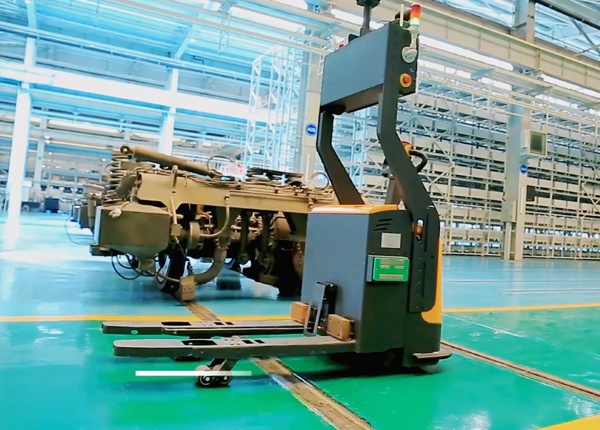
Some industrial AGVs and autonomous forklifts can use closed-loop motor control, wheel-speed feedback and motion-control algorithms to reduce excessive wheel spin. However, “traction control” is not a universal specification that should be assumed for every Chinese AGV.
Depending on the vehicle design, the control system may monitor motor speed, encoder feedback, commanded velocity and actual vehicle movement. When the controller detects a significant difference between expected and measured motion, it can reduce acceleration or adjust the drive command.
For a procurement project, ask the supplier specifically whether the vehicle supports:
Wheel or motor encoder feedback
Closed-loop drive control
Wheel-slip detection
Acceleration and deceleration limiting
Speed reduction on low-traction surfaces
Abnormal motion detection
Automatic stop or controlled recovery after excessive slip
These details are much more useful than simply asking whether the AGV has “anti-slip technology.”
An oily area can suddenly reduce the friction available between the drive wheel and the floor. If the vehicle continues applying the same drive torque, the wheel may rotate faster than the actual vehicle movement.
This creates two separate concerns: traction and localization.
From a traction perspective, excessive wheel spin can increase stopping distance and reduce directional control. From a navigation perspective, wheel odometry may temporarily become less reliable because the encoder measures wheel rotation rather than directly measuring how far the vehicle has traveled across the floor.
This is why a professional AGV should not depend entirely on wheel odometry for localization.
Yes, wheel slip can temporarily reduce the accuracy of odometry. However, that does not necessarily mean that the entire SLAM map becomes damaged or unusable.
In a Laser SLAM system, localization can combine multiple information sources, such as LiDAR observations, scan matching and wheel odometry. If wheel movement does not match the expected vehicle movement, the localization algorithm can use environmental observations to correct the estimated position.
The actual behavior depends on the navigation architecture used by the AGV manufacturer.
For this reason, a warehouse should test wheel-slip conditions during commissioning rather than assuming that SLAM will automatically compensate for every type of floor problem.
A useful FAT or SAT test can include controlled low-traction areas, changes in floor surface and controlled acceleration and braking tests. The objective is to verify whether the vehicle remains within the required localization, stopping and load-handling performance.
In many cases, tire and drive-wheel specifications can be discussed as part of an AGV configuration, but the exact options depend on the vehicle architecture.
For example, an AGV may use different wheel materials or tread designs depending on whether it operates on smooth concrete, coated floors, rough industrial surfaces or areas where floor contamination is possible.
Soft rubber or high-friction materials may improve traction in some applications, but selecting the softest possible wheel is not automatically the best solution. Wheel material also affects wear, rolling resistance, turning behavior, floor marking and service life.
When requesting a quotation from a Chinese AGV manufacturer, specify the actual floor conditions instead of simply asking for “soft rubber wheels.” Include:
Polished concrete or coated concrete
Dry and wet operating conditions
Potential oil or chemical contamination
Floor temperature range
Expected payload
Maximum travel speed
Acceleration requirements
Turning frequency
Expected operating hours per day
The supplier can then determine whether the proposed drive wheel, caster and steering configuration is appropriate for the application.
Emergency braking cannot be evaluated only from the vehicle's maximum speed. The available stopping distance depends on several factors, including vehicle speed, load, braking response, floor traction, wheel condition, floor slope and the control system's deceleration limits.
A simplified engineering relationship is that braking distance increases rapidly as vehicle speed increases. This is one reason autonomous forklifts should use different speed limits for different operating zones.
On a highly polished floor, the available friction may be lower than on a normal concrete surface. The vehicle therefore needs sufficient margin between its detection distance and the actual stopping distance.
A properly engineered safety system should not simply assume one universal braking distance for every floor condition.
Usually, you should not assume that an autonomous forklift continuously measures the exact coefficient of friction of the floor in real time.
More commonly, the system is designed around known operating conditions and validated speed, acceleration and braking parameters. Additional safety margins can then be applied to account for changes in operating conditions.
Some advanced systems may use motion feedback or abnormal wheel-speed behavior to identify a loss of traction. However, this is different from directly measuring the floor's friction coefficient everywhere the AGV travels.
For a warehouse with highly polished or occasionally contaminated floors, the better engineering approach is to establish acceptable floor conditions, define operating speed limits and validate braking performance during site acceptance testing.
A wet floor can create an intermittent traction problem. An AGV may operate normally for most of its route and then encounter a small area with significantly lower friction.
This is particularly important for autonomous forklifts carrying elevated loads. A sudden change in traction can affect vehicle acceleration, braking and steering behavior while the vehicle is carrying a pallet.
The warehouse should therefore identify areas where water, oil, condensation or cleaning chemicals may accumulate. These areas may require drainage improvements, cleaning procedures, floor treatment or reduced AGV speed.
In other words, AGV safety is partly a vehicle engineering issue and partly a warehouse-floor management issue.
For an overseas AGV project, the following questions are more useful than asking whether the vehicle is simply “anti-slip.”
| Procurement Question | Why It Matters |
|---|---|
| Does the drive system use encoder feedback? | Helps determine how vehicle motion is monitored. |
| How does the AGV detect excessive wheel slip? | Shows how abnormal traction conditions are handled. |
| What wheel materials are available? | Wheel selection affects traction, wear and floor compatibility. |
| What are the validated speed and braking parameters? | Provides a basis for site safety evaluation. |
| How does localization respond to wheel slip? | Important for Laser SLAM and odometry reliability. |
| Can low-traction floor conditions be tested during SAT? | Allows the actual vehicle and floor combination to be validated. |
A warehouse should not wait until the AGV fleet is fully deployed to discover that a polished floor creates traction problems.
During site assessment, identify the areas with the lowest expected traction. The supplier can then evaluate the proposed wheel material, speed settings, acceleration limits and braking performance for those areas.
For SAT, useful tests can include loaded and unloaded travel, straight-line braking, turning, pallet pickup and placement, operation through different floor surfaces and controlled testing of representative low-traction conditions.
The test should verify actual performance rather than relying only on a manufacturer's general specification.
Wet or highly polished floors should be treated as part of the AGV system specification, not as a minor detail after the vehicle has been purchased.
A suitable solution may combine appropriate drive-wheel material, closed-loop motion control, conservative acceleration, speed zoning, reliable localization, validated braking performance and good floor maintenance.
Most importantly, do not assume that every Chinese autonomous forklift uses the same traction-control or emergency-braking strategy. Put the required floor conditions, wheel specification, operating speed, braking performance and testing requirements into the technical specification before placing the order.
For a warehouse with wet, polished or occasionally contaminated floors, the most valuable procurement document is not a generic product brochure. It is a project-specific technical specification showing exactly how the selected AGV is expected to operate on your actual floor.





 Chinese
 English