


When importing an AGV fleet from China, some warehouse operators may want to replace the original safety laser scanners with equipment from established industrial safety brands such as SICK or Banner. This can happen because the customer already has a preferred safety-sensor standard, wants to simplify spare-parts inventory, or requires a specific sensor for an existing safety architecture.
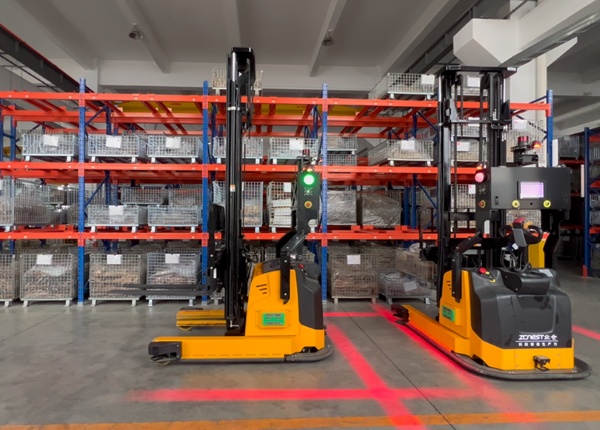
However, replacing a safety laser scanner is not the same as replacing an ordinary proximity sensor. The scanner can be part of the AGV's functional safety system, including safety inputs, protective fields, warning fields, braking logic and safety-rated control circuits.
For this reason, compatibility should be evaluated at the system level. A different safety scanner may be technically installable but still require engineering changes, safety validation and supplier approval before the vehicle can return to production.
Potentially, but there is no universal plug-and-play standard that makes every safety laser scanner interchangeable.
The replacement must be compatible with the AGV's electrical, communication and safety architecture. The engineering team needs to evaluate more than the physical connector.
Important compatibility factors include:
Supply voltage
Current requirements
Connector and wiring
Safety-rated outputs
Input and output architecture
Communication protocol
Response time
Protective-field configuration
Warning-field configuration
Integration with the safety controller
Mounting position and scanning geometry
A scanner that physically fits the AGV does not necessarily provide a functionally equivalent safety interface.
This depends on how the original AGV was designed.
Some autonomous forklifts use dedicated safety controllers or safety I/O modules between the safety scanner and the main vehicle controller. In that architecture, replacing the scanner may involve changing the safety interface rather than modifying the main motherboard.
Other systems may integrate safety devices more tightly into the vehicle control architecture.
Therefore, the right question for the manufacturer is not simply “Does the motherboard support SICK?” Ask for the complete safety architecture and determine where the scanner connects.
Before ordering a replacement, request:
Electrical schematics
Safety I/O documentation
Controller model information
Communication-interface documentation
Safety scanner configuration requirements
Supported scanner models
Safety validation procedure
Yes, this is often the best time to discuss sensor-brand requirements.
If your company has standardized on a particular safety scanner brand, specify it during the RFQ rather than purchasing the standard Chinese configuration and attempting to replace the sensor later.
The RFQ should identify the exact manufacturer and model where possible, rather than simply saying “European safety laser” or “Western safety scanner.”
You should also ask the Chinese AGV manufacturer to confirm in writing:
Whether the requested scanner is supported
Whether the vehicle wiring must be modified
Whether the safety controller configuration changes
Whether new software or firmware is required
Whether protective fields must be reconfigured
Whether additional engineering charges apply
Whether the modified configuration remains under warranty
Getting this information before the purchase order is issued is much safer than negotiating compatibility after the vehicles arrive.
A safety laser scanner is normally part of a safety function rather than simply a navigation sensor.
For example, the scanner may create protective fields around the vehicle. When a person or obstacle enters a defined field, the safety system may initiate a controlled stop or another predefined safety response.
Changing the scanner can therefore affect the complete safety function.
This is why replacing a safety scanner should not be treated like replacing a damaged camera, encoder or ordinary proximity switch.
Often, yes.
The required protective-field configuration depends on the scanner's detection characteristics, mounting position, vehicle speed, stopping performance and the hazards present around the AGV.
Changing the scanner can change its scanning geometry, detection behavior or response characteristics. Even if the new scanner provides similar functionality, the safety fields should be reviewed and validated rather than copied blindly from the previous configuration.
This can include:
Protective field dimensions
Warning field dimensions
Field shape
Detection zones around forks or load areas
Stopping behavior
Vehicle speed limits
Sensor mounting height
Sensor orientation
No. These are different engineering tasks.
Navigation mapping determines how the AGV understands and localizes within its operating environment. Safety-field configuration determines the area in which the safety system detects hazards and triggers the required safety response.
Replacing a safety scanner may require safety-field configuration and validation without necessarily requiring a complete navigation-map rebuild.
However, if the replacement affects the vehicle's navigation sensors or physical geometry, additional navigation testing may also be necessary. The supplier should determine the actual impact based on the AGV architecture.
The difficulty depends heavily on the AGV manufacturer's software and safety architecture.
If the manufacturer has already integrated the replacement scanner into the vehicle software, configuration may be relatively straightforward. If the new scanner uses a different safety interface or requires changes to the safety controller, the project can become significantly more complex.
A proper change process may involve:
Installing the new scanner.
Checking electrical and communication interfaces.
Loading the approved scanner configuration.
Configuring protective and warning fields.
Reviewing speed and braking parameters.
Testing detection performance.
Testing stopping response.
Documenting the final configuration.
Completing the required safety validation.
The exact process should be defined by the supplier and the customer's safety team.
It may be technically possible, but standardizing one approved scanner model across the fleet is generally easier to manage.
A mixed fleet can introduce additional differences in configuration software, spare parts, mounting arrangements, field settings, diagnostic procedures and maintenance training.
If different AGV models require different scanners, document each configuration separately and make sure maintenance personnel understand which scanner and safety configuration belongs to each vehicle.
For a large fleet, standardization can reduce spare-parts complexity and simplify troubleshooting.
It can, depending on the supplier's warranty terms and whether the replacement is authorized.
A factory may treat an unauthorized modification to a safety-critical component as a warranty exclusion, particularly if the modification changes the vehicle's electrical system, safety controller, software or protective-field configuration.
However, an approved factory-engineered alternative can be handled differently.
The safest approach is to obtain written confirmation before making the change. The documentation should state:
Approved replacement sensor model
Approved wiring configuration
Required software changes
Required safety-field configuration
Required validation procedure
Warranty status after modification
Do not rely on a sales engineer's informal statement that “the warranty will be fine.” Put the approved modification into the project documentation.
If sensor-brand flexibility is important to your organization, make it an explicit RFQ requirement.
| RFQ Requirement | What the Supplier Should Confirm |
|---|---|
| Safety scanner brand | Exact manufacturer and model |
| Safety interface | Electrical and communication architecture |
| Controller compatibility | Safety controller and I/O compatibility |
| Field configuration | Protective and warning field setup |
| Validation | Required testing after installation |
| Warranty | Warranty coverage after approved modification |
| Spare parts | Availability and recommended spare inventory |
If a specific safety scanner brand is required, it is generally better to specify it before the AGV is manufactured.
Changing the component after delivery can involve electrical modifications, mechanical mounting changes, software configuration, safety validation and potentially warranty negotiations.
If the factory can install and validate the requested scanner before shipment, the customer can avoid many of these complications.
The AGV should not return to normal operation immediately after the replacement.
The new configuration should be tested according to the applicable safety requirements and the manufacturer's validation procedure.
Testing should verify that the scanner detects representative hazards at the intended locations and that the vehicle responds correctly. The test should also verify the relevant protective fields, warning fields, stopping behavior and recovery behavior.
The final configuration should be documented so that future maintenance personnel know exactly which scanner, settings and safety parameters are approved for that vehicle.
Mixing safety scanner brands on a Chinese AGV fleet is not necessarily impossible, but it should be treated as an engineering change rather than a simple spare-parts replacement.
The physical connector is only one part of the compatibility question. The safety controller, I/O, communication interface, response time, protective fields, vehicle braking performance and validation process all need to be considered.
If your company prefers SICK, Banner or another safety scanner brand, the best time to specify it is during the RFQ stage. Ask the Chinese manufacturer to integrate the exact model, document the safety architecture and confirm warranty coverage before production.
If a replacement is required after delivery, obtain factory approval before changing the component and complete the required safety configuration and validation before putting the AGV back into production.
For a B2B AGV project, the goal should not simply be to make a different sensor “work.” The goal is to have a documented, validated and supportable safety configuration that remains compatible with the vehicle, the warehouse and the manufacturer's warranty obligations.
FREE ENGINEERING SUPPORT Stop Gambling on Generic Platforms. Get an AGV/AMR Tailored to Your Warehouse.Buying automated guided vehicles involves complex safety standards (CE/ANSI), navigation setups (Laser SLAM), and ERP system integration. Don't risk your factory safety with middle-men. ✓ 100% Direct Factory: Customized payload up to 5 Tons. ✓ Free CAD Simulation: Send us your layout, and our engineers will simulate the optimal AGV routes. ✓ Global Support: Overseas installation guidance & local maintenance partners. |





 Chinese
 English