


Dynamic fork distance adjustment can be valuable when an autonomous forklift needs to handle multiple pallet types or SKU configurations. Instead of using one fixed fork position, the AGV can adjust the distance between the forks according to the required load configuration.
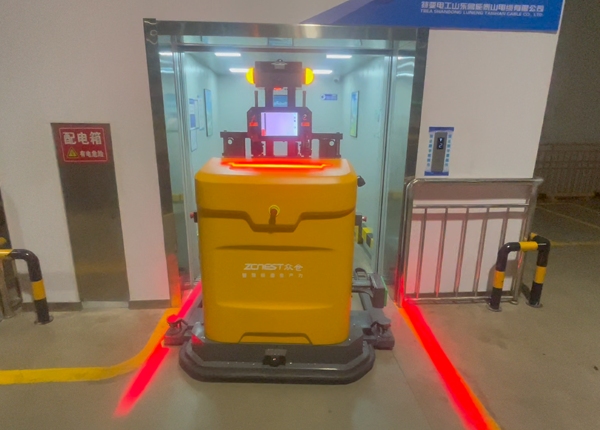
For a warehouse importing AGVs from China, however, the important question is not simply whether the forks can move automatically. The real question is how accurately the system can position the forks and whether that accuracy remains reliable during repeated pallet pickup and placement.
The final result depends on the entire system, including the fork-position sensing method, mechanical drive, control algorithm, vehicle localization, pallet tolerance and the physical condition of the forks.
Some autonomous forklifts can be configured with electrically or hydraulically controlled fork-position adjustment. The vehicle can receive a target fork position from its control system and move the forks to the required configuration automatically.
This can be useful when a warehouse handles pallets with different overall dimensions or different fork-entry requirements.
However, automatic fork adjustment is not necessarily standard equipment on every Chinese AGV. It should be specified as part of the vehicle configuration during the RFQ process.
Ask the supplier whether the system supports:
Automatic fork-width adjustment
Predefined fork positions for different SKU types
Recipe-based fork configurations
Position feedback
Fork-position error detection
Automatic positioning before pallet entry
Different fork configurations for different rack locations
If your warehouse handles multiple pallet specifications, this capability should be demonstrated with representative pallets before the system is accepted.
The basic sequence is relatively straightforward. The fleet or vehicle controller determines the required fork configuration, commands the fork mechanism to move, monitors the actual position and stops the mechanism when the target position is reached.
The system may use different technologies to determine fork position, depending on the AGV design.
Possible approaches include:
Encoder feedback
Linear position sensors
Proximity or limit sensors
Hydraulic position feedback
Motor position feedback
Mechanical reference positions
The exact technology matters because it affects how the system detects the actual fork position and how accurately it can return to a commanded position.
There is no single accuracy value that applies to all Chinese AGVs.
More importantly, the specification should distinguish between sensor measurement accuracy and actual fork positioning accuracy.
A position sensor may measure movement very precisely, but the physical fork assembly can still have mechanical clearance, backlash, flexing or tolerance.
For example, the final position of a fork can be affected by:
Sensor resolution
Sensor accuracy
Mechanical backlash
Fork carriage tolerance
Drive mechanism wear
Hydraulic or electric actuator behavior
Fork deformation under load
Vehicle positioning error
Floor unevenness
Pallet dimensional tolerance
Therefore, asking only “What is the sensor accuracy?” does not tell you whether the AGV can reliably enter a pallet.
For procurement, ask the manufacturer to provide several separate specifications rather than one generic “fork accuracy” number.
| Specification | What It Tells You |
|---|---|
| Sensor resolution | Smallest position change the sensor can detect. |
| Sensor accuracy | How closely the sensor measurement represents actual position. |
| Repeatability | How consistently the forks return to the same position. |
| Fork positioning accuracy | Actual mechanical positioning performance of the fork system. |
| Pallet entry performance | Whether the complete vehicle can reliably enter representative pallets. |
The last measurement is often the most useful for an operating warehouse because it evaluates the complete system rather than one sensor.
The actual adjustment time depends on the actuator, travel distance, control strategy and required positioning accuracy.
A small adjustment between two nearby positions can naturally be faster than moving the forks across most of their available adjustment range.
The warehouse should therefore avoid accepting a generic statement such as “fast fork adjustment.” Instead, define representative SKU transitions and measure the complete cycle.
For example, the test can measure the time from the command to change from Position A to Position B until the forks reach the target position and are confirmed ready for the next operation.
This is more meaningful than measuring only the motor movement time because the AGV controller may include acceleration, deceleration, position verification and error checking.
Depending on the fleet software, predefined fork configurations can potentially be associated with different pallet or SKU types.
For example, one SKU could use a narrow fork configuration while another requires a wider spacing. The fleet system or WMS integration can provide the relevant load information, while the AGV applies the corresponding fork position.
However, this capability is supplier-specific. Ask whether fork-position parameters can be configured through the fleet system, vehicle controller or WMS interface and whether the customer can modify those parameters without changing the core software.
A misaligned or incorrectly calibrated position sensor can cause the controller to believe that the forks are in a different position from their actual mechanical position.
Depending on the system design, this could result in an incorrect fork width, an inaccurate target position or a fault condition.
In a poorly controlled system, an incorrect fork position could increase the risk of contacting a pallet during entry.
A properly engineered system should have appropriate fault detection, configuration limits and commissioning procedures to reduce this risk.
This is why sensor calibration should be treated as a maintenance and safety-related procedure rather than an optional software adjustment.
It can contribute to an entry problem, but the fork sensor is only one possible source of error.
Successful pallet entry depends on several variables:
AGV localization accuracy
Vehicle heading relative to the pallet
Fork spacing
Fork height
Pallet dimensions
Pallet deformation
Fork alignment
Load position
Floor conditions
Approach speed
A fork sensor that is offset can make the situation worse, but correcting the sensor alone may not solve the entire pallet-entry problem.
The best way to evaluate dynamic fork adjustment is through representative pallet-entry testing.
Use the actual pallet types, pallet dimensions and load conditions expected in the warehouse.
Testing should include different fork positions and representative approach conditions. If the warehouse has several pallet suppliers or pallet materials, those variations should also be considered.
The test should measure not only whether the AGV can complete the pickup, but also whether the forks remain clear of the pallet structure and whether the load is properly positioned after insertion.
Yes. If automatic fork adjustment is important to the project, it should be included in the Factory Acceptance Test rather than treated as a demonstration feature.
The FAT can verify different fork positions, position repeatability, adjustment time and representative pallet handling.
The customer can define several target positions and require the AGV to repeatedly move between them. The test results can then be recorded and compared with the agreed technical specification.
This gives the buyer objective evidence of the system's performance before the vehicles are shipped from China.
If automatic fork adjustment is important, avoid writing only “automatic adjustable forks” in the RFQ.
A more useful specification should describe the actual operating requirement.
| RFQ Item | Recommended Requirement |
|---|---|
| Fork adjustment | Automatic adjustment between predefined positions. |
| Position feedback | Specify the sensing method and feedback architecture. |
| Repeatability | Define the required repeated positioning performance. |
| Adjustment time | Specify representative position-to-position transition time. |
| Pallet compatibility | List actual pallet dimensions and fork-entry requirements. |
| Error handling | Define behavior when the commanded and measured positions disagree. |
| FAT | Require repeated fork-position and pallet-entry tests. |
It can.
The position of an unloaded fork and the behavior of a loaded fork are not necessarily identical. Mechanical components can experience deflection or changes in force when handling heavy pallets.
For this reason, a serious acceptance test should include representative payloads instead of validating fork adjustment only with an unloaded vehicle.
If the AGV will handle high or offset loads, those conditions should also be considered during validation.
The AGV cannot compensate for every possible pallet variation simply by having accurate fork positioning.
Wooden pallets, plastic pallets and other load carriers can vary in dimensions, fork-entry geometry and physical condition. Damaged or deformed pallets can create additional clearance problems even when the AGV is correctly calibrated.
Therefore, pallet specifications should be included in the AGV project requirements.
If several pallet suppliers are used, collect representative samples or dimensions before finalizing the fork configuration.
Dynamic fork adjustment introduces additional moving components and sensing requirements compared with a fixed fork configuration.
Maintenance personnel should periodically inspect the fork mechanism, mechanical guides, sensors, cables and mounting hardware.
Calibration should also be checked after relevant maintenance work, mechanical impact or replacement of position sensors.
The supplier should provide a documented calibration procedure and identify which parameters are customer-adjustable and which should only be changed by qualified service personnel.
When evaluating a Chinese AGV with automatic fork adjustment, it is tempting to focus on the advertised sensor resolution. That is only one part of the system.
The more useful performance indicators are repeatable fork positioning, successful pallet entry, adjustment time, fault detection and performance under representative load conditions.
A high-resolution sensor cannot compensate for mechanical backlash, poor calibration, inaccurate vehicle positioning or inconsistent pallet dimensions.
For this reason, buyers should evaluate dynamic fork adjustment as a complete vehicle function.
The best approach is to define the actual pallet-handling requirement during the RFQ stage.
Provide the Chinese manufacturer with pallet dimensions, fork-entry geometry, payloads, SKU variations and expected operating cycle. Then ask the supplier to specify the proposed fork-adjustment mechanism, position feedback method and expected performance.
The final specification should distinguish sensor accuracy from mechanical positioning accuracy and should include a practical pallet-entry test.
If a sensor becomes misaligned during operation, the vehicle should have an appropriate fault-detection and maintenance procedure rather than allowing the operator to simply change calibration values without verification.
For an imported Chinese autonomous forklift, the safest procurement strategy is to test dynamic fork adjustment with your actual pallet types before shipment, document the approved settings and make the agreed performance part of FAT and SAT.
FREE ENGINEERING SUPPORT Stop Gambling on Generic Platforms. Get an AGV/AMR Tailored to Your Warehouse.Buying automated guided vehicles involves complex safety standards (CE/ANSI), navigation setups (Laser SLAM), and ERP system integration. Don't risk your factory safety with middle-men. ✓ 100% Direct Factory: Customized payload up to 5 Tons. ✓ Free CAD Simulation: Send us your layout, and our engineers will simulate the optimal AGV routes. ✓ Global Support: Overseas installation guidance & local maintenance partners. |





 Chinese
 English