


When a U.S. warehouse operator purchases an automated forklift fleet or AGV system from a Chinese manufacturer, the payment schedule can be just as important as the technical specification. A low equipment price does not eliminate financial risk if most of the purchase price must be paid before the system is proven in the buyer's facility.
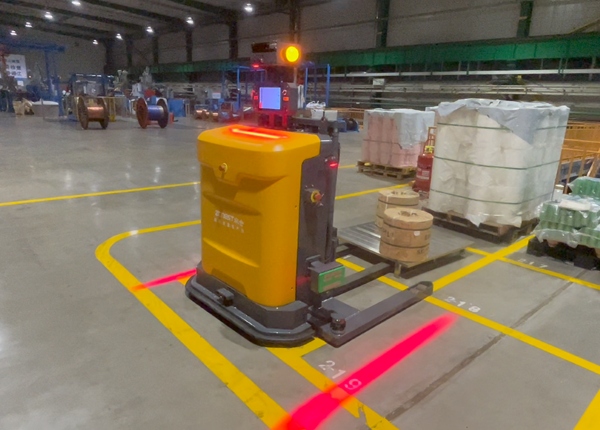
For international automation projects, payment terms are usually negotiated around several milestones, such as contract signing, production, Factory Acceptance Testing (FAT), shipment, installation, commissioning, and Site Acceptance Testing (SAT). The exact structure depends on the supplier, project size, customization level, and bargaining position of the buyer.
There is no single payment schedule that applies to every Chinese automation project. However, international equipment transactions commonly use milestone-based payments rather than paying the entire amount at the beginning.
For an AGV or automated forklift project, a commercial structure may include several stages:
Deposit or down payment when the purchase contract becomes effective
Progress payment after production reaches an agreed milestone
Payment after Factory Acceptance Testing (FAT)
Balance payment before shipment or against agreed shipping documents
Final retention payment after installation and Site Acceptance Testing (SAT)
The more customized the project is, the more important milestone payments become. A fleet with standard AGV models may have a simpler commercial structure, while a project involving custom forks, special mast heights, WMS integration, warehouse mapping, safety modifications, or elevator integration normally requires more detailed payment milestones.
A 30% down payment followed by 70% before shipment can be used in international equipment transactions, including some Chinese automation projects. However, buyers should not treat 30/70 as a mandatory industry standard.
The supplier may request a substantial deposit because customized automation equipment requires the manufacturer to purchase components, reserve production capacity, engineer the system, manufacture the vehicles, and configure software before shipment.
From the buyer's perspective, however, paying the remaining 70% before shipment creates a significant risk. The buyer may have paid nearly the entire contract value before the AGVs have been installed and tested in the actual warehouse.
For this reason, a stronger commercial structure is often based on measurable milestones rather than simply "30% deposit and 70% before shipment."
| Milestone | Example Payment Structure | Buyer Protection |
|---|---|---|
| Contract / PO | 20–30% | Starts engineering and production |
| Production Milestone | 20–30% | Payment tied to visible progress |
| FAT Passed | 20–30% | Confirms agreed factory tests |
| Shipment | 10–20% | Links payment to shipment documents |
| SAT / Retention | 5–10% | Provides leverage for site acceptance |
These percentages are examples for negotiation rather than universal industry standards. A supplier may require a different structure depending on project value, customization, component purchasing requirements, credit history, and the commercial relationship between the parties.
Yes. A buyer can negotiate a retention amount that becomes payable after successful Site Acceptance Testing. Whether the supplier accepts 10% depends largely on the supplier's commercial policy and the risk allocation negotiated in the contract.
For a U.S. warehouse purchasing autonomous forklifts from China, retaining 5–10% until SAT can provide meaningful protection because some problems cannot be fully evaluated during FAT.
FAT can verify vehicle functions, navigation behavior, lifting performance, safety functions, fleet software, and other agreed factory-level requirements. SAT, however, tests the system in the actual warehouse environment.
The SAT may involve:
Actual warehouse aisles and rack locations
Representative pallets and loads
Actual floor conditions
WMS or WCS communication
Charging and battery operation
Safety zones and warehouse traffic conditions
Task dispatching and fleet management
Required throughput or cycle-time performance
Obstacle detection and recovery behavior
The important point is not simply to write "10% payable after SAT." The contract should define exactly what constitutes a passed SAT.
For example, the contract can identify the test procedures, sample size, operating conditions, required throughput, navigation accuracy, pallet handling requirements, safety tests, software functions, defect classification, and the process for correcting failed items.
A retention payment should also have a defined payment date after successful acceptance. Otherwise, an unclear SAT clause can create disputes even when both parties intended to use it as a protection mechanism.
Escrow can be proposed for an international automation transaction, but buyers should not assume that every Chinese robotics manufacturer will accept a third-party escrow arrangement.
For a manufacturer, escrow can delay access to working capital that is needed for engineering, component procurement, manufacturing, and project execution. For the buyer, however, escrow can reduce counterparty risk by keeping part of the funds under agreed release conditions.
The practical question is therefore not simply whether a supplier "accepts escrow." The buyer should determine:
Who will hold the funds?
Which country's law governs the escrow arrangement?
When are funds released?
What documents or test results trigger release?
What happens if FAT fails?
What happens if shipment is delayed?
What happens if SAT fails?
Who pays escrow fees?
How are disputes handled?
For smaller equipment orders, a traditional milestone payment structure may be easier to implement than a formal escrow arrangement. For larger automated warehouse projects, buyers may have more leverage to negotiate staged payments, bank instruments, retention, or other forms of payment security.
A shipment delay does not automatically create a specific financial penalty. The applicable compensation depends on the written contract and the governing law.
For this reason, a buyer should not rely on a general promise such as "delivery will be on time." The purchase agreement should define the contractual delivery date, conditions that can extend the date, notice requirements, and the financial consequences of an unjustified delay.
A negotiated liquidated-damages clause may specify a predetermined amount or percentage for qualifying delays, subject to the applicable contract law and the negotiated terms. The contract should also distinguish supplier-caused delays from events outside the supplier's reasonable control.
For example, the agreement can define:
Contractual shipment date
Permitted production extensions
Buyer-caused delays
Approved change orders
Force majeure events
Grace period, if any
Liquidated damages for qualifying delay
Maximum accumulated liability
Buyer's right to terminate after a prolonged delay
Refund procedures after termination
It is also important to distinguish shipment delay from project completion delay. An AGV fleet can leave China on time but still arrive late at the warehouse because of ocean transportation, customs clearance, inland transportation, site readiness, or other factors. The contract should identify which party controls each milestone.
For a U.S. warehouse operator importing autonomous forklifts from China, the safest commercial approach is to connect payment to objectively verifiable project milestones.
Instead of focusing only on the percentage of the deposit, negotiate the relationship between payment, engineering completion, FAT, shipment, commissioning, and SAT.
A practical negotiation framework could look like this:
Initial payment: Pay the agreed deposit after the contract, technical specification, scope of supply, and project schedule are finalized.
Production milestone: Release another payment after agreed manufacturing evidence or inspection milestones are completed.
FAT milestone: Link a payment portion to successful completion of documented FAT.
Shipment milestone: Release the shipment payment against the agreed commercial and shipping documents.
SAT retention: Keep a negotiated percentage until the system passes the defined site acceptance criteria.
This structure gives both parties protection. The manufacturer receives working capital during production, while the buyer retains some financial leverage until the equipment has demonstrated the agreed performance.
Payment terms should never be separated from the technical and commercial contract. For an AGV project, the buyer should make sure that the following items are clearly documented.
| Contract Item | What to Define |
|---|---|
| Payment Milestones | Percentage and trigger for each payment |
| FAT | Test procedures and pass/fail criteria |
| Shipment | Required shipping documents and shipment deadline |
| SAT | Site acceptance criteria and correction procedure |
| Retention | Amount, release conditions and payment deadline |
| Delay | Qualifying delay, notice, damages and termination rights |
| Change Orders | Price and schedule impact of engineering changes |
| Warranty | Start date, coverage and supplier obligations |
The buyer should also make sure that the commercial contract and technical specification do not contradict each other. For example, if the payment contract says the final 10% is released after SAT, the technical agreement should contain measurable SAT requirements.
For Chinese AGV and automated forklift projects, 30% upfront and 70% before shipment can be a workable commercial structure, but it should not automatically be accepted as the only option.
A U.S. buyer with a large fleet purchase may be able to negotiate milestone payments, FAT-based releases, SAT retention, escrow, documentary payment mechanisms, or other protections. The supplier's willingness to accept these terms will depend on the project value, customization, production cost, relationship, and commercial risk.
The strongest negotiation is therefore not simply asking the manufacturer to reduce the deposit. It is defining exactly what must happen before each payment becomes due and what happens if the project misses an agreed milestone.
FREE ENGINEERING SUPPORT Stop Gambling on Generic Platforms. Get an AGV/AMR Tailored to Your Warehouse.Buying automated guided vehicles involves complex safety standards (CE/ANSI), navigation setups (Laser SLAM), and ERP system integration. Don't risk your factory safety with middle-men. ✓ 100% Direct Factory: Customized payload up to 5 Tons. ✓ Free CAD Simulation: Send us your layout, and our engineers will simulate the optimal AGV routes. ✓ Global Support: Overseas installation guidance & local maintenance partners. |











 Chinese
 English




