


When an autonomous forklift carries a pallet several meters above the warehouse floor, load stability becomes a critical safety and reliability issue. A pallet that is poorly wrapped, unevenly stacked, or slightly leaning can become more unstable when the vehicle accelerates, turns, brakes, or raises the load to a high position.
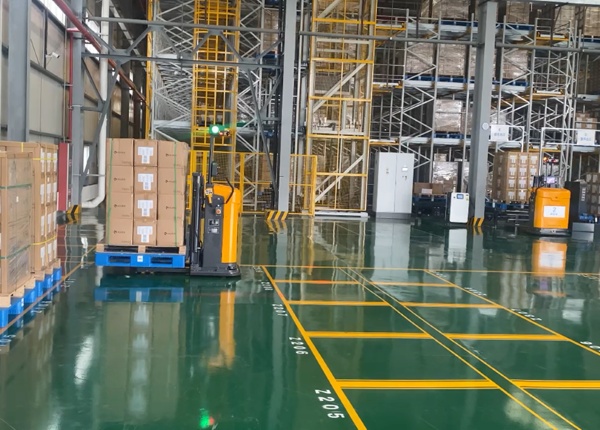
For U.S. warehouse operators evaluating Chinese unmanned forklifts, the important question is not simply whether the robot has "load detection." The buyer needs to understand what the vehicle can actually measure, which conditions can trigger a response, and whether load-handling parameters can be configured for different products.
Chinese autonomous forklifts can use several different mechanisms to manage pallet stability, but the exact configuration depends on the vehicle model and supplier. There is no universal load-stability system installed on every Chinese AGV.
A typical system may combine information from:
Load weight or load-presence sensors
Fork height or mast position feedback
Fork tilt or mast angle feedback
Wheel encoder and vehicle motion feedback
Inertial measurement sensors
Safety scanners or LiDAR
Optional cameras or 3D vision systems
Vehicle speed, acceleration, and braking parameters
The onboard controller can use these inputs to determine whether the vehicle is operating inside its configured load-handling limits.
For example, a vehicle may be permitted to travel at a higher speed when carrying a low load at a low fork height, while the permitted speed is reduced when the forks are raised or when a heavier load is being transported.
This is different from directly "seeing" whether the pallet is leaning. A vehicle can control the risk of an unstable load through motion and lifting parameters without having a dedicated sensor that measures the pallet's physical lean angle.
Therefore, when an RFQ states "load stability detection," the buyer should ask exactly what is being detected and which sensor provides the information.
The detection method depends heavily on the AGV design. A standard autonomous forklift may detect the presence and position of a pallet without directly detecting every deformation of the load.
Several technologies can potentially be used.
Load cells, pressure sensors, fork position sensors, or other load-related feedback can help determine whether a load has been picked up and whether the vehicle is operating within its configured load range.
These sensors do not necessarily determine whether the cartons on top of a pallet are leaning. Their primary purpose may be load presence, weight estimation, lifting control, or overload protection.
Angle sensors or position feedback can monitor the mast or fork position. If the vehicle supports automatic tilt control, the controller can maintain a specified fork or mast angle during lifting and transport.
This helps control the load but does not automatically mean that the system can detect a leaning stack of cartons.
LiDAR or safety scanners are commonly used for obstacle detection and personnel protection. Depending on their mounting position, field of view, and software configuration, additional sensing information may also be available around the carried load.
However, a safety scanner should not automatically be described as a pallet-stability sensor. Its primary safety function and its ability to detect load geometry are separate technical questions.
A more advanced system can use cameras or 3D vision to evaluate the geometry of a pallet or load. This approach may help identify an abnormal load profile, excessive overhang, or visible changes in the load shape.
Whether the Chinese AGV actually provides this capability should be verified with the supplier. A vehicle having a camera does not automatically mean that its software performs automated load-stability analysis.
Not necessarily. The response depends on what the system can actually detect and how the supplier has configured the vehicle's safety and motion-control logic.
If the vehicle has a dedicated load-shift detection function and the measured condition exceeds a defined threshold, possible responses may include:
Reducing vehicle speed
Reducing acceleration or deceleration
Stopping the vehicle
Preventing further lifting
Generating an alarm
Requesting operator intervention
Switching to a predefined recovery procedure
However, the phrase "the AGV will stop immediately if the pallet moves" should not be used as a generic specification unless the vehicle has a validated sensor and control function that can detect the relevant movement.
There is another important issue: maximum travel speed does not necessarily mean that the AGV should continue operating at maximum speed under every load condition.
A properly configured vehicle may use speed zoning or load-dependent speed limits. For example, the allowable speed can be reduced when the forks are raised, when the load is heavy, when the vehicle approaches a turn, or when operating in a particular warehouse area.
This preventive approach can be more important than waiting for a physical load shift to occur.
A vehicle does not necessarily need to calculate a complete physical model of the pallet to manage top-heavy risk. In many industrial systems, the risk is controlled through predefined operating limits based on load, fork height, vehicle speed, acceleration, braking, and other operating parameters.
For example, the controller may use a parameter set such as:
| Parameter | Possible Control Function |
|---|---|
| Load Weight | Limits lifting or travel conditions |
| Fork Height | Reduces permitted travel speed at higher elevations |
| Mast/Fork Angle | Controls load orientation |
| Vehicle Speed | Controls dynamic load movement |
| Acceleration | Limits sudden load movement |
| Braking | Controls forward load movement during stopping |
The controller may therefore treat a high, heavy load as a higher-risk operating condition and automatically apply more conservative motion parameters.
This should not be confused with a universal "top-heavy detection algorithm." Some suppliers may have more advanced load models, while others primarily rely on validated operating envelopes and parameter limits.
For a high-bay warehouse, this distinction is particularly important. The buyer should ask the supplier how the vehicle's permitted speed, acceleration, braking, and lifting behavior changes as load height increases.
Possibly, but this is a supplier-specific software capability and should be treated as an RFQ requirement rather than an assumed standard feature.
Some autonomous forklift platforms can use different motion profiles or task parameters for different load types, warehouse zones, or operating conditions. Depending on the software architecture, configurable parameters may include:
Maximum travel speed
Acceleration and deceleration limits
Fork lifting speed
Fork lowering speed
Mast or fork tilt limits
Maximum lifting height for a load profile
Load weight limits
Turning speed
Stopping behavior
Task-specific operating profiles
Torque limits require additional clarification. The term "torque limit" can refer to different parameters in the drive, lifting, or hydraulic system. A buyer should not assume that an operator can simply enter a torque value into the fleet-management interface.
Some parameters may only be accessible to qualified service personnel or the manufacturer's engineering team because changing them can affect vehicle performance, component protection, and safety.
For fragile products, it may therefore be more practical to define a complete load-handling profile rather than requesting only a torque limit.
If a warehouse handles fragile products, the buyer should define the required behavior using actual operating conditions.
For example, one SKU profile could require:
Lower maximum travel speed
Lower acceleration
Lower deceleration
Reduced fork lifting speed
Controlled fork lowering speed
Restricted mast or fork tilt
Additional stopping distance
Special handling rules at intersections and turns
The software could then associate the profile with a product, pallet type, warehouse zone, or task type if the supplier's fleet-management system supports this level of configuration.
The key procurement question is therefore not simply "Can the software change torque?" A better question is: "Can the system assign and enforce different motion and load-handling parameters for specific SKU or pallet profiles, and which parameters can the customer modify?"
A buyer should convert the general concept of "load stability" into measurable RFQ and FAT requirements.
| RFQ Question | Why It Matters |
|---|---|
| How is load presence detected? | Confirms the basic load-sensing method |
| Can the system detect abnormal load geometry? | Determines whether leaning or overhanging loads can actually be detected |
| Which sensors provide the detection? | Separates actual sensing from software assumptions |
| What happens after an abnormal condition is detected? | Defines alarm, slowdown, stop, or recovery behavior |
| Can speed vary with fork height and load? | Helps manage top-heavy operating conditions |
| Can SKU-specific motion profiles be configured? | Important for fragile or unstable loads |
| Which parameters can the customer modify? | Prevents confusion between customer settings and engineering-only parameters |
| Can these functions be demonstrated during FAT? | Turns a software claim into an acceptance test |
Load stability should not be accepted solely from a supplier's brochure. The actual pallet, load height, load weight, packaging condition, fork position, travel speed, acceleration, braking, and warehouse environment can all influence the result.
For FAT, the buyer can provide representative pallet samples and define specific test conditions. The supplier can demonstrate the configured motion profile, lifting behavior, alarms, and recovery behavior.
During SAT, the same requirements should be verified in the actual warehouse. This is particularly important for high-position AGVs because rack height, aisle width, floor conditions, pallet quality, and real traffic patterns can differ significantly from the factory test environment.
If fragile or unstable loads are important to the project, the buyer should include representative loads in the acceptance test rather than testing only empty forks or standardized demonstration pallets.
This distinction should be clearly understood before purchasing a Chinese autonomous forklift.
A load sensor can confirm that a pallet has been picked up. A fork-position sensor can confirm fork position. A mast-angle sensor can measure tilt. A LiDAR scanner can detect objects within its sensing field. A 3D camera can potentially analyze load geometry.
None of these capabilities, by itself, proves that the AGV can identify every poorly wrapped or top-heavy pallet.
The correct procurement approach is to identify the exact sensing mechanism, the software logic, the response behavior, and the test conditions used to validate the function.
For a U.S. warehouse importing autonomous forklifts from China, this makes load stability a specification and acceptance-test issue rather than simply a marketing feature. The strongest requirement is not "the AGV must prevent unstable loads," but a measurable definition of what the vehicle must detect, how it must respond, and under which operating conditions the function must work.
FREE ENGINEERING SUPPORT Stop Gambling on Generic Platforms. Get an AGV/AMR Tailored to Your Warehouse.Buying automated guided vehicles involves complex safety standards (CE/ANSI), navigation setups (Laser SLAM), and ERP system integration. Don't risk your factory safety with middle-men. ✓ 100% Direct Factory: Customized payload up to 5 Tons. ✓ Free CAD Simulation: Send us your layout, and our engineers will simulate the optimal AGV routes. ✓ Global Support: Overseas installation guidance & local maintenance partners. |





 Chinese
 English