


A specialized explosion-protected VNA stacking AGV can be technically possible, but it should never be purchased simply because a supplier describes a vehicle as "explosion-proof." The correct question is whether the complete vehicle, its electrical components, charging system, operating environment, and certification are suitable for the exact hazardous area where the AGV will operate.
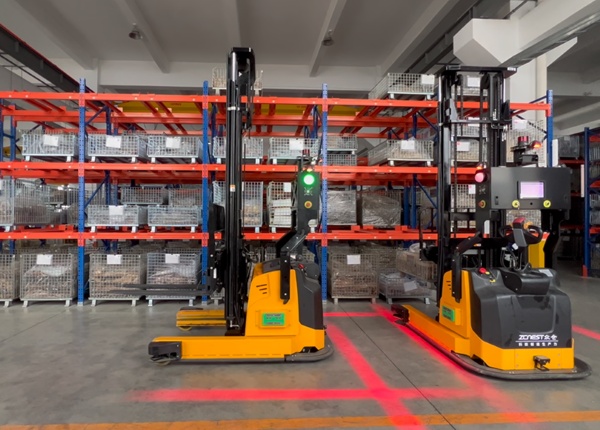
This is particularly important in paint factories, coating facilities, chemical warehouses, and other environments where flammable gases, vapors, or combustible dust may be present. In the United States, hazardous areas can be classified under systems such as Class I, Division 1/2 or Class I Zone 0/1/2, depending on the site and applicable requirements. OSHA requires electrical equipment in hazardous locations to be intrinsically safe, approved for the hazardous location, or otherwise demonstrated to be safe for that location. Equipment also needs to match the relevant properties of the gas, vapor, dust, or fiber involved.
Potentially, yes. Chinese automation manufacturers can engineer specialized vehicles for hazardous environments, but availability depends on the required hazardous-area classification, vehicle architecture, payload, lift height, aisle width, battery system, navigation technology, and certification requirements.
A standard VNA stacking AGV should not automatically be considered suitable for a hazardous environment. A conventional vehicle may contain electrical components, motors, connectors, sensors, relays, contactors, batteries, and charging equipment that were not designed or certified for an explosive atmosphere.
Before requesting a quotation, the buyer should provide the supplier with the actual hazardous-area information rather than simply saying "this is a paint factory."
Useful information includes:
Hazardous-area classification
Class and Division or Zone designation
Gas, vapor, mist, or dust involved
Applicable gas or dust group
Temperature classification
Ambient temperature range
Ventilation conditions
Operating area of the AGV
Required payload
Required lift height
Required aisle width
Battery and charging requirements
Navigation technology
Required operating hours
OSHA specifically notes that hazardous locations are determined according to the properties of the flammable materials and the likelihood that a flammable concentration will be present. Each room or area should be considered individually. :contentReference[oaicite:2]{index=2}
This cannot be answered from the country of manufacture alone. A Chinese manufacturer may offer an explosion-protected configuration, but the buyer must verify the exact vehicle model, certification scope, protection method, hazardous-area classification, and component approvals.
Paint manufacturing and finishing areas can contain flammable vapors. OSHA explicitly lists paint-finishing process plants among examples of facilities where hazardous classified locations may exist. :contentReference[oaicite:3]{index=3}
However, not every part of a paint facility necessarily has the same classification. A warehouse aisle, mixing room, paint booth, charging area, and maintenance area may have different environmental conditions and classifications.
Therefore, the buyer should not ask the supplier simply:
"Is your AGV spark-free?"
A more useful question is:
"Which hazardous-area classification is this exact AGV configuration certified or approved for, under which protection standard, and with which limitations?"
The answer should be supported by technical documentation rather than a marketing statement.
Protecting a VNA AGV for a hazardous environment involves much more than sealing the lift motor against volatile organic compounds.
The engineering team may need to evaluate potential ignition sources throughout the vehicle, including:
Lift motors
Drive motors
Steering motors
Motor controllers
Contactors and relays
Battery protection components
Electrical connectors
Cable glands and cable assemblies
Control electronics
Safety scanners
Proximity sensors
Encoders
Cooling fans
Braking components
Charging interfaces
The appropriate protection method depends on the hazardous-area classification and the equipment design. OSHA identifies several protection techniques for hazardous locations, including explosionproof apparatus, intrinsically safe equipment, purged and pressurized systems, nonincendive equipment, dust ignitionproof equipment, and other approved protection methods. :contentReference[oaicite:4]{index=4}
Therefore, a supplier should explain the protection architecture for the complete vehicle rather than only describing how one motor enclosure is sealed.
No. An IP rating and hazardous-location approval address different characteristics.
An ingress-protection rating describes resistance to the entry of solids and water under defined test conditions. It does not by itself demonstrate that electrical equipment is suitable for an atmosphere containing ignitable concentrations of flammable gas or vapor.
This distinction is especially important in chemical and paint facilities. A vehicle can have a high IP rating and still be unsuitable for a particular hazardous location.
The buyer should therefore request the hazardous-location approval or certification applicable to the exact equipment and installation rather than accepting an IP rating as evidence of explosion protection.
ATEX and U.S. hazardous-location classifications should not be treated as interchangeable certificates.
The EU ATEX Directive 2014/34/EU covers equipment and protective systems intended for use in potentially explosive atmospheres and establishes essential safety requirements and conformity-assessment procedures for products placed on the EU market. :contentReference[oaicite:5]{index=5}
In the United States, hazardous electrical installations can use classifications such as Class I Division 1, Class I Division 2, and Class I Zone 0/1/2. OSHA's requirements also address whether equipment is approved for the specific class and the ignitable properties of the gas, vapor, dust, or fiber involved. :contentReference[oaicite:6]{index=6}
For a U.S. warehouse or factory, an ATEX certificate should therefore not automatically be presented as proof that the complete AGV is acceptable for a U.S. hazardous location.
The customer should have the exact certification and installation requirements reviewed by the appropriate U.S. electrical, safety, engineering, or AHJ professionals.
For an explosion-protected AGV, documentation is almost as important as the vehicle itself.
Depending on the target market and certification route, the buyer may need documentation such as:
Exact AGV model and configuration identification
Hazardous-area classification covered
Protection concept
Certification or approval documents
Certificate number where applicable
Applicable standards
Equipment marking information
Gas or dust group information
Temperature classification
Permitted ambient temperature
Battery certification documentation
Charger certification documentation
Safety component documentation
Installation limitations
Maintenance requirements
Inspection requirements
Change-control requirements
For ATEX equipment, EU rules include requirements relating to conformity assessment, technical documentation, EU declarations of conformity, and retention of documentation. The applicable documentation should be tied to the actual product model and configuration. :contentReference[oaicite:7]{index=7}
There is no reliable universal percentage difference between Western and Chinese explosion-protected warehouse robots.
The price can change significantly depending on the hazardous-area classification, payload, lift height, VNA geometry, battery system, navigation system, certification requirements, testing, charger configuration, quantity, engineering customization, and local commissioning.
A standard VNA AGV and a certified hazardous-location VNA AGV should not be compared as if the only difference were the motor enclosure.
The buyer should instead compare the total project cost:
AGV hardware
Explosion-protection engineering
Certification and testing
Battery system
Explosion-protected charging equipment
Fleet software
Safety equipment
Site modifications
Engineering documentation
Installation and commissioning
Training
Spare parts
Maintenance
Local inspection or approval costs
A lower factory quotation may not produce a lower installed project cost if additional certification, engineering, testing, or local approval work is required after arrival.
If the AGV is genuinely being supplied under the ATEX framework, the manufacturer should be able to provide the applicable conformity documentation for the exact product and configuration.
However, the buyer should not rely on the phrase "ATEX tracking number" alone. Ask for the actual certificate, EU Declaration of Conformity where applicable, product identification, certification scope, and the relationship between the certificate and the specific AGV configuration.
EU ATEX requirements include product conformity assessment and documentation, and manufacturers must retain relevant technical documentation and declarations for the specified period. :contentReference[oaicite:8]{index=8}
The plant manager should also confirm whether the supplied documentation covers the complete AGV or only individual components.
For example, an ATEX-certified motor does not automatically make the complete AGV ATEX-compliant. The certification scope of the complete assembled vehicle and its individual components must be understood.
This should not be assumed.
Replacing a standard motor with an explosion-protected motor, changing a few connectors, or adding sealed enclosures does not automatically transform a conventional AGV into a compliant hazardous-location vehicle.
Changes to motors, controllers, wiring, battery systems, sensors, cooling systems, charging interfaces, or safety components can affect the overall certification and safety assessment.
For this reason, hazardous-location requirements should be defined before the vehicle design is frozen. Retrofitting a standard AGV after delivery may create substantial engineering and certification problems.
The RFQ should contain the hazardous-area requirements as technical specifications rather than leaving them to the supplier's sales description.
Required hazardous-area classification
Gas, vapor, mist, or dust type
Class, Division, or Zone requirements
Applicable group classification
Temperature classification
Payload requirement
Lift height
Required aisle width
Battery chemistry
Charging method
Navigation technology
Operating temperature
Required certification
Certification body or approval route
Required technical documentation
Maintenance and inspection requirements
Change-control requirements
The RFQ should also require the supplier to identify which components are covered by the hazardous-location certification and which components are outside the certification scope.
Before installation, the buyer should verify that the delivered vehicle matches the configuration and certification documents used during the safety assessment.
Important checks can include:
Vehicle model and serial number
Battery model
Motor model
Controller configuration
Sensor configuration
Safety scanner configuration
Electrical enclosure configuration
Charging equipment
Certification markings
Documentation revision
Installation conditions
Maintenance procedures
OSHA requires hazardous-location equipment to be appropriate for the specific location and, where approval is used, for the specific class and ignitable or combustible properties involved. :contentReference[oaicite:9]{index=9}
That makes configuration control particularly important. Substituting a component after certification without reviewing the effect on the approved configuration can create a serious compliance issue.
The best comparison is not simply "Chinese versus Western." The more useful comparison is whether each supplier can deliver a complete system that matches the site's hazardous-area requirements.
| Evaluation Area | What to Verify |
|---|---|
| Vehicle | Payload, lift height, dimensions, VNA performance |
| Explosion Protection | Protection method and applicable hazardous classification |
| Certification | Exact model, certificate scope, marking and documentation |
| Battery | Battery chemistry, BMS, protection and certification |
| Charging | Charger suitability and hazardous-area requirements |
| Software | Fleet management, alarms and operational controls |
| Support | Engineering response, spare parts and local service |
| Total Cost | Equipment, certification, installation and lifecycle cost |
This approach makes it possible to compare suppliers based on technical suitability and total project risk instead of country of origin alone.
The key question is not whether a Chinese supplier can add an "explosion-proof" option to its product catalog.
The real question is whether the complete AGV configuration has been engineered, documented, tested, and approved for the exact hazardous environment in which it will operate.
For a U.S. paint or chemical facility, the hazardous-area classification should be established first. The AGV specification and certification requirements should then be derived from that classification. ATEX documentation can be valuable when the equipment is intended for the EU market, but it should not automatically be treated as a substitute for the applicable U.S. hazardous-location requirements. :contentReference[oaicite:10]{index=10}
Only after these requirements are established does it make sense to compare Chinese and Western suppliers on price, lead time, customization, service, and total cost of ownership.
FREE ENGINEERING SUPPORT Stop Gambling on Generic Platforms. Get an AGV/AMR Tailored to Your Warehouse.Buying automated guided vehicles involves complex safety standards (CE/ANSI), navigation setups (Laser SLAM), and ERP system integration. Don't risk your factory safety with middle-men. ✓ 100% Direct Factory: Customized payload up to 5 Tons. ✓ Free CAD Simulation: Send us your layout, and our engineers will simulate the optimal AGV routes. ✓ Global Support: Overseas installation guidance & local maintenance partners. |





 Chinese
 English