


The purchase price of a Chinese industrial AGV is only one part of its real cost.
For a warehouse evaluating a five-year automation project, the more important question is the total cost of ownership (TCO):
how much will the fleet actually cost to purchase, operate, maintain, upgrade, and support over its useful life?
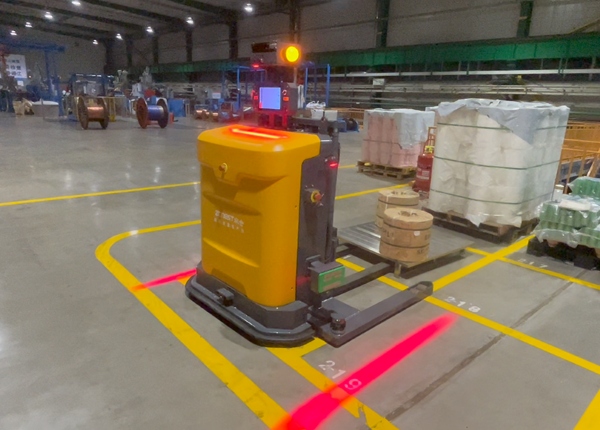
A realistic TCO model should include the initial AGV investment, international logistics, software, charging infrastructure, electricity, spare parts, maintenance, technical support, system integration, and potential replacement costs.
It should also account for downtime and the expected residual value of the equipment.
A practical five-year TCO calculation normally has several cost categories:
AGV purchase price
Freight, insurance, customs duties, and import-related costs
Installation and commissioning
Fleet management software and software licenses
WMS, ERP, or warehouse control system integration
Server, networking, and IT infrastructure
Charging equipment and electrical installation
Electricity consumption
Preventive maintenance
Tires, hoses, sensors, forks, and other wear parts
Battery replacement or battery refurbishment
Remote technical support and software updates
On-site service and technician travel
Operator and maintenance training
Downtime and productivity losses
Equipment residual value at the end of the five-year period
The important point is that not every supplier charges these costs in the same way. Two AGV quotations with similar vehicle prices can have very different five-year TCOs because of differences in software licensing, service contracts, spare parts, battery design, and integration requirements.
This is one of the most important questions to ask before purchasing Chinese AGVs. The phrase “software included” does not necessarily mean that every software-related service is free for five years.
Depending on the supplier and system architecture, recurring costs may include:
Annual fleet management software licenses
Cloud platform subscriptions
Remote monitoring services
Remote technical support
WMS or ERP interface maintenance
API access or additional software modules
Server maintenance
Software upgrades or major version upgrades
Additional AGV licenses when the fleet is expanded
Third-party database, operating system, or communication services
However, these fees are not universal. Some Chinese AGV manufacturers provide a local fleet management server with the initial project, while others use a subscription-based cloud platform. Some suppliers also include basic software support for a defined period and charge separately after the warranty period.
For this reason, the RFQ should explicitly ask:“Please provide a five-year software and connectivity cost schedule, including all recurring licenses, API fees, cloud fees, remote support fees, software upgrades, and additional vehicle licenses.”
The buyer should also clarify whether historical fleet data can be exported and whether the warehouse can continue operating locally if the external cloud connection is unavailable. These questions can have a significant impact on long-term IT costs and operational risk.
There is no reliable universal annual replacement cost for AGV tires or hydraulic hoses because wear depends heavily on vehicle type, payload, operating hours, floor conditions, turning frequency, travel distance, and maintenance practices.
A high-capacity counterbalanced AGV operating continuously on concrete can have a very different tire replacement cycle from a pallet truck operating on a smooth warehouse floor. A reach truck or high-lift AGV may also have different wear characteristics from a low-level pallet transport vehicle.
A better TCO approach is to request a five-year spare-parts consumption forecast from the supplier. The forecast should identify:
Drive wheels
Load wheels
Steering wheels
Hydraulic hoses
Hydraulic seals
Fork components
Proximity sensors
Safety scanner components
Contactors and electrical components
Filters and lubricants
Battery-related components
For critical warehouse operations, the purchase decision should not focus only on the price of individual spare parts. The availability and delivery time of those parts can be equally important. A low-cost wheel that requires several weeks to arrive may create more operational cost than a more expensive locally stocked spare part.
Electricity cost is relatively easy to model, but the calculation should be based on actual vehicle energy consumption rather than simply multiplying the battery capacity by 24 hours.
An AGV does not continuously consume its maximum rated electrical power. Energy consumption changes with travel distance, payload, lift height, acceleration, braking, charging efficiency, traffic conditions, and idle time.
For example, suppose a fleet of 10 AGVs averages 2.5 kWh of electricity consumption per operating hour per vehicle, including the operating profile and charging losses. If all ten vehicles operate continuously for 24 hours per day:
10 × 2.5 kWh × 24 hours = 600 kWh per day
At an electricity rate of $0.12 per kWh, that would represent approximately:
$72 per day
or approximately:
$26,280 per year
This is only an example calculation. The actual cost can be substantially different depending on the AGV model, workload, electricity tariff, charging efficiency, and utilization.
For a procurement project, ask the supplier for measured energy consumption under a representative operating cycle rather than relying on the battery's nominal kWh rating. A useful test cycle should include the expected payload, travel distance, lift height, number of lifts, idle time, and charging method.
This distinction is important when calculating TCO. A warehouse may operate three shifts per day, but an AGV fleet does not necessarily perform productive work continuously.
The fleet may spend part of the day:
Waiting for transport requests
Charging
Waiting for an elevator or dock
Waiting for another AGV to clear an aisle
Waiting for a pallet to become available
Performing safety stops
Recovering from an operational exception
Therefore, the TCO model should connect electricity consumption with actual fleet utilization and throughput. The objective is not simply to minimize electricity consumption. A slightly higher energy cost may be acceptable if the fleet achieves substantially higher productive throughput.
This comparison is more complicated than comparing an AGV purchase price with a forklift rental payment. The two operating models have different cost structures.
| Cost Category | Chinese AGV Fleet | Manual Forklift Lease |
|---|---|---|
| Equipment | AGV purchase or financing | Monthly lease or rental |
| Labor | Lower direct driving labor requirement | Forklift operators required |
| Software | Fleet management and integration costs | Usually limited compared with an AGV fleet |
| Energy | Electricity and charging losses | Fuel or electricity depending on forklift type |
| Maintenance | Vehicle, sensors, drive system, hydraulic system and software support | Forklift maintenance and service contract |
| Infrastructure | Charging, network, safety and integration infrastructure | Usually lower automation infrastructure requirements |
| Productivity | Potentially higher consistency and longer unattended operating periods | Dependent on operator availability and performance |
| Residual Value | Depends on vehicle condition, battery health and software support | Depends on lease structure and contract terms |
The most important difference is that a manual forklift lease converts much of the equipment cost into a predictable monthly expense, while an AGV project usually requires a larger initial investment but can reduce recurring labor requirements.
Therefore, the correct comparison is not:“AGV purchase price versus forklift lease price.”
It should be:“Five-year cost per productive pallet movement.”
A warehouse may spend more money on an automated system and still achieve a lower operating cost if the fleet performs enough productive work.
For example, the five-year model can calculate:
Five-Year TCO ÷ Total Productive Pallet Movements Over Five Years
This allows procurement teams to compare different technologies using the same operational metric. It also helps prevent an inexpensive AGV from appearing attractive simply because its initial purchase price is low.
A vehicle with a lower purchase price but poor uptime, limited spare-parts availability, or expensive software support may ultimately have a higher five-year cost.
A five-year TCO calculation is only useful if the major assumptions are documented in the commercial contract.
Before placing an order, the buyer should request written clarification on:
Warranty duration and coverage
Software license duration
Annual software or cloud fees
Remote support fees
API and WMS integration charges
Software upgrade policy
Spare-parts pricing
Recommended spare-parts inventory
Battery warranty and expected service life
On-site service rates
Remote diagnostic charges
Travel and accommodation charges for engineers
Response times for technical support
Availability of software and fleet data exports
Support availability after the warranty period
The buyer should also ask what happens if the fleet is expanded from 10 to 20 or 30 vehicles. Some software architectures charge additional licenses as the fleet grows, while others may use a project-level or server-level license. That difference can materially change the economics of fleet expansion.
The most reliable approach is to build a spreadsheet with one-time costs, recurring costs, variable operating costs, and productivity assumptions.
| TCO Item | Year 0 | Years 1–5 |
|---|---|---|
| AGVs | Purchase | Depreciation / residual value |
| Import logistics | Freight, insurance, duties and handling | — |
| Integration | WMS, software, commissioning | Support and upgrades |
| Charging | Chargers and electrical installation | Electricity |
| Maintenance | Initial spare-parts stock | Preventive and corrective maintenance |
| Software | Initial license/configuration | Recurring fees and support |
| Labor impact | Training and change management | Remaining labor requirement |
| Residual value | — | Subtract estimated end-of-year-5 value |
The final TCO should then be compared with the existing manual operation using the same five-year period and the same expected throughput. This produces a much more meaningful investment analysis than comparing equipment quotations alone.
The strongest business case is usually not based on the AGV being the cheapest vehicle. It is based on whether the entire system can deliver the required warehouse throughput with predictable operating costs.
For a five-year investment decision, procurement teams should therefore evaluate three numbers together:
Total five-year cost
Total productive pallet movements
Total labor and operating hours replaced or avoided
This approach makes it easier to compare an imported Chinese autonomous forklift fleet against domestic forklift leasing, manual operation, or other warehouse automation options on an equal economic basis.
FREE ENGINEERING SUPPORT Stop Gambling on Generic Platforms. Get an AGV/AMR Tailored to Your Warehouse.Buying automated guided vehicles involves complex safety standards (CE/ANSI), navigation setups (Laser SLAM), and ERP system integration. Don't risk your factory safety with middle-men. ✓ 100% Direct Factory: Customized payload up to 5 Tons. ✓ Free CAD Simulation: Send us your layout, and our engineers will simulate the optimal AGV routes. ✓ Global Support: Overseas installation guidance & local maintenance partners. |





 Chinese
 English