


Warehouse forklift collisions can create costs far beyond vehicle repairs. Damaged pallet racks, spilled products, downtime and workplace investigations can quickly turn a single impact into a significant operational expense. Automated forklifts can reduce some of these risks through controlled navigation, speed management and integrated safety systems.
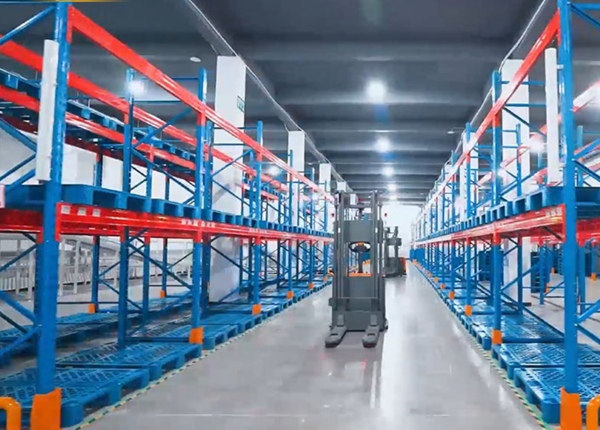
Chinese AGVs can potentially reduce collision-related costs by replacing unpredictable manual driving with controlled routing, speed limits, obstacle detection and automated stopping. However, the actual savings depend on the existing accident rate, rack configuration, traffic density, AGV safety functions and local operating conditions.
There is no universal percentage that applies to every warehouse. The better approach is to calculate the current annual cost of forklift-related incidents and then estimate how much of that cost could realistically be avoided.
For example, a warehouse may have collision-related expenses from several different sources rather than simply forklift repair.
Rack Repairs
Bent uprights, beams, guards and other structural components may require replacement.
Product Damage
Pallets, packaging and finished products can be damaged during collisions or sudden braking.
Downtime
Blocked aisles and damaged equipment can interrupt warehouse operations.
Inspection Costs
Serious impacts may require rack inspections, equipment checks and corrective action.
Important:
Do not calculate AGV savings using forklift repair costs alone. Rack damage, inventory loss and operational downtime can represent a much larger portion of the total collision cost.
An AGV does not rely on a driver continuously judging distance, speed and surrounding traffic. Its movement is controlled by navigation software, safety sensors and predefined operating rules.
Obstacle Detection
Detects people, vehicles, pallets and other objects within configured safety zones.
Speed Control
Vehicle speed can be automatically reduced in narrow aisles, intersections and pedestrian areas.
Automatic Braking
The vehicle can stop when an obstacle enters a configured protective field.
Route Control
AGVs follow predefined routes rather than allowing unrestricted manual driving.
Yes, controlled acceleration and deceleration can reduce sudden vehicle movements. This can be particularly useful when transporting unstable, fragile or high-value pallet loads.
Instead of relying on a human driver to determine how aggressively to accelerate or brake, an automated vehicle can use programmed motion profiles.
Acceleration
Limits sudden vehicle movement when starting a pallet transport task.
Cruising
Maintains a predefined operating speed according to the route and load.
Deceleration
Uses controlled braking rather than depending entirely on manual driver judgment.
Load Stability Still Matters
Controlled driving cannot compensate for an unstable pallet. Load height, pallet condition, center of gravity, fork positioning and wrapping quality should still be checked during AGV system design.
Forklift tilt sensing can provide information about the position of the fork carriage or mast. This information can be used by the control system to help maintain the intended operating position.
For high-lift applications, this becomes particularly important because a small alignment error can become more significant as the lifting height increases.
Load center
Payload weight
Fork position
Mast configuration
Lift height
Floor conditions
Vehicle acceleration
Load packaging
For a high-bay warehouse, the supplier should provide the relevant operating limits rather than simply claiming that the AGV can keep every load perfectly level.
Fleet-management software can record operational data that helps warehouse managers investigate incidents. Depending on the system design, this may include vehicle location, speed, task status, alarms and sensor events.
This information can help determine whether an incident occurred during travel, pallet pickup, rack approach, intersection movement or another operating condition.
Vehicle Position
Where the AGV was operating when the event occurred.
Vehicle Speed
Operating speed immediately before the event.
Alarm History
Safety or system alarms associated with the event.
Task Information
The delivery or transport task being executed.
Before purchasing AGVs, calculate the cost of forklift incidents over the previous 12 to 24 months. This creates a baseline for comparing the potential financial impact of automation.
Annual Collision Cost =
Rack Repairs + Product Damage + Vehicle Repairs + Downtime + Inspection Costs + Other Incident Costs
Then compare the historical cost with the expected cost under the proposed automated operation. The calculation should use conservative assumptions rather than assuming that automation eliminates every accident.
| Evaluation Area | What to Check |
|---|---|
| Safety Sensors | Detection zones, stopping behavior and sensor redundancy |
| Navigation | Positioning accuracy and obstacle-handling performance |
| Load Handling | Payload, load center, fork positioning and stability |
| Fleet Software | Alarm history, telemetry and incident reporting |
| Support | Remote diagnostics, spare parts and local service capability |
A supplier demonstration is not enough. The AGV should be tested under conditions that resemble the actual warehouse environment.
Obstacle Test
Verify detection and stopping behavior around realistic obstacles.
Load Test
Test representative pallet weights and load centers.
Intersection Test
Evaluate traffic behavior at high-volume warehouse junctions.
Emergency Stop
Verify stopping behavior at representative operating speeds.
Telemetry Test
Confirm that important alarms and operating events are recorded.
Recovery Test
Test how the vehicle behaves after an obstacle or system interruption.
The strongest business case for automated forklifts is not simply a lower vehicle purchase price. Measure your existing rack damage, product loss, forklift repairs and downtime first, then compare those costs with the safety, telemetry and controlled-driving capabilities of the proposed AGV fleet.
FREE ENGINEERING SUPPORT Stop Gambling on Generic Platforms. Get an AGV/AMR Tailored to Your Warehouse.Buying automated guided vehicles involves complex safety standards (CE/ANSI), navigation setups (Laser SLAM), and ERP system integration. Don't risk your factory safety with middle-men. ✓ 100% Direct Factory: Customized payload up to 5 Tons. ✓ Free CAD Simulation: Send us your layout, and our engineers will simulate the optimal AGV routes. ✓ Global Support: Overseas installation guidance & local maintenance partners. |











 Chinese
 English




