


Low-profile objects are a critical safety consideration when deploying autonomous forklifts in a busy warehouse. Cardboard boxes, wooden blocks, pallet debris, tools and small amounts of standing water can appear directly in an AGV's travel path. The detection performance depends on the vehicle's safety sensors, sensor mounting height, scanning field, software configuration and the characteristics of the object itself.
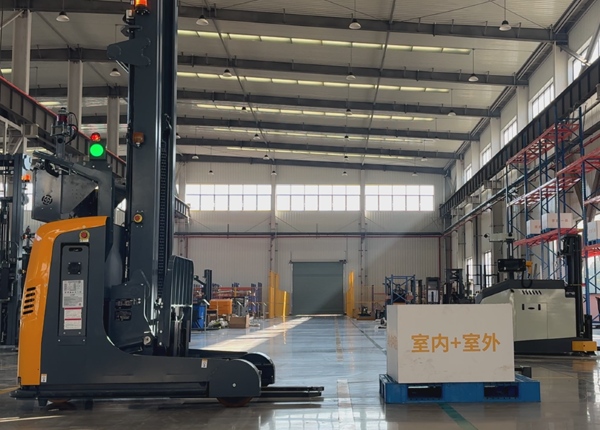
A Chinese autonomous forklift can potentially detect low-profile obstacles, but detection capability is not determined by the vehicle's country of origin. It depends on the specific safety scanner, sensor installation height, detection field, obstacle dimensions, surface characteristics and safety configuration. A 5 cm cardboard box should therefore be treated as a specific validation case rather than assuming that every AGV will automatically detect it.
Potentially, yes, but the correct answer must come from the specific AGV's safety sensor specification and validation test. A low obstacle can be difficult to detect if it is below or outside the effective scanning field of the safety sensor.
For example, a safety scanner mounted relatively high on the vehicle may not provide the same floor-level coverage as a scanner specifically configured to detect low obstacles. The box's position, dimensions, color, reflectivity and orientation can also influence detection.
Sensor Height
The mounting position affects whether a low object enters the scanner's effective detection plane.
Object Geometry
Height, width, orientation and position can influence whether the object is detected.
Surface Properties
Dark, reflective, transparent or irregular surfaces may require specific sensor validation.
Do Not Use “Obstacle Detection Range” as the Only Specification
A manufacturer may quote a scanner's maximum range, but that number alone does not prove reliable detection of a 5 cm object. Ask for the minimum detectable obstacle size and the actual safety-field configuration.
Autonomous forklifts can use several sensing technologies for obstacle detection. The exact configuration varies between vehicle models and suppliers.
Safety LiDAR
Creates a defined safety detection field around the vehicle and can be configured to trigger protective stops.
3D LiDAR
Provides spatial information that can help the vehicle perceive objects at different heights.
Vision Sensors
Cameras can provide additional information about object appearance and location.
Bumper / Contact Sensors
Some vehicle designs include physical contact detection as an additional protective layer.
There is no single scanning angle or range shared by all Chinese warehouse robots. These specifications depend on the safety scanner model and how it is installed on the AGV.
More importantly, buyers should distinguish between the sensor's maximum detection range and the AGV's configured protective field. The protective field is normally determined according to vehicle speed, braking performance, stopping distance and the surrounding operating environment.
Safety scanner model and manufacturer.
Maximum detection range.
Configured protective field dimensions.
Scanning angle or field of view.
Minimum detectable object size.
Minimum installation height above the floor.
Response time and protective-stop behavior.
Not necessarily. Clear water on a warehouse floor is a very different detection problem from a solid obstacle. Whether an AGV recognizes it depends on the sensor technology, viewing angle, surface conditions and the vehicle's floor-clearance and traction systems.
A safety LiDAR is primarily designed to detect objects within its configured safety field. It should not automatically be treated as a liquid-detection sensor.
Do Not Assume Water Detection Equals Obstacle Detection
A warehouse AGV may detect a person, pallet or box while failing to identify a thin layer of clear water as a discrete obstacle. Water should therefore be handled through facility procedures, floor inspection and traction requirements rather than relying solely on the obstacle sensor.
An autonomous forklift does not necessarily need to identify an object as a “human foot” before initiating a safety response. Safety systems can be designed to react to an object entering a defined protective field.
Higher-level perception systems may use additional sensor information to classify objects, estimate their location and determine appropriate navigation behavior. However, the safety function should not depend solely on object classification.
Detection
A sensor detects an object entering the configured area.
Classification
Additional perception software may estimate whether the object resembles a person, pallet or other obstacle.
Protective Response
The vehicle can reduce speed or initiate a protective stop according to its configured safety logic.
The same LiDAR model can produce very different practical results depending on where it is mounted. A scanner positioned too high may leave an area close to the floor outside its effective detection geometry.
For a forklift AGV, the front fork structure, wheels, pallet load and chassis can also create physical areas that need to be considered during safety-field design.
The area directly in front of the forks.
Both sides of the vehicle.
Areas close to the front wheels.
The vehicle's turning path.
The approach path toward pallet locations.
The area beneath or around the carried load where applicable.
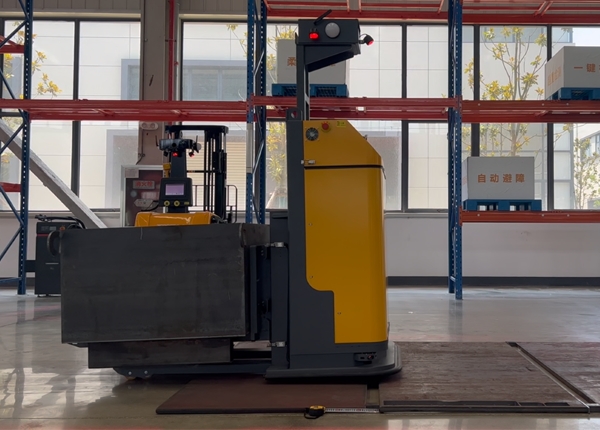
Before approving an AGV for production operation, conduct a controlled site acceptance test using representative obstacles from the actual warehouse.
5 cm
Cardboard Box
10 cm
Wooden Block
Dark Object
Low-Reflectivity Surface
Irregular Object
Warehouse Debris
Wet Floor
Clear Water Condition
Instead of asking only whether the robot “has obstacle detection,” request measurable information that can be verified during commissioning.
| Specification | Why It Matters |
|---|---|
| Minimum detectable obstacle | Shows whether low-profile objects can be detected reliably. |
| Sensor mounting height | Helps identify potential floor-level blind spots. |
| Protective field | Defines the actual area used for safety intervention. |
| Stopping response | Shows what the AGV does after an obstacle enters the safety zone. |
| Sensor model | Allows your engineering team to verify the sensor's technical documentation. |
| SAT test procedure | Allows the promised performance to be tested before production acceptance. |
1
Review Sensor Specifications
2
Check Sensor Placement
3
Define Minimum Obstacle Size
4
Perform Controlled Testing
5
Document SAT Results
6
Approve Production Deployment
When evaluating a Chinese unmanned forklift, avoid relying on a generic claim such as “360° obstacle detection.” Ask for the sensor model, minimum detectable obstacle size, protective field, mounting position and stopping response. Then test the AGV with real warehouse conditions such as low cardboard boxes, dark objects, pallet debris and floor contamination before accepting the system for production use.
FREE ENGINEERING SUPPORT Stop Gambling on Generic Platforms. Get an AGV/AMR Tailored to Your Warehouse.Buying automated guided vehicles involves complex safety standards (CE/ANSI), navigation setups (Laser SLAM), and ERP system integration. Don't risk your factory safety with middle-men. ✓ 100% Direct Factory: Customized payload up to 5 Tons. ✓ Free CAD Simulation: Send us your layout, and our engineers will simulate the optimal AGV routes. ✓ Global Support: Overseas installation guidance & local maintenance partners. |











 Chinese
 English




