


Importing an AGV from China is not simply a question of whether the manufacturer has an ISO certificate or whether the vehicle carries a CE marking. For an international warehouse project, the buyer needs to separate three different issues: the manufacturer's management-system certifications, the AGV's machine safety design, and the legal or workplace requirements in the country where the vehicle will actually operate.
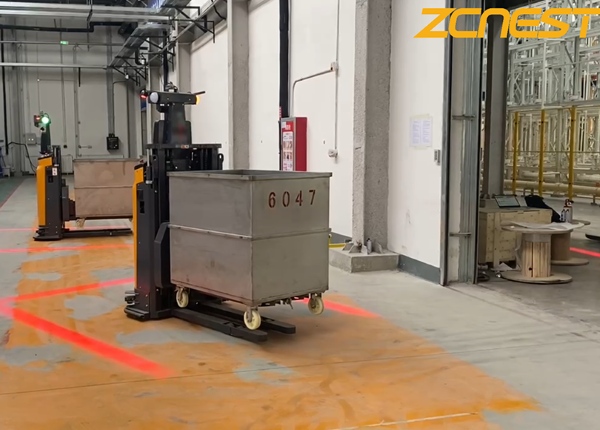
This distinction is particularly important for autonomous forklifts. A supplier may hold ISO 9001 and ISO 14001 certification while the individual AGV model still requires project-specific safety verification, documentation, testing, or third-party evaluation.
For driverless industrial trucks, one of the most important international standards to review is ISO 3691-4.
The current published edition is ISO 3691-4:2023, Industrial trucks — Safety requirements and verification — Part 4: Driverless industrial trucks and their systems. ISO identifies automated guided vehicles, autonomous mobile robots, automated guided carts, and similar driverless industrial trucks within its scope.
ISO 3691-4 is particularly relevant because it addresses the truck together with its control system, guidance system, and operating environment. It covers significant hazards and includes requirements related to safeguarding, load handling, steering, stability, warning systems, loss of communication, and safety-related control functions.
However, buyers should not assume that the words “ISO 3691-4 compliant” on a quotation are sufficient evidence. Ask the supplier to identify the exact vehicle model, configuration, edition of the standard used, applicable clauses, verification method, and supporting test documentation.
There is also an important current-standard issue. ISO is developing a new edition, currently designated ISO/DIS 3691-4. It is still a draft rather than the published replacement. Therefore, a procurement specification should identify the exact edition being used rather than simply writing “latest ISO 3691-4.”
ISO 3691-4 is not the only standard that may be relevant. The applicable standards depend on the vehicle type, functions, destination market, and project architecture.
ISO 12100 is commonly used as the foundation for machinery risk assessment and risk reduction. For an AGV project, the risk assessment should consider the vehicle, load, operating area, pedestrians, racks, charging stations, interfaces, maintenance activities, and foreseeable misuse.
This is important because an AGV's safety cannot be evaluated only from the vehicle itself. The warehouse environment can materially change the risk profile.
ISO 13849-1 addresses the design and integration of safety-related parts of control systems and includes the concept of Performance Level. It provides a framework for determining and designing the required safety performance of safety functions.
This is where buyers may encounter terms such as PL c, PL d, and PL e.
However, there is no rule saying that every Chinese AGV must automatically use PL d or PL e. The required performance level belongs to the specific safety function and its risk assessment.
For example, an emergency stop, protective scanner, access gate, or other safety function may have a defined target performance level based on the risk assessment. The buyer should therefore ask:
What safety functions are implemented?
What PL or SIL target applies to each safety function?
What safety architecture is used?
Which components perform the safety function?
How is the safety function validated?
IEC 62061 provides requirements for the design, integration, and validation of safety-related control systems for machinery. It is another important functional-safety framework and works within the broader IEC 61508 family.
Depending on the manufacturer's engineering approach, the supplier may use ISO 13849-1, IEC 62061, or a combination of applicable standards to demonstrate the safety performance of the control architecture.
Emergency-stop functions are another area that should be specifically documented. For driverless industrial trucks, ISO 3691-4:2023 references emergency-stop requirements and the safety design should be evaluated as a complete function rather than simply checking whether a red button exists.
The buyer should request the emergency-stop circuit architecture, response behavior, stopping performance, reset logic, and validation evidence for the actual AGV configuration.
If the Chinese AGV will operate in the United States, the buyer should also review relevant U.S. standards rather than treating ISO compliance as a substitute for U.S. requirements.
One important standard is ANSI/ITSDF B56.5-2024, which addresses safety requirements for driverless, automatic guided industrial vehicles and automated functions of manned industrial vehicles.
For industrial mobile robots, the ANSI/RIA R15.08 series may also become relevant depending on the vehicle and application. ANSI's current standards packages specifically group ISO 3691-4, ANSI/ITSDF B56.5, and ANSI/RIA R15.08 for driverless industrial vehicles and industrial mobile robots.
The important procurement question is therefore not “Does the AGV have ISO certification?” but “Which standards apply to this exact AGV and this exact U.S. application?”
ISO 9001 is a management-system standard. It is not an AGV product-safety certification.
ISO 9001 defines requirements for a quality-management system. ISO itself does not certify companies. Certification is performed by external certification bodies.
When a Chinese supplier claims ISO 9001 certification, request the complete certificate rather than accepting a logo on the website.
Check:
Legal company name
Registered company address
Certificate number
Certification standard and edition
Scope of certification
Original certification body
Accreditation body, where applicable
Issue date
Expiry or validity information
Current surveillance or recertification status
The scope is especially important. A certificate covering a company's general trading activities is not equivalent to a certificate whose scope covers manufacturing or engineering activities relevant to the AGVs being purchased.
ISO 14001 concerns an organization's environmental management system rather than the safety performance of its AGV.
There is also a current edition change that international buyers should know about. ISO 14001:2026 was published in April 2026 and replaced ISO 14001:2015. Organizations certified to the previous edition need to transition according to arrangements established with their certification body.
Therefore, if a supplier presents an ISO 14001 certificate, check which edition is stated on the certificate and whether it is still valid under the applicable transition arrangements.
As with ISO 9001, verify the certificate with the issuing certification body or an appropriate accredited-certification database where available. IAF CertSearch was designed to provide validation of accredited management-system certifications issued by certification bodies accredited by IAF MLA signatory accreditation bodies.
No.
This is one of the most important distinctions for an AGV buyer.
ISO 9001 demonstrates that the organization has a certified quality-management system within the stated scope. It does not mean that every machine manufactured by the company has been independently safety certified.
Similarly, ISO 14001 concerns environmental management. It does not certify the AGV's emergency-stop circuit, safety scanner, stability, braking system, or autonomous navigation.
A serious supplier qualification process should therefore maintain separate folders for:
Company management-system certifications
Vehicle safety documentation
Functional-safety documentation
Electrical certifications
Test reports
Risk assessments
FAT/SAT records
Destination-market compliance documents
There is no universal “Chinese AGV safety circuit” architecture.
A modern autonomous forklift may use safety scanners, emergency stops, safety relays or safety PLCs, monitored outputs, redundant channels, drive safety functions, braking systems, and other protective measures. The architecture should be evaluated against the required safety functions.
The buyer should ask the manufacturer for a safety-function table such as:
| Safety Function | What to Verify |
|---|---|
| Emergency Stop | Target PL/SIL, architecture, stopping behavior, validation |
| Safety Scanner | Protective field, response, safety interface, fault behavior |
| Overspeed | Detection method, safe reaction, validation |
| Drive Safety | Torque removal, braking, feedback and fault handling |
| Load Handling | Stability, lift limits and safe-stop behavior |
| Communication Loss | Defined safe behavior when communication fails |
This approach is more useful than simply asking the supplier whether the AGV is “PL d” or “PL e.”
No.
Performance Level normally relates to a specific safety function or safety-related part of the control system. A statement such as “PL e safety system” should therefore be investigated further.
Ask the supplier:
Which safety function has the stated PL?
What is the required Performance Level?
What is the achieved Performance Level?
Which components form the safety chain?
How is diagnostic coverage achieved?
How are single faults detected?
What validation report supports the calculation?
This prevents a common procurement problem in which a component-level safety claim is incorrectly interpreted as a certification of the entire autonomous forklift.
Possibly, but there is no universal rule that every imported Chinese AGV must obtain one additional third-party certificate before it can operate.
The requirement depends on the destination jurisdiction, the specific equipment, the electrical installation, the workplace, the customer's internal safety program, and the authority having jurisdiction.
For the United States, OSHA's NRTL program is particularly important for certain categories of equipment. OSHA explains that its standards require NRTL approval for certain products, including many types of electrical equipment, but OSHA does not require every manufacturer or supplier to have every product NRTL-certified.
This means a buyer should not make the blanket statement “all Chinese AGVs require UL certification.” Instead, determine which components or equipment categories fall under applicable OSHA or local electrical requirements and whether an NRTL listing, field evaluation, or another form of evaluation is required or commercially expected.
OSHA also makes an important distinction regarding CE marking: CE is an EU conformity marking and is not, by itself, a substitute for U.S. NRTL requirements where OSHA requires NRTL approval.
For European deployment, the compliance route is different from the U.S. approach. The buyer should determine which EU machinery legislation, harmonized standards, electrical requirements, and site-specific requirements apply to the exact vehicle and application.
The supplier's technical file, risk assessment, Declaration of Conformity, safety functions, instructions, and applicable standards should all be consistent with the exact machine being supplied.
A CE mark should therefore be treated as part of a broader conformity assessment rather than as proof that the vehicle automatically satisfies every requirement of the customer's warehouse.
For a serious international AGV purchase, the pre-PO compliance package should include more than certificates.
Exact AGV model and configuration
Applicable standards list
Machine risk assessment
ISO 3691-4 compliance or verification documentation where applicable
Safety-function list
PL/SIL assessment where applicable
Safety circuit diagrams
Safety scanner specifications
Emergency-stop architecture
Brake and stopping test results
Load and stability information
Electrical schematics
Battery and charger documentation
Applicable declarations and conformity documents
FAT procedures and test records
SAT procedures and acceptance criteria
ISO 9001 certificate
ISO 14001 certificate, where claimed
The key is to connect every document to the actual model and configuration being purchased. A certificate for a parent company, another factory, another model, or another production site may not establish conformity for the AGV being imported.
Instead of writing “AGV must comply with international standards,” an RFQ should create a compliance matrix.
| Requirement | Supplier Response |
|---|---|
| ISO 3691-4 | Applicable edition + compliance evidence |
| ISO 12100 | Risk assessment available |
| ISO 13849-1 / IEC 62061 | Applicable safety functions + PL/SIL evidence |
| ANSI/ITSDF B56.5 | Applicable for U.S. project + evidence |
| ISO 9001 | Certificate + verification status |
| ISO 14001 | Current certificate + edition |
| Third-party validation | Required / not required + responsible party |
This forces the supplier to distinguish between a management-system certificate, a product standard, a functional-safety assessment, and a destination-market certification.
The strongest compliance strategy is not to collect as many certificates as possible. It is to establish a traceable connection between the AGV model, safety function, applicable standard, test evidence, and destination-market requirement.
ISO 3691-4:2023 is a key international reference for driverless industrial trucks, while ANSI/ITSDF B56.5-2024 is an important U.S. reference for driverless automatic guided industrial vehicles. Functional-safety standards such as ISO 13849-1 and IEC 62061 help address safety-related control systems.
ISO 9001 and ISO 14001 answer a different question: whether the manufacturer's management system is certified within the stated scope. They should not be presented as proof that an individual AGV is safety-certified.
For an imported AGV fleet, the final compliance decision should therefore combine manufacturer documentation, applicable standards, project-specific risk assessment, FAT/SAT evidence, and any additional third-party or local-authority requirements that apply at the destination site.





 Chinese
 English