


One of the most common questions from overseas warehouse operators is simple: "How many unmanned forklifts do I need?"
The answer should not be based on warehouse size alone. A 100,000-square-foot warehouse may require fewer AGV forklifts than a smaller facility if pallet movement is lower or travel distances are shorter.
Fleet sizing should be based on workload, cycle time, travel distance, charging requirements, traffic congestion and required service level.
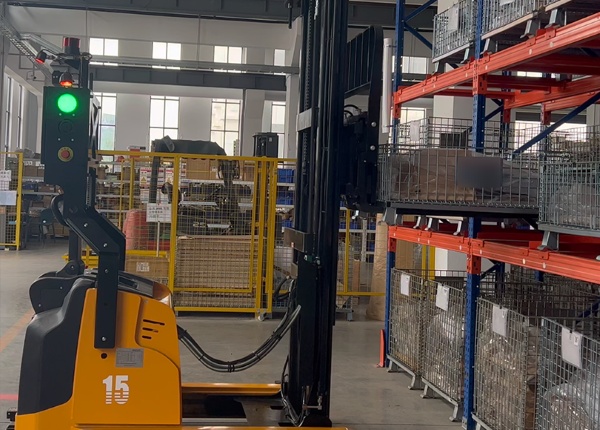
The first number a supplier needs is the actual workload.
Inbound pallet movements per hour
Put-away movements per hour
Retrieval movements per hour
Outbound movements per hour
Peak-hour workload
Average workload
Number of shifts per day
Operating hours per shift
Average workload is useful, but peak workload is usually more important for fleet sizing.
Two warehouses may have the same number of pallet movements but require completely different fleet sizes.
If an AGV only moves pallets between nearby staging areas, its cycle time may be relatively short. If the same AGV must travel from receiving docks to high-bay racks several hundred meters away, each mission consumes considerably more vehicle time.
The supplier should therefore calculate the complete mission rather than only the driving distance.
Pickup
Fork insertion
Load confirmation
Travel
Turning
Lifting
Rack positioning
Load placement
Empty return or next task
Waiting and traffic delay
A fleet that handles the average workload may still fail during a two-hour shipping peak.
For example, a warehouse might average 40 pallet movements per hour but reach 80 movements per hour during the outbound shipping window.
The AGV fleet should be evaluated against the actual operating requirement rather than a simple daily average.
Battery charging should be considered as part of fleet planning.
The supplier should explain how many vehicles can operate during the planned shift pattern, how charging is scheduled, what charging method is proposed, and how the fleet manager prioritizes vehicles when battery levels fall.
A vehicle that is technically capable of working continuously may still become a bottleneck if charging infrastructure is insufficient.
A spare-vehicle strategy depends on the required warehouse service level.
For a small proof-of-concept fleet, the customer may accept manual backup procedures. For a mission-critical distribution center, the business may require higher fleet availability and a defined recovery plan.
Instead of asking the supplier for a generic "recommended spare percentage," define what happens when one vehicle is unavailable and how quickly the remaining fleet can compensate.
| Test | What It Shows |
|---|---|
| Peak task simulation | Whether the fleet can handle peak demand |
| Traffic simulation | Whether intersections become bottlenecks |
| Charging simulation | Whether battery management reduces availability |
| Failure simulation | How the fleet behaves when one AGV is unavailable |
| Peak-hour test | Whether throughput remains within the required range |
Warehouse area is useful background information, but it is not a fleet-sizing calculation.
A serious AGV proposal should show the assumptions behind the recommended fleet quantity: workload, mission distance, cycle time, charging, traffic, utilization and peak demand.
For an overseas buyer, this also makes quotations from different Chinese AGV manufacturers easier to compare because every supplier is working from the same operational assumptions.





 Chinese
 English