


An overseas buyer may send a Chinese AGV manufacturer a simple request such as "Please quote 10 autonomous forklifts for our warehouse."
The supplier can certainly provide a preliminary price. However, that quotation may change substantially once the actual warehouse requirements are understood.
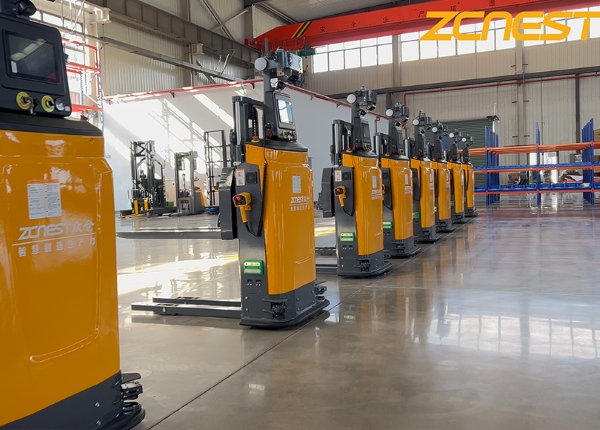
If you want a more useful quotation, provide enough technical information for the manufacturer to determine the vehicle type, fleet quantity, navigation method, charging strategy and integration requirements.
Send a current warehouse layout whenever possible.
Useful information includes building dimensions, columns, racks, aisles, loading docks, staging areas, pedestrian zones, doors, elevators and restricted areas.
A CAD drawing can be useful as a reference for engineering analysis, but the supplier may still need an on-site survey or mapping process before production deployment.
Pallet information is critical for an automated forklift.
Pallet length
Pallet width
Pallet height
Empty pallet weight
Maximum loaded weight
Load center
Fork-entry direction
Runner configuration
Wooden, plastic or metal construction
Percentage of non-standard pallets
If the warehouse uses several pallet types, list each major profile instead of describing them as simply "standard pallets."
For a high-bay warehouse, send the rack elevation and beam information.
The supplier needs to understand the required storage height, pallet overhang, rack opening, beam position and clearance.
This is especially important when evaluating reach AGVs or VNA forklift AGVs.
Tell the supplier how many pallets need to be moved.
| Information | Example Requirement |
|---|---|
| Inbound | Pallets per hour |
| Put-away | Pallets per hour |
| Retrieval | Pallets per hour |
| Outbound | Pallets per hour |
| Peak | Maximum expected workload |
If possible, provide actual historical data rather than an estimate.
Provide the normal origin and destination of pallet movements.
For example:
Receiving dock → inspection area
Inspection → storage rack
Storage rack → picking area
Picking → shipping staging
Shipping staging → outbound dock
This allows the supplier to estimate actual cycle time instead of relying on theoretical driving speed.
Tell the supplier whether the warehouse has unusual environmental conditions.
Cold storage
High temperature
Dust
Humidity
Outdoor operation
Wet floors
Low lighting
Reflective surfaces
Food or pharmaceutical requirements
If the AGV will connect to an existing WMS or ERP, tell the supplier before receiving the final quotation.
Provide the relevant interface requirements, network restrictions, cybersecurity requirements and preferred deployment model.
If the enterprise requires an on-premise fleet server or restricted external connectivity, this should be included in the RFQ.
One of the most useful procurement practices is to ask the supplier to list the assumptions behind the quotation.
The supplier should clearly state:
Recommended AGV model
Payload
Lift height
Aisle requirement
Recommended fleet quantity
Navigation technology
Charging method
Software configuration
WMS integration scope
Site modifications
Commissioning scope
FAT and SAT scope
Excluded items
This turns a simple price quotation into a technical proposal that can actually be compared with other suppliers.
A supplier cannot accurately size an unmanned forklift fleet without understanding the warehouse environment and workload.
For overseas buyers, sending a structured site-data package before requesting a final quotation can reduce repeated questions, prevent incorrect model selection and make competing Chinese AGV quotations much easier to compare.











 Chinese
 English




