


For an overseas company purchasing unmanned forklifts from China, the acceptance process can be just as important as the equipment specification.
The buyer should not wait until the AGVs arrive at the warehouse to discover that pallet handling, navigation, WMS integration or throughput does not match the original proposal.
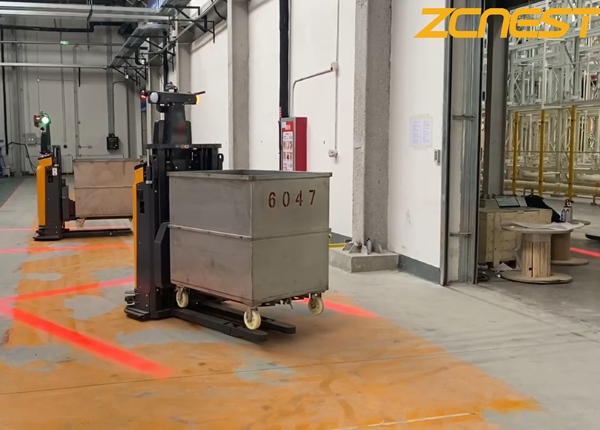
A better approach is to divide acceptance into engineering approval, factory testing, shipment readiness, site commissioning and final operational acceptance.
FAT, or Factory Acceptance Testing, is performed before shipment.
The purpose is to verify that the equipment and agreed functions are ready to leave the factory.
The buyer should define the FAT criteria before production is completed.
Vehicle basic movement
Steering
Fork lifting
Fork lowering
Pallet pickup
Pallet placement
Navigation
Safety scanner functions
Emergency stop
Obstacle response
Automatic charging
Fleet dispatch
WMS communication
Fault recovery
Operator permissions
For high-lift applications, the buyer should also test representative pallet loads and storage positions rather than only demonstrating an empty vehicle.
A warehouse may use wooden pallets, plastic pallets, steel skids or several different pallet profiles.
A vehicle can perform perfectly with a clean test pallet but encounter problems with warped boards, different runner positions, damaged corners or off-center loads.
The FAT should therefore use representative pallets whenever possible.
SAT, or Site Acceptance Testing, verifies the system in the customer's actual warehouse.
This matters because the actual site may contain conditions that cannot be reproduced completely in the factory.
Real rack geometry
Actual floor conditions
Real pallets
Pedestrian traffic
WMS connection
Warehouse Wi-Fi
Actual travel distances
Charging location
Staging areas
Actual peak workload
| Category | Acceptance Item |
|---|---|
| Navigation | Routes, localization and traffic behavior |
| Handling | Pickup and placement of representative pallets |
| Storage | Rack access and required lift positions |
| Throughput | Required pallet movements under agreed conditions |
| Safety | Safety functions and defined abnormal conditions |
| Software | WMS/RCS/WCS task exchange and exception handling |
| Charging | Charging operation and fleet battery management |
The contract should define the procedure before the project starts.
A practical process is:
Record the failed test.
Identify the technical cause.
Assign responsibility.
Define a correction deadline.
Repeat the failed test.
Update the relevant documentation if required.
Record the final acceptance result.
This is particularly important when the supplier and buyer are located in different countries.
For a large automation project, buyers often structure payments around measurable milestones rather than paying almost the entire amount before the equipment is tested.
Possible milestones may include engineering approval, production completion, FAT, shipment readiness and SAT. The exact percentages are commercial terms and should be negotiated according to the project.
The important principle is that each payment milestone should correspond to a clearly defined deliverable.
Equipment manuals
Electrical drawings
Mechanical drawings where applicable
Spare-parts list
Software documentation
Network information
Maintenance procedures
Safety documentation
FAT records
SAT records
Training records
Final configuration records
Buying an unmanned forklift internationally creates additional distance between the equipment manufacturer and the final warehouse.
A clearly documented FAT and SAT process reduces ambiguity about what was promised, what was tested and what remains to be corrected.
For buyers comparing Chinese AGV manufacturers, acceptance criteria can therefore be used as part of the supplier-selection process. A supplier that can provide a detailed testing plan, measurable acceptance criteria and a clear commissioning process gives the buyer a much clearer basis for evaluating the project.





 Chinese
 English