


For an overseas warehouse project, the delivery date of an unmanned forklift is not the same as the date when the equipment becomes operational.
The complete project may include technical clarification, engineering design, production, factory testing, export preparation, ocean transportation, customs clearance, local delivery, installation, mapping, software integration, training and site acceptance.
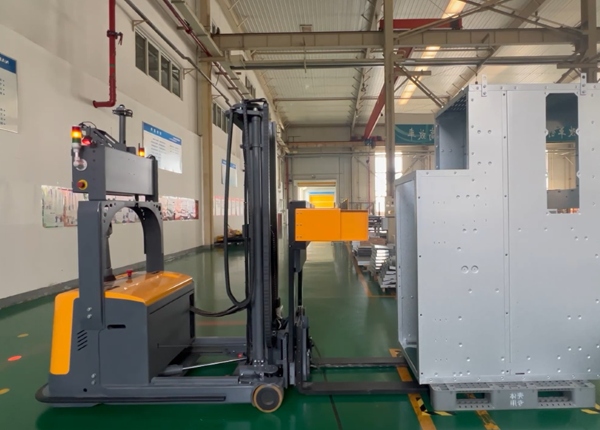
The first stage is defining what the vehicle needs to do.
The buyer and supplier should confirm payload, lift height, pallet dimensions, aisle width, navigation, safety, charging, software and integration requirements.
Custom engineering requirements can affect the production schedule, so they should be finalized before the manufacturing schedule is treated as fixed.
Production time depends heavily on the vehicle model and customization scope.
Standard configurations may follow an established manufacturing process, while custom chassis, forks, lift systems, safety components or software functions can require additional engineering and testing.
Before shipment, the buyer should verify that the agreed functions are ready.
FAT may include vehicle movement, pallet handling, safety functions, fleet software, charging, WMS integration and fault recovery.
Any major issue identified during FAT should be resolved before shipment whenever practical.
After FAT, the equipment still needs to be packed, documented and prepared for export.
Ocean transportation time varies by origin, destination, routing, carrier schedule and current shipping conditions.
The buyer should therefore avoid using a single fixed number of days for the entire China-to-warehouse project.
After arrival at the destination port, the equipment may still require customs clearance, terminal handling, inland transportation and unloading.
Heavy or oversized AGVs may require additional planning for unloading, rigging or warehouse access.
The AGVs are not operational simply because they have arrived at the warehouse.
Commissioning may include:
Vehicle inspection
Battery and charger setup
Network configuration
Laser SLAM or other mapping
Route configuration
Traffic rules
WMS integration
Safety verification
Pallet handling tests
Operator training
SAT should demonstrate that the system performs under actual warehouse conditions.
This may include real pallets, real racks, actual travel distances, WMS tasks and representative workload.
| Stage | Main Deliverable |
|---|---|
| Technical clarification | Approved technical specification |
| Engineering | Final design and configuration |
| Production | Completed AGV fleet |
| FAT | Factory acceptance |
| Shipping | International transportation |
| Commissioning | Operational system |
| SAT | Final site acceptance |
Provide complete warehouse information early.
Confirm pallet specifications before engineering.
Freeze the technical specification before production.
Define FAT criteria before testing.
Prepare the warehouse network before equipment arrival.
Prepare charging infrastructure before commissioning.
Confirm WMS integration requirements early.
Plan unloading and warehouse access in advance.
Define SAT criteria before shipment.
The most effective way to shorten an international AGV project is usually not to ask the manufacturer for an unrealistically short production time. It is to remove uncertainty from each stage of the project.





 Chinese
 English