


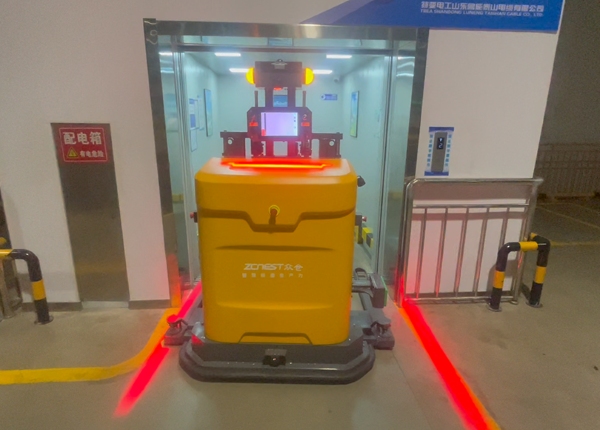
However, a POC should not be treated simply as “two machines for testing.” It should be designed as a controlled version of the future production system.
Before purchasing the pilot units, define the questions that the POC must answer.
Can the AGVs handle the actual pallets?
Can they navigate the warehouse reliably?
Can they operate in the required aisle width?
Can they achieve the required lift height?
Can they maintain the required throughput?
Can they integrate with the WMS?
Can they operate safely around people and manual equipment?
Can the charging strategy support the workload?
A POC performed in an empty demonstration area does not prove that the same system will work in the production warehouse.
The pilot should use representative pallets, racks, floor conditions, aisle dimensions, travel distances, staging areas, traffic patterns, and workload.
If the future fleet will operate in narrow aisles and high-bay storage locations, those conditions should be part of the POC wherever practical.
The POC should produce measurable operating data instead of relying only on operator impressions.
Useful measurements include mission completion time, travel time, waiting time, charging time, manual intervention, failed missions, pallet handling errors, and vehicle availability.
The buyer can then compare the measured performance against the workload that the future 40-unit fleet is expected to handle.
Software integration is one of the reasons a technically successful vehicle demonstration can still fail as a warehouse project.
The POC should test the actual task flow:
WMS task → fleet system → AGV mission → pallet pickup → transport → pallet placement → completion feedback → WMS status update.
Exception handling should also be tested. For example, what happens when a pallet is missing, a destination is occupied, an AGV loses communication, or a task is cancelled?
Two AGVs can reveal whether the proposed charging concept works before the buyer invests in a much larger fleet.
Test the charging locations, charging schedule, battery state monitoring, charging during peak operation, and recovery after charging interruptions.
For a larger fleet, charging capacity and charging scheduling should be validated against the expected simultaneous workload rather than simply multiplying the number of chargers by the number of vehicles.
Two AGVs are particularly useful for testing traffic logic.
Run both vehicles through shared aisles, intersections, pickup points, staging areas, and charging zones. Observe whether the fleet software prevents unnecessary blocking and whether the vehicles recover correctly from temporary obstacles.
This is more valuable than testing a single AGV repeatedly on an isolated route.
The buyer and supplier should agree in advance on what constitutes a successful pilot.
For example, the agreement can define required task completion, handling accuracy, intervention rate, integration functions, safety tests, charging performance, and documentation.
The expansion decision should then be based on measured POC results rather than a general statement that the AGVs “worked well.”
A pilot should use the same basic architecture planned for the future fleet whenever possible.
Ask whether the fleet software, server, WMS interface, wireless network, charging system, and traffic-management architecture can support the planned fleet size.
If the POC requires a completely different architecture when expanding, some of the pilot results may not represent the final production system.
For a project that may grow from two AGVs to approximately 40 units, the commercial agreement can define how expansion will be handled.
The buyer may negotiate future pricing, software licensing, spare-parts pricing, additional engineering requirements, production lead time, and the technical conditions for adding vehicles.
This avoids treating the pilot and production fleet as two completely unrelated projects.
At the end of the pilot, the warehouse team should have measurable results, integration records, safety test records, operating data, identified limitations, and a list of required changes before fleet expansion.
A two-AGV POC is most useful when it answers a simple procurement question: “What must be proven before we commit to the larger fleet?”





 Chinese
 English