


INVENTORY CONTROL AND AUTOMATION
Automated pallet movements do not eliminate the need to verify inventory accuracy. A well-planned cycle-counting process helps warehouse teams investigate discrepancies while coordinating vehicle tasks, storage access and inventory updates without creating avoidable operational disruption.
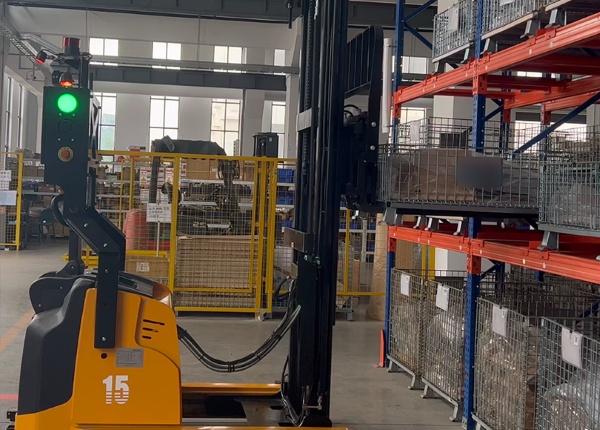
Cycle counting verifies selected inventory records during normal warehouse operations rather than relying only on a full physical stocktake. In an AGV forklift warehouse, the process must account for both the recorded inventory and the physical movement of pallets during the count.
A count can become unreliable if a pallet is moved after the counting task is created, if a location record is updated before the physical movement is confirmed or if an inventory adjustment is posted without an approved review.
To prevent these problems, define the counting scope, control the inventory state during verification and establish how discrepancies are investigated and corrected.
Cycle-counting tasks should specify whether the warehouse is verifying a storage location, a handling-unit identifier, a quantity, an SKU or another inventory attribute.
These count types require different checks. A location count may compare the physical contents of a rack position with the recorded inventory. A handling-unit check may confirm that a particular pallet is present and associated with the expected inventory record.
Define the count scope before releasing work. Include the warehouse zone, relevant locations or handling units, the required verification method and the person or system authorized to confirm the result.
If the count requires direct physical inspection at an elevated storage position, confirm that the process uses approved access and equipment. Do not assume an AGV forklift can perform an inventory inspection simply because it can transport a pallet to or from that location.
Counting should be scheduled to minimize interference with important transport tasks. Some locations may be easier to verify during lower-demand periods, while other counts can be integrated into planned movements if the inventory state remains unambiguous.
Consider the location's movement frequency, inventory value, discrepancy history and impact on active operations. A frequently accessed location may require a more controlled count window than a location with few movements.
Define whether the location or handling unit must be temporarily reserved, whether new movements are paused and how pending transport requests are treated. If the warehouse continues moving inventory during the count, the system needs a reliable way to distinguish the inventory state at the count's reference time.
Do not choose a counting schedule solely to maximize the number of locations visited. The count must produce trustworthy results without introducing uncontrolled inventory changes.
Before the count begins, review whether any AGV task is already assigned to move a pallet into or out of the affected location. A count and a transport task should not independently change the same inventory state without a defined coordination rule.
Depending on the warehouse system, the count process may temporarily block the location, wait for existing tasks to finish or record a reference state while allowing selected movements to continue under controlled conditions.
Define what happens if a vehicle arrives after a count has started, a task is canceled or the count cannot be completed. The system should preserve the location and handling-unit records until the actual inventory state is verified.
Also consider the effect on fleet dispatch. A temporary location restriction may cause other tasks to be delayed or reassigned, so the counting schedule should be visible to the systems responsible for warehouse execution.
Counting instructions should explain what the operator must verify and how the result is recorded. Where a barcode, RFID tag or other identification method is used, confirm that the identifier corresponds to the physical pallet or inventory unit being checked.
For a location-based count, the procedure should account for all visible inventory within the defined scope. For a handling-unit check, it should verify the unit's identity and location rather than assuming that a nearby label belongs to the pallet being counted.
Where packaging obscures product labels or a pallet contains mixed SKUs, define the additional verification needed. A count should not be marked complete merely because the outer handling-unit identifier can be read.
Record the result, timestamp, location and responsible person or system. If a count is interrupted, retain its status so the next operator knows whether the location is unverified, partially checked or ready for review.
A mismatch between the physical count and the system record should trigger an investigation, not an automatic inventory adjustment in every case.
Potential causes include a delayed movement confirmation, an incorrectly identified pallet, a misplaced handling unit, an incomplete receipt, an unrecorded manual movement or a previous count error.
Review relevant task histories and inventory transactions. Determine whether a pallet is physically present at another approved location, whether a movement remains incomplete or whether the underlying inventory quantity is genuinely incorrect.
Define who can approve adjustments and what evidence is required. Keep the original count, investigation result and approved correction traceable so the warehouse can explain how the final inventory state was established.
Once the count or investigation is complete, verify that the inventory system reflects the approved result. If a location was temporarily blocked, confirm that the restriction is removed only after the count has been resolved.
Check for pending transport tasks, stale reservations and inventory updates that may have been delayed during the counting process. A count can appear complete while an earlier movement transaction is still waiting for confirmation.
Where the warehouse uses separate inventory and fleet systems, define which system owns the authoritative inventory record and how approved changes are communicated. Avoid allowing multiple systems to independently overwrite location data.
Finally, confirm that the AGV fleet can resume normal operations in the affected area and that any tasks held during the count can proceed safely under the approved rules.
Record count completion rates, discrepancy frequency, investigation time and repeat discrepancy causes. These measures can help the warehouse determine whether errors are concentrated in certain zones, handling processes or inventory categories.
Review repeated discrepancies rather than treating each one as an isolated event. If errors frequently follow manual transfers, examine the confirmation process. If mismatches occur after canceled transport tasks, review how the system reconciles task and inventory states.
Count frequency should reflect the warehouse's inventory-control policy and risk assessment. The results can inform future count planning, but changes to the policy should be approved by the responsible inventory-control team.
The count type, scope and reference time are defined.
Existing and pending AGV tasks are reviewed.
Location restrictions and movement rules are documented.
Counting results identify the relevant pallet or inventory record.
Discrepancies require investigation and authorized correction.
Inventory and fleet-system states are reconciled.
Repeat discrepancies are reviewed for underlying causes.
Key checkpoint: A cycle count is complete only when the physical observation, inventory record and any pending transport transactions have been reconciled under the warehouse's approved procedure.
During project planning, explain how cycle counting is performed today and which activities should remain unchanged after automation. Identify the inventory system that owns the record, the roles authorized to approve adjustments and the information needed to investigate discrepancies.
Ask the supplier to confirm how counting-related location restrictions and task status changes can be represented in the proposed system. Test the process with an active transport task, a mismatched pallet identifier and a count that requires investigation before production deployment.












 Chinese
 English





