


WAREHOUSE STORAGE STRATEGY
Choosing a storage location is not simply a matter of finding an empty rack position. Effective slotting rules must balance storage compatibility, future retrieval demand, travel requirements and inventory policy so AGV forklifts can support the warehouse's actual operating priorities.
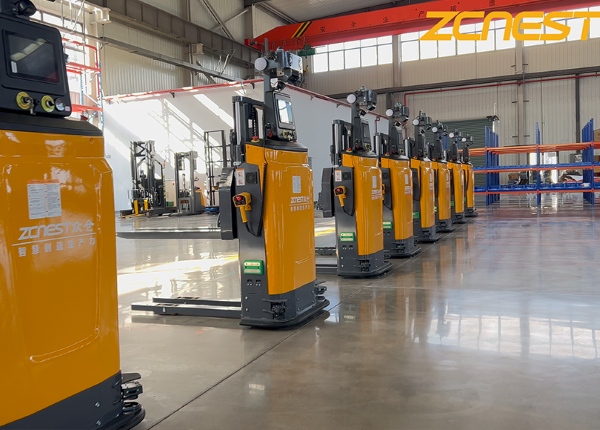
Warehouse slotting determines how inventory is distributed among eligible storage locations. For AGV forklift operations, the decision influences future retrieval travel, the balance of work across storage areas and the availability of suitable positions for incoming loads.
A nearest-empty-location strategy may work for some operations, but it can create avoidable travel if frequently retrieved products are stored far from their next destination. It can also create an uneven workload if many high-demand products are concentrated in one area.
A practical slotting policy defines which locations are eligible, how competing choices are ranked and when the warehouse should preserve an existing assignment rather than move inventory unnecessarily.
Before optimizing travel or retrieval speed, exclude locations that cannot safely or operationally accept a particular load.
Eligibility rules may consider the load's dimensions and weight, pallet format, storage restrictions, inventory status and the actual capabilities of the intended equipment. For high-bay applications, the relevant rack position and vehicle operating limits must also be respected.
Define the eligible location set before ranking alternatives. A location that is close to the next destination should not be selected if it violates the warehouse's storage or handling rules.
Make the rules explicit and maintain them through an approved process. If a rack position becomes unavailable or its permitted use changes, the slotting logic should not continue assigning inventory based on outdated information.
Review how often each product or inventory category is retrieved and where those retrievals usually need to go. Frequently requested inventory may benefit from locations that reduce recurring travel, provided those positions remain compatible with the load and storage policy.
Use historical movement data over a representative period. Consider seasonal variation and planned changes in demand rather than relying on a short period that may not reflect normal operations.
Product turnover is only one factor. A high-demand SKU may occupy several locations, require batch separation or have storage restrictions that limit its placement. The slotting policy should account for these conditions rather than assigning locations based on turnover alone.
For warehouses with frequent order peaks, examine whether the distribution of high-demand inventory creates congestion in particular aisles. A shorter individual route may not improve overall performance if many tasks compete for the same constrained area.
High-density storage can increase the number of pallet positions available within a warehouse footprint. However, storage density should be considered alongside the actual process for accessing each position.
Review whether the proposed slotting pattern creates concentrated retrieval demand, additional transfers or repeated movements through the same access points. A storage plan that maximizes occupancy without considering movement may increase the workload required to retrieve inventory.
Compare alternative assignments using the warehouse's real task mix and travel constraints. Where several locations are equally suitable, the system may prioritize travel efficiency, workload distribution or another approved operating objective.
Do not assume that the shortest route for one pallet produces the best result for the whole fleet. Evaluate the combined effect of the slotting policy on task demand, congestion and storage access.
Some warehouses must preserve distinctions between lots, batches, ownership categories, quality statuses or other inventory attributes. Slotting rules should prevent a convenient empty location from overriding these requirements.
Specify which inventory categories may share an area and which require separation. Determine whether the location assignment must preserve a lot sequence, stock rotation policy or another warehouse-specific restriction.
For mixed-SKU pallets or handling units with special status, confirm how the warehouse system represents the inventory and determines eligible destinations. Do not rely on the physical location alone to convey information that belongs in the inventory record.
Where a product's storage eligibility changes, define how existing inventory is reviewed and how new assignments are controlled. Any relocation should follow the approved inventory and transport process.
Slotting rules should not trigger repeated relocations merely because another location becomes marginally more attractive. Relocation consumes transport capacity and may interfere with normal receiving, retrieval or dispatch work.
Define the conditions that justify a reassignment. These may include a change in demand, a storage restriction, an unavailable location or a planned warehouse reorganization. The decision should consider both the expected benefit and the movement required to implement the change.
For existing inventory, determine whether the warehouse will keep the current location until the next natural movement or create a separate relocation task. The appropriate rule depends on storage capacity, inventory policy and the expected value of the proposed change.
Track relocation tasks separately from normal putaway and retrieval where this helps explain their effect on operational capacity.
Slotting decisions must be available to the systems responsible for inventory, destination assignment and transport execution. Define which system owns the storage assignment and how changes become effective.
Where a location is reserved for an incoming pallet, ensure that another task cannot assign the same position without following the approved reservation rules. Also define how reservations are released when a task is canceled or the destination becomes unavailable.
When slotting rules are updated, test them with representative loads and task scenarios. Confirm that the system selects eligible locations and records the resulting inventory state correctly.
If the warehouse uses separate software components, document which system proposes a destination, which system validates it and which system confirms the completed physical movement. This avoids conflicting location updates across the workflow.
Review the effect of slotting rules using measures that reflect both storage and transport performance. Useful indicators include average retrieval travel, task completion time, location occupancy, relocation volume and the distribution of work across storage zones.
Compare similar periods and account for changes in order volume, product mix and available storage capacity. A shorter average route does not necessarily mean that the overall operation improved if more relocation work or congestion was created elsewhere.
Run a controlled trial where possible. Apply the proposed rule to a defined set of inventory or locations, observe the result and review the trade-offs before extending it across the warehouse.
Mandatory load and location eligibility rules are defined.
Retrieval demand is based on representative operating data.
Storage density and access requirements are evaluated together.
Lot, batch and inventory-status restrictions are preserved.
Reassignment rules prevent unnecessary relocation tasks.
Storage assignments and reservations remain consistent across systems.
Slotting changes are evaluated using operational KPIs.
Key checkpoint: The best storage position is an eligible position that supports the warehouse's broader workload—not simply the nearest empty location. Evaluate the effects on future retrieval, congestion and relocation before changing the slotting policy.
When planning an AGV forklift project, provide the supplier with the storage-location structure, inventory restrictions, retrieval patterns and rules for assigning or changing destinations.
Ask how the proposed warehouse and fleet systems will represent eligible locations, reservations and reassignment requests. Validate the policy with actual storage scenarios before relying on automated putaway for normal operations.












 Chinese
 English





