


Automated pallet replenishment depends on more than moving stock between storage locations. The warehouse must release the right task at the right time, maintain sufficient forward inventory, and avoid overwhelming aisles with unnecessary movements.
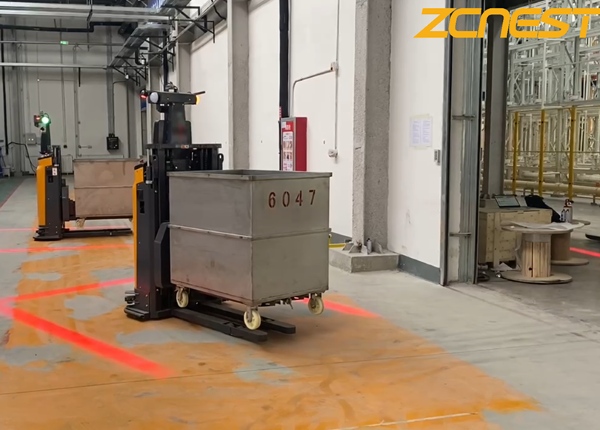
When a picking location runs out of stock, the immediate problem may appear to be a missing pallet. The underlying cause is often a replenishment rule that releases work too late, ignores actual demand, or competes with other warehouse movements for the same aisle capacity.
For an AGV forklift warehouse, replenishment planning must connect inventory availability, picking demand, reserve stock, transport capacity, and destination readiness. The objective is not to move as many pallets as possible. It is to keep required inventory available without filling the warehouse with premature transfers.
Start by identifying which locations hold reserve inventory and which locations supply routine picking. These areas serve different purposes and should not use identical replenishment rules.
Reserve storage: Holds bulk or backup inventory and may require longer travel or high-level retrieval.
Forward picking: Supplies frequent order lines and should maintain enough usable stock for expected demand.
Replenishment handover points: Provide a controlled location where pallets can be transferred, checked, or prepared for the next movement.
Define the permitted source and destination for each replenishment task. A nearby empty location is not automatically a valid destination, and a reserve pallet is not necessarily eligible for replenishment if its inventory status, batch, or product attributes do not meet the picking requirement.
A fixed minimum quantity is easy to configure, but it may be unsuitable when demand changes significantly throughout the day. A better trigger considers usable inventory, expected demand during replenishment lead time, and a practical safety buffer.
For example, a warehouse may release a replenishment task when the usable quantity at a picking location falls below the amount expected to be consumed before the next delivery can arrive. The exact threshold should reflect order patterns, retrieval time, vehicle availability, and the consequences of a stockout.
Before setting a trigger, answer these questions:
Does the available quantity exclude stock already reserved for confirmed orders?
Can the system identify pallets that are physically present but unavailable for picking?
How long does replenishment take during busy and quiet periods?
Can multiple open tasks accidentally replenish the same location?
Does the rule consider destination capacity and the permitted pallet quantity?
A trigger based only on the last recorded inventory quantity can generate incorrect tasks if outstanding picks, pending transfers, or stock reservations are ignored.
When inventory drops below a threshold, several order lines may evaluate the same location at nearly the same time. Without a reservation or task-control rule, the warehouse may release more replenishment work than required.
Use a controlled sequence:
Confirm the location's current usable inventory.
Check open replenishment tasks and quantities already committed.
Calculate the remaining replenishment requirement.
Confirm that eligible reserve inventory is available.
Release the task and reserve the required source and destination capacity.
Reconcile the result after physical delivery.
Define what happens when a task is cancelled, a source pallet becomes unavailable, or the destination is no longer suitable. A cancelled task must not leave a permanent reservation, while a task still in progress should not be treated as completed inventory.
Replenishment tasks may compete with outbound retrievals, putaway, and urgent pallet transfers. Releasing every replenishment request immediately can increase aisle traffic and create queues at shared handover points.
Use clear release conditions. For instance, routine replenishment may be released in manageable batches, while a picking location approaching a confirmed stockout receives earlier attention. The rule should consider operational urgency without allowing every task to be labelled urgent.
Where narrow aisles or high-level storage are involved, assess the full movement cycle: travel to the reserve location, retrieval, travel to the forward location, delivery confirmation, and the vehicle's next assignment. The total cycle matters more than the driving time alone.
Key checkpoint
A replenishment task should be released only when there is a genuine inventory need, an eligible source pallet, a valid destination, and a defined rule for handling work already in progress.
High task volume does not necessarily indicate good replenishment performance. A warehouse can move many pallets while still suffering picking shortages, excessive reserve retrievals, or unnecessary congestion.
Review the following measures:
Picking stockout frequency: How often a required picking location lacks usable stock.
Replenishment lead time: Time from task release to confirmed delivery.
Emergency replenishment rate: The proportion of tasks released after a shortage has already disrupted picking.
Duplicate task rate: Replenishment requests that exceed the actual requirement.
Delivery failure rate: Tasks that cannot be completed because the source or destination is unsuitable.
Waiting time: Time spent waiting for a location, handover point, or vehicle assignment.
Review results by product group, picking area, and time period. A shortage concentrated in one area may indicate an unsuitable trigger or insufficient forward capacity rather than a fleet-wide transport problem.
Reserve and forward-picking locations are clearly distinguished.
Replenishment triggers use usable inventory and expected demand.
Open tasks and reserved quantities are considered before new tasks are released.
Source inventory and destination capacity are validated.
Urgent replenishment has an explicit business rule.
Task cancellation and failed delivery have defined recovery procedures.
Inventory is reconciled after physical delivery.
Stockout frequency and replenishment lead time are reviewed together.
Reliable replenishment requires the right combination of storage rules, task-release logic, vehicle capacity, and physical handover design. Before configuring an automated system, map the reserve and picking areas, identify the busiest replenishment periods, and establish how the warehouse will handle shortages and competing tasks.
Share your warehouse layout, pallet profile, storage height, and replenishment workflow with the ZCNest Robotics team to discuss suitable AGV forklift configurations and automation planning.












 Chinese
 English





