


When pallets need to move between warehouse floors, AGV forklifts must coordinate with freight elevators as well as the warehouse's transport and inventory systems. Reliable automation depends on elevator access, load clearance, door control, and clear task handover rules.
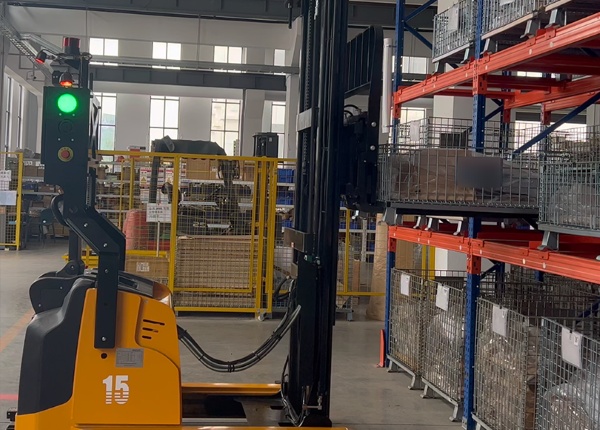
Warehouses with multiple floors may use freight elevators to connect receiving, storage, picking, and shipping areas. If AGV forklifts are deployed on more than one floor, the elevator becomes part of the automated transport route.
This introduces additional coordination requirements. A vehicle must reach the correct elevator, wait for access, enter with the load, travel to the assigned floor, exit safely, and continue to its destination. The elevator must also be able to handle the vehicle's dimensions, weight, and operating requirements.
Without a defined integration process, vehicles may wait at elevator doors, enter an elevator that is not ready, or receive a destination instruction that conflicts with the elevator's actual operating state.
The first step is to confirm that the freight elevator can accommodate the selected AGV forklift and its intended load.
Review the following information:
Elevator rated load capacity.
Cabin length, width, and usable height.
Door opening width and height.
Floor level differences and entrance conditions.
Vehicle turning and positioning requirements.
Clearance for the pallet and any load overhang.
Elevator control interfaces and access permissions.
Calculate the total weight of the vehicle, battery, and transported load. Do not compare only the pallet weight with the elevator's rated capacity.
Also check whether the vehicle can enter and exit without turning inside the cabin. Some installations may require straight-through movement or a specific approach direction.
The AGV control system needs a reliable way to request elevator access and determine whether the elevator is ready. Depending on the equipment, this may involve a PLC interface, digital I/O, an industrial communication protocol, or an approved elevator control gateway.
The integration should define how the AGV requests a floor, how the elevator confirms availability, and how the vehicle receives permission to enter. A request being sent is not the same as permission to enter.
Establish clear signals for elevator availability, door-open status, floor arrival, door-closed status, and access authorization. The exact signals and interface method should be agreed with the elevator supplier and automation project team.
Elevator entry is a controlled movement, not an ordinary route segment. The vehicle should approach a designated waiting point and enter only after the elevator is confirmed to be at the correct floor with the required access conditions.
Define the entry position, travel direction, stopping position inside the cabin, and exit path. The vehicle's navigation and positioning method must support reliable alignment with the elevator entrance.
After arrival at the destination floor, the AGV should confirm that the exit conditions are suitable before moving out. If the doorway is blocked or the elevator does not provide the expected status, the vehicle should remain in a safe state and follow the agreed exception process.
A typical cross-floor task includes more than one movement segment. The system must coordinate travel to the elevator, elevator access, floor transfer, and travel to the final destination.
The WMS creates a transport task with the pickup and destination floors.
The RCS selects an eligible AGV forklift.
The vehicle transports the pallet to the designated elevator waiting point.
The AGV requests elevator access.
The elevator confirms the required floor and entry conditions.
The AGV enters and confirms its position inside the cabin.
The elevator travels to the destination floor.
The AGV exits and continues to the delivery location.
The system confirms delivery and updates the task status.
Each stage should have a clear status and timeout rule. If a step is not completed within the agreed period, the task should enter an exception state instead of allowing the vehicle to proceed based on an assumed elevator condition.
Freight elevators are shared resources. If several AGV forklifts request the same elevator at once, they can create queues that delay pallet movements on multiple floors.
The RCS should coordinate elevator requests and consider task priority, current elevator position, vehicle availability, and destination floor. Where appropriate, it can group compatible requests or schedule access to reduce unnecessary elevator travel.
However, grouping tasks should not create excessive waiting for urgent pallet movements. The control strategy should balance elevator utilization with the operating requirements of each warehouse area.
Provide designated waiting positions near elevator entrances. These positions should not block pedestrian access, fire exits, manual handling routes, or other vehicle paths.
Elevator faults, maintenance, manual operation, and temporary access restrictions can interrupt automated transport. The warehouse should define how active tasks are handled when an elevator becomes unavailable.
Possible responses include holding the task at an approved waiting point, redirecting the pallet to an authorized temporary location, or assigning a manual recovery procedure. The correct choice depends on where the pallet is and whether the vehicle has entered the elevator.
If the elevator stops while a vehicle is inside, the response must follow the elevator manufacturer's procedures and the site's safety requirements. Do not use ordinary fleet dispatch commands as a substitute for approved elevator recovery procedures.
Confirm these items before commissioning:
Elevator capacity and cabin dimensions match the AGV and load.
Door opening and vehicle clearance are verified.
Elevator call and status interfaces are agreed.
Entry, stopping, and exit positions are defined.
Each elevator operation has clear authorization conditions.
Vehicle queues and waiting locations are planned.
Unavailable elevator scenarios have defined responses.
WMS, RCS, and elevator status records remain synchronized.
Emergency and maintenance procedures are coordinated with the elevator supplier.
Key checkpoint: An AGV forklift should enter a freight elevator only after the elevator has confirmed the correct floor, door status, and access authorization. Treat elevator access as a controlled interface, not an assumed part of the navigation route.
Testing should cover the complete journey from pickup to final delivery, including the elevator interface. Verify normal access, repeated calls, delayed responses, occupied cabins, unavailable floors, and interrupted communication.
Measure elevator waiting time, entry and exit time, total cross-floor task duration, and the number of tasks delayed by elevator availability. These figures help determine whether the elevator has sufficient capacity for the planned AGV workload.
For warehouses with high-bay storage on multiple floors, also verify that the vehicle can complete the required rack approach and pallet handling operations after leaving the elevator. A successful floor transfer does not by itself prove that the entire storage task is feasible.












 Chinese
 English





