


Warehouse fire doors and security shutters divide buildings into controlled areas. When AGV forklifts need to cross these boundaries, the vehicle, door controller, and fleet system must coordinate access without bypassing the building's safety functions.
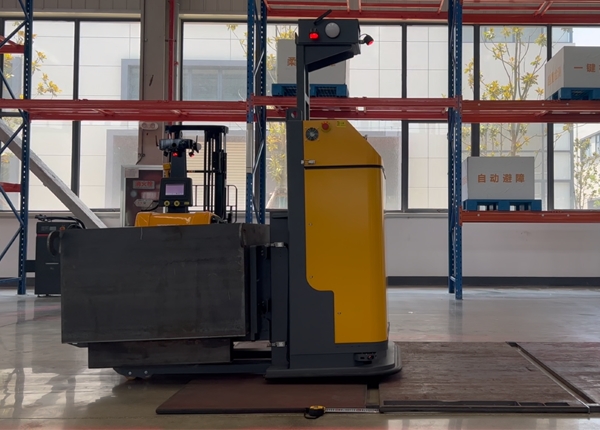
Large warehouses often use fire doors, rapid-roll doors, security shutters, and controlled access barriers to separate operational zones. AGV forklifts may need to pass through these openings to move pallets between receiving, storage, picking, and dispatch areas.
For automated transport to work reliably, the door must open at the right time, remain open long enough for the vehicle and load to pass, and return to its required state afterward. The AGV must also know when passage is permitted and when it needs to wait.
Fire doors require particular care because they are part of the building's fire protection strategy. Their automatic operation must follow the approved fire alarm and building safety design. Fleet software must never override or defeat those functions.
Start by mapping the doors and barriers that an AGV forklift needs to cross. Record the door type, location, opening dimensions, operating mode, control interface, and access conditions.
Different door types may have different requirements:
Rapid-roll doors: Often used for frequent movement between warehouse areas.
Security shutters: Used to control access to restricted areas or building sections.
Fire doors: Designed to maintain fire compartmentation and operate according to the building's fire protection strategy.
Controlled access doors: May require authorization before a vehicle can enter a designated zone.
Map the door locations on the AGV route plan and identify which movements require a door request. This makes it possible to estimate crossing frequency and identify doors that may become traffic bottlenecks.
The opening must accommodate the AGV forklift, pallet, and load in the actual travel orientation. Checking only the vehicle width is insufficient when a pallet or product extends beyond the fork carriage.
Measure usable opening width and height, floor transitions, door movement clearance, and the space required for the vehicle to approach and pass through. Include the largest approved load configuration in the assessment.
Also confirm the vehicle's positioning accuracy at the door. If the AGV must stop at a designated request point, the location should be suitable for repeatable approach and departure without blocking other traffic.
The AGV fleet system needs a clear interface with the door controller. Depending on the equipment, this may use digital I/O, PLC communication, or another approved industrial interface.
A typical sequence may include:
The AGV approaches the designated door waiting point.
The vehicle or RCS sends an access request.
The door controller checks its operating conditions.
The door begins opening when access is permitted.
The controller confirms that the opening is sufficient for passage.
The AGV receives the approved passage signal.
The vehicle and load pass through the opening.
The system confirms that the crossing is complete.
The door returns to its required operating state.
The exact sequence depends on the door supplier and site design. The important principle is that the AGV should not proceed merely because it has sent a request. It must receive the required permission and status confirmation.
Fire doors are not ordinary access barriers. Their operation may be connected to fire alarm systems, emergency controls, and building compartmentation requirements.
The integration design should be reviewed by the responsible building fire safety professionals, door supplier, and relevant control-system specialists. The fire protection system must retain its approved authority over fire door operation.
AGV access requests should be handled only through an approved interface that does not interfere with fire alarm responses or prevent the door from performing its intended function. If a fire alarm or emergency condition changes the door state, the fleet system should respond by stopping or rerouting affected transport tasks according to the approved site procedure.
Never use a fleet-control command to hold a fire door open against its designed safety behavior or to bypass a required closure condition.
Doors can become bottlenecks when several AGV forklifts need to cross the same opening. A vehicle waiting too close to a doorway may block pedestrians, manual equipment, or other traffic.
Establish a designated waiting position outside the door's operating area. The RCS should coordinate access requests so that only the appropriate vehicle receives passage authorization at a given time when required by the door design.
Consider the time needed for the door to open, the vehicle to pass, and the door to return to its normal state. This crossing time should be included in transport capacity calculations, especially when one door connects two high-volume warehouse zones.
A door may fail to open, remain open longer than expected, or report an inconsistent status. The AGV system should not assume that the opening is safe simply because the expected time has elapsed.
Define how the fleet responds to:
No response after an access request.
Door opening timeout.
Opening confirmation not received.
Door unexpectedly closing during an approach.
Obstruction or safety sensor activation.
Communication loss between the door controller and RCS.
Emergency or fire alarm operating conditions.
Depending on the event, the vehicle may need to wait at a safe position, stop the task, or use an approved alternative route. Recovery should follow the door manufacturer's and site's procedures rather than relying on an automatic retry in every situation.
Before deploying AGV forklifts across controlled doorways, confirm:
All doors and controlled openings are mapped on the AGV routes.
Opening dimensions accommodate the vehicle and largest approved load.
Approach and waiting positions are clearly defined.
Door request and passage permission signals are agreed.
Door status confirmation is available to the fleet system.
Fire door operation remains under the approved fire protection design.
Vehicle queues do not block pedestrian or emergency access.
Door faults and communication failures have defined responses.
Testing includes normal operation and emergency conditions.
Key checkpoint: The AGV should cross a controlled doorway only after receiving the required access permission and opening confirmation. Fire doors must retain their approved safety functions independently of normal warehouse traffic control.
Test every controlled doorway that forms part of the planned AGV route. Verify the request sequence, opening confirmation, vehicle passage, completion signal, and return to the normal door state.
Include tests for multiple vehicles requesting access, blocked openings, delayed door responses, communication interruptions, and the activation of relevant safety conditions. Confirm that the AGV waits or stops as designed and that the door retains control of its own safety functions.
Record the crossing time and the number of delayed tasks associated with each door. If a doorway is used frequently, this information can help determine whether route adjustments or a different traffic arrangement are needed.












 Chinese
 English





