


A pallet may fit the nominal rack dimensions while the products on top extend beyond its edges. This overhang can affect fork entry, aisle clearance, rack placement, and vehicle movement. Automated handling requires the complete load envelope to be considered.
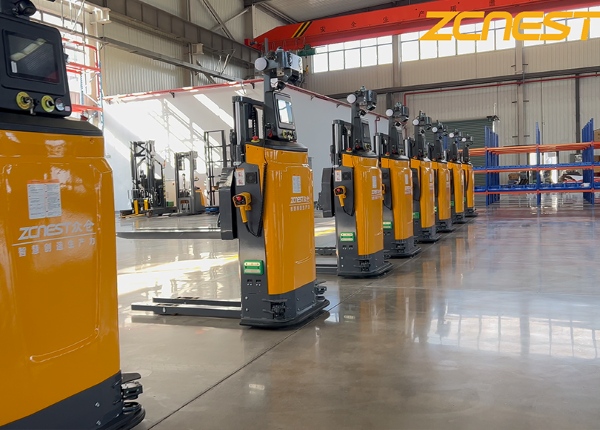
Warehouse pallet specifications often describe the pallet itself, but the actual load can be wider, longer, or less regular. Products may extend beyond the pallet because of packaging dimensions, stacking arrangements, or the way goods are secured.
For manual forklift operations, an experienced operator may compensate for some variation through visual judgment. An AGV forklift follows configured movement and handling rules. If the load envelope is not included in the project design, a vehicle may approach a rack, transfer station, or narrow passage with insufficient clearance.
Before automating pallet transport, warehouse managers should define acceptable load dimensions and identify which overhang conditions require a different route, special handling, or manual inspection.
The relevant dimensions are the outer dimensions of the loaded pallet. Measure the maximum width, length, and height, including packaging, wrapping, protruding products, and any protective materials.
Also identify whether the overhang is symmetrical. A load extending equally on both sides may require a different clearance allowance from one that extends mainly to the left or right.
For project planning, classify loads into standard dimensional groups. If the warehouse handles several product families, use representative samples that reflect the largest and most irregular approved loads.
Overhang can affect how the AGV forklift approaches and lifts a pallet. Products or packaging may obstruct fork entry, while an uneven load can change the center of gravity and the way the pallet is supported.
Verify:
Fork entry direction and available opening.
Pallet condition and structural integrity.
Clearance between the forks and protruding products.
Load center and weight distribution.
Whether the load remains stable during lifting and travel.
Whether packaging or wrapping can catch on the vehicle or nearby equipment.
Do not assume that a pallet is suitable for automated handling simply because its nominal weight is below the forklift's rated capacity. Load geometry and stability also matter.
High-bay storage and narrow-aisle operations require careful dimensional checks. The load must fit within the permitted storage envelope and maintain the required clearance from rack uprights, beams, neighboring pallets, and other structures.
Use the actual loaded dimensions when checking rack compatibility. Include the position of the pallet on the forks, the vehicle's positioning tolerance, and the expected placement clearance.
In narrow aisles, also assess the load envelope during travel and turning. A pallet that fits within the rack opening may still create a clearance issue when the AGV approaches the aisle or passes another designated operating area.
There is no single overhang limit suitable for every warehouse. The permitted dimensions depend on pallet design, load type, rack configuration, vehicle capability, handling direction, and site safety requirements.
Set approved dimensional limits for each pallet category. The limits should be based on engineering assessment and actual testing, not on an informal assumption that a small amount of overhang is always acceptable.
Where different load categories require different limits, record the category in the warehouse system or an approved handling profile. This allows the warehouse to route non-standard loads to an appropriate process rather than treating every pallet as identical.
Loads outside the approved dimensional envelope should not automatically enter the normal AGV transport process.
Depending on the warehouse design, a non-standard pallet may be sent to a measurement station, repacking area, or manual verification point. After the load has been corrected or approved, the warehouse can release a new transport task using the appropriate handling information.
If the load cannot be made compatible with the automated route, define an approved alternative handling method. This prevents an oversized pallet from entering a narrow aisle or high-bay storage area where it may become difficult to recover.
The WMS should identify which pallet or load category is being transported. The RCS should receive enough information to select a suitable vehicle and route, based on the capabilities configured for the project.
Where the system supports dimensional profiles, use them to distinguish standard loads from special loads. The rules may control which transfer stations, aisles, rack locations, and vehicle types are eligible for each category.
If dimensions are not available electronically, establish a defined verification process at receiving or another control point. Do not rely on the AGV to infer the complete load envelope from the pallet's nominal size.
Before approving a pallet type for automated handling, confirm:
Maximum loaded width, length, and height are measured.
Asymmetric overhang is identified.
Fork entry and load support are suitable.
Load center and weight distribution are acceptable.
Rack openings and storage clearances are verified.
Narrow-aisle travel and turning clearance are assessed.
Approved dimensional limits are documented.
Non-standard loads have a separate handling process.
Vehicle and route eligibility rules reflect load dimensions.
Key checkpoint: The AGV forklift must be selected and configured for the complete loaded-pallet envelope, not only the pallet's base dimensions. Confirm overhang, load stability, fork clearance, and rack compatibility before allowing the load into automated storage routes.
Use actual warehouse pallets to test the full range of approved load profiles. Include the maximum permitted dimensions, asymmetric overhang, different pallet conditions, and representative weight distributions.
Test pickup, lifting, travel, turning, approach to transfer stations, and rack placement. Confirm that the vehicle maintains the required clearance and that the load does not interfere with nearby equipment or structures.
Where the warehouse uses high-bay storage, validate the placement process at the intended storage heights and rack configurations. A successful floor-level pickup test does not prove that the same load is suitable for elevated storage.
Record the approved load profiles and any restrictions in the project documentation. This gives warehouse operators a consistent standard for accepting pallets into the automated process.












 Chinese
 English





