


When an outbound order is cancelled after warehouse work has started, reserved stock may need to be released, pallets may need to return to storage, and unfinished transport tasks must be reconciled. A controlled return-to-stock workflow keeps AGV forklifts, warehouse software, and inventory records aligned.
Order cancellations become more complicated when a pallet has already been assigned to an outbound order, picked from a rack, or moved toward a dispatch area. The warehouse must decide whether to stop the current movement, redirect the pallet, place it in a temporary holding location, or return it to an approved storage position.
In an AGV forklift warehouse, the physical movement is only one part of the process. The inventory system must also update the order status, reservation status, pallet location, and eligibility for future orders. If these records are updated at different times, the same pallet may appear available to a new order while an existing AGV task is still moving it.
This guide explains how warehouse operators and automation project teams can design a return-to-stock workflow for cancelled or reduced outbound orders.
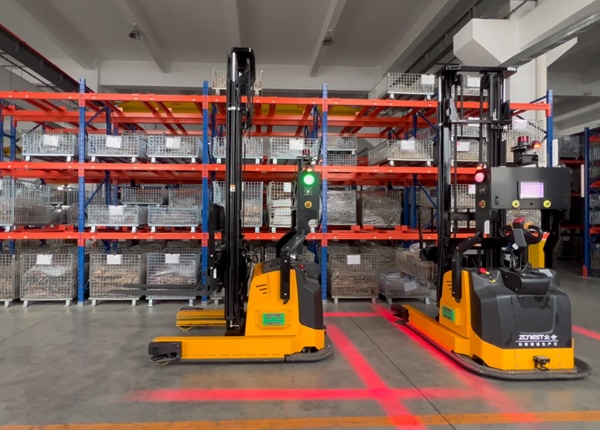
Not every cancelled order requires a return movement. The correct action depends on how far the pallet has progressed through the outbound process.
| Order Status at Cancellation | Required Workflow |
|---|---|
| Order allocated, no AGV task released | Cancel the reservation and verify that the pallet remains in its recorded storage location. |
| AGV task created but movement has not started | Withdraw the task through the dispatch system and confirm that it can no longer be executed. |
| Pallet has left the storage location | Choose an approved destination based on the pallet's actual position and operational status. |
| Pallet has reached outbound staging | Confirm the cancellation, release any applicable reservation, and create a return or reassignment task. |
| Pallet has been loaded or dispatched | Follow the shipment cancellation or physical return process rather than treating it as a normal warehouse return-to-stock task. |
The warehouse management system (WMS) should establish the business decision, while the robot control system (RCS) manages executable movement tasks according to the configured interface. The exact division of responsibility depends on the project's system architecture.
Cancelling an outbound order does not automatically mean that its pallets can be allocated to another customer. The warehouse may still need to verify the physical quantity, pallet identity, product condition, and any customer-specific restrictions.
Use separate status transitions for the order and the inventory. For example, an order can be marked cancelled while the pallet remains reserved, under verification, or in a temporary location. The inventory should become available for new orders only after the relevant checks are complete.
A practical workflow should verify the following:
The cancelled order no longer requires the pallet.
No active AGV movement still owns the pallet's current transport assignment.
The pallet identifier matches the inventory record.
The physical location is confirmed, either by a completed system transaction or an approved verification process.
Any customer-specific, quality, or shipping restrictions have been reviewed before the stock is released.
Key checkpoint: An order cancellation should trigger an inventory-state review, not an unconditional release of stock. The system must distinguish between “order cancelled,” “pallet physically located,” and “inventory available for allocation.”
The original storage position is not always the best destination. It may have been reassigned, blocked, filled by another pallet, or made inaccessible by a changed warehouse condition. An AGV forklift should not be instructed to return a pallet to an address that is no longer valid.
Define destination rules before deployment. A typical priority sequence is:
Original storage location: Use it when the address remains valid, available, compatible with the pallet, and permitted for the inventory.
Approved alternative storage location: Select another compatible position using the warehouse's location rules and storage constraints.
Designated temporary holding area: Use a controlled location when no suitable storage address can be confirmed automatically.
Manual review: Escalate pallets with uncertain identity, damaged packaging, special restrictions, or unresolved inventory discrepancies.
For high-bay warehouses, destination selection must account for rack compatibility, pallet dimensions, load weight, available height, and the reach truck or VNA forklift's operating envelope. The automation system should not choose a location solely because it is the nearest available address.
A frequent failure scenario occurs when an order is cancelled while an AGV task is already in progress. The WMS may issue a return task before the original movement has been confirmed as cancelled. The result can be two active instructions referring to the same pallet.
To prevent this, define a cancellation handshake between the WMS and RCS. The workflow should include a unique task identifier, a cancellation request, a task-state response, and a clear rule for when a replacement task can be released.
A robust sequence is:
Record the order cancellation and freeze new allocations for the affected pallet until its status is reconciled.
Check whether an existing transport task has been created, accepted, started, or completed.
Request cancellation or controlled completion of the existing task, depending on its execution state.
Wait for a confirmed response and reconcile the pallet's actual position.
Create a return task only after the previous task's state is sufficiently clear.
Confirm arrival and complete the inventory-location transaction before making the pallet available again.
If a robot loses communication during a movement, the software should not assume that the pallet remains at its original location. The workflow must follow the project's recovery procedure to establish the actual position before releasing a new task.
Some cancellations affect only part of an order. A customer may reduce the requested quantity, remove selected SKUs, or change the delivery schedule after picking has started. The remaining pallets may still be required, while the excess pallets need to return to available inventory.
The WMS should calculate which pallet assignments remain valid rather than cancelling every task associated with the original order.
For example, if an order originally requires ten pallets and is reduced to six, the workflow should identify the four surplus pallets by their actual pallet IDs. It should then determine whether any of those pallets are already moving or have reached outbound staging. The six retained pallets should continue through the approved outbound process, while the four surplus pallets follow the return-to-stock workflow.
Where a pallet contains mixed products, customer-specific goods, or quantities that cannot be safely reassigned, the system may need to route it to a verification area rather than directly back to ordinary storage.
A return task can fail because a destination becomes unavailable, a route is blocked, a pallet cannot be confirmed, or a robot requires intervention. The warehouse should define how each condition is handled before live operations begin.
| Failure Condition | Recommended Control |
|---|---|
| Destination is unavailable | Re-evaluate approved locations or move to the designated temporary holding area. |
| Pallet identity cannot be verified | Keep the inventory restricted and request an authorized verification. |
| Robot stops during transport | Follow the configured recovery procedure and confirm the actual pallet position before issuing another movement. |
| Inventory and physical location disagree | Prevent reallocation until the discrepancy has been resolved. |
Assign an owner to each recovery condition. Warehouse operations should be responsible for inventory and order decisions, while the automation support team should handle robot or task-state issues according to the agreed support model. Unclear ownership can leave cancelled orders unresolved even when the robot itself is operating normally.
Acceptance testing should cover cancellations at different points in the outbound workflow, not just a successful return from staging to storage. Testing should verify the physical movement, inventory transaction, order state, and task history together.
Use the following checklist during system validation:
Cancel an order before any AGV task is released.
Cancel an order after a task is accepted but before movement starts.
Cancel an order while a pallet is in transit.
Cancel an order after a pallet reaches outbound staging.
Reduce an order quantity while preserving the remaining valid pallet assignments.
Attempt to return a pallet to an unavailable or invalid storage position.
Simulate a communication interruption and verify that duplicate tasks are not created.
Confirm that the final physical location matches the inventory record.
Verify that the pallet cannot be reallocated before required checks are complete.
Confirm that the task history records the cancellation, recovery action, and final outcome.
Agree on expected results for every test case with the warehouse operator, WMS provider, and AGV supplier. The purpose is to confirm that the system handles order changes predictably, including cases where a movement cannot be cancelled immediately.
When evaluating an AGV forklift project, ask the supplier and software team to explain how the system handles outbound cancellations and inventory returns.
Can the system distinguish an unstarted task from a task already in motion?
How does it confirm cancellation before creating a replacement task?
Can the WMS select an alternative storage location when the original position is no longer available?
How are partial order cancellations mapped to individual pallet assignments?
What happens if the robot stops or loses communication during a return movement?
Which system owns the final inventory-location update?
Can operators trace the order cancellation, robot task, and final pallet location in the system history?
These questions help determine whether the proposed solution can handle routine order changes without relying on manual reconciliation for every cancelled shipment. The answer should be demonstrated through workflow design and acceptance tests, rather than based only on a general claim of WMS or RCS integration.
A reliable return-to-stock process links order cancellation, task-state confirmation, destination selection, physical movement, and inventory release. The workflow should keep the pallet unavailable for new allocation until its location and status are confirmed, while allowing unaffected outbound tasks to continue.
For high-bay and narrow-aisle warehouses, destination validation and task coordination are especially important because returning a pallet may involve precise rack access and constrained routes. Define these rules with the AGV supplier and warehouse software team before deployment, then validate them with realistic cancellation scenarios.












 Chinese
 English





