


Empty pallets are essential handling resources, but unmanaged pallet circulation can create congestion, inaccurate counts, and unnecessary manual work. AGV forklifts can automate pallet movements when pallet types, quantities, and destinations are clearly controlled.
Empty pallets are often treated as secondary materials in warehouse automation projects. Yet they are needed at receiving areas, picking stations, production supply points, and outbound operations. If empty pallets are not available when required, normal material handling can be delayed even when the AGV fleet is operating correctly.
Automating empty pallet movements requires a defined circulation process. The warehouse must know which pallet types are available, where they are stored, which areas need replenishment, and how damaged or unsuitable pallets are removed from circulation.
This guide explains how to design an empty pallet management process using AGV forklifts.
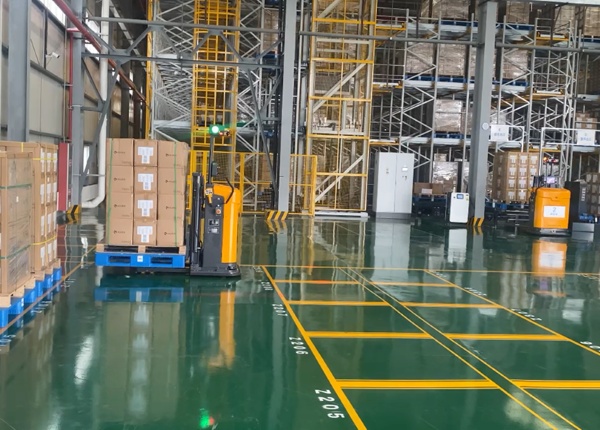
Empty pallets are not always interchangeable. Warehouses may use different dimensions, materials, load ratings, entry configurations, and ownership categories.
Define the pallet categories that the automation system must recognize. For example, a warehouse may distinguish between standard wooden pallets, plastic pallets, export pallets, and dedicated customer-owned pallets.
For each category, document:
External dimensions and pallet height.
Weight and handling characteristics.
Fork entry direction and compatible fork arrangement.
Stacking rules and maximum stack quantity.
Ownership or reuse restrictions.
Conditions that make a pallet unsuitable for automated handling.
These attributes help determine which AGV forklift model and handling configuration are suitable for the pallet pool.
Before deciding where to store empty pallets, identify where they enter and leave the warehouse process.
Typical generation points include receiving stations after goods are unloaded, picking stations after products are removed, and outbound areas after reusable pallets are emptied. Consumption points include inbound preparation, order picking, repacking, and other pallet-based handling operations.
Record the expected pallet type and quantity at each point. This gives the warehouse a basis for designing replenishment rules rather than relying on operators to request pallets only after a shortage occurs.
Empty pallet storage should be designed around pallet type, stack height, access requirements, and the selected AGV forklift's operating envelope.
A dedicated storage area makes it easier to count available pallets and assign replenishment tasks. Where several pallet types are used, separate positions or clearly identified zones can prevent incompatible pallets from being delivered to the wrong operation.
For automated storage, verify that:
Stack height remains within the equipment's approved handling limits.
Pallet stacks are stable and correctly aligned.
Storage positions are identifiable by the warehouse system.
The floor and rack conditions support the intended load.
Collection and replenishment routes do not interfere with other warehouse activities.
Empty pallet delivery should be triggered by a defined requirement. The warehouse can use minimum stock levels, station capacity, confirmed upcoming demand, or operator requests, depending on how predictable the process is.
For example, a picking station may have a minimum quantity of available empty pallets. When the recorded quantity reaches that threshold, the system can request replenishment from the designated pallet storage area.
Define the following parameters:
Minimum and maximum quantity at each consumption point.
Required pallet type.
Approved source storage area.
Delivery position and maximum receiving capacity.
Priority rules when several stations request pallets simultaneously.
The replenishment quantity should account for the receiving station's actual capacity. Delivering more pallets than the station can hold may create congestion instead of improving availability.
Some businesses own their pallets, while others use customer-owned or supplier-returnable pallets. These categories may have different circulation and accounting requirements.
The warehouse management system should record the pallet category and, where necessary, its ownership. If individual pallet tracking is required, each pallet should have a unique identifier. If pallets are managed in batches, the system should still maintain reliable quantity records by type and location.
Do not treat all empty pallets as unrestricted warehouse resources. A pallet reserved for a specific customer or supplier return process may not be available for general use.
Empty pallets may be damaged during handling or become unsuitable after repeated use. The automation workflow should provide a way to remove these units from the reusable pool.
Define inspection criteria for broken boards, damaged blocks, loose components, deformation, contamination, and other conditions relevant to the pallet type. Pallets that fail inspection should be moved to a designated review or disposal area, not returned to ordinary storage.
If the AGV forklift cannot reliably identify pallet condition, assign the inspection decision to an operator or a separate verification process. The system should update the pallet's status before it can be requested again.
Empty pallet tasks often compete for space and equipment capacity with loaded-pallet movements. The warehouse should define how these tasks are scheduled so that empty pallet replenishment does not interfere with critical material handling.
Consider whether empty pallet movements can be grouped by destination, assigned to specific operating periods, or handled by a dedicated vehicle. The best approach depends on travel distances, demand frequency, vehicle capacity, and the overall fleet workload.
The robot control system should receive clear pickup and drop-off instructions, while the WMS maintains the pallet pool's quantity and location records. Task completion should be linked to a confirmed physical handover.
Classify pallet types and handling requirements.
Identify pallet generation and consumption points.
Define dedicated empty-pallet storage positions.
Set minimum and maximum quantities for receiving stations.
Document pallet ownership and reuse restrictions.
Create a process for damaged or unsuitable pallets.
Verify stack stability and AGV handling compatibility.
Test replenishment tasks and inventory quantity updates.
Key checkpoint: Empty pallet availability must be managed by type, quantity, location, and status. A simple count of all empty pallets is not enough when different operations require different pallet specifications.
Can the proposed vehicle handle the warehouse's empty pallet types and stack configurations?
Can the system transport stacked pallets safely under the specified operating conditions?
Can the WMS trigger replenishment based on station-level quantities?
How are pallet ownership and pallet categories represented?
Can damaged pallets be excluded from automated circulation?
How are pallet pickup and drop-off confirmations recorded?
Ask for a demonstration using the actual pallets and stacking conditions from the warehouse. A vehicle that can transport a single empty pallet may not be suitable for handling the warehouse's full pallet circulation process.
Empty pallet management is a recurring warehouse process that deserves the same planning attention as loaded-pallet transportation. Clear pallet classifications, storage rules, replenishment triggers, and inventory records help AGV forklifts support a more predictable material handling operation.





 Chinese
 English