


Planning Vertical Movement Between Different Storage Levels
Some warehouses operate across multiple floors or elevated storage areas. Moving pallets between these levels introduces additional engineering and control requirements beyond ordinary horizontal transport. AGV forklift projects must consider the vertical transfer method, load limits, floor transitions, and how transport tasks are coordinated between levels.
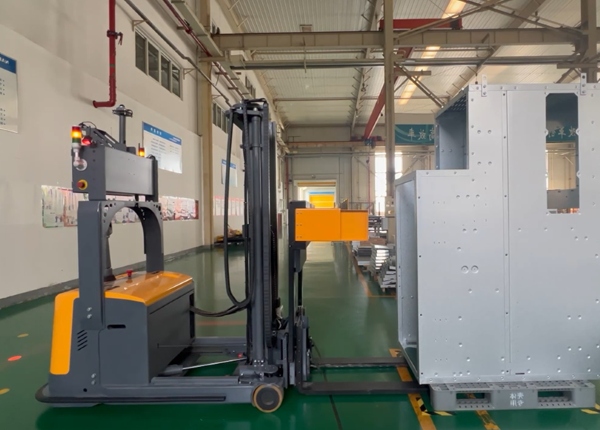
A multi-floor warehouse may use freight elevators, dedicated lifting platforms, or engineered ramps to move materials between levels. Each method creates different requirements for AGV forklift compatibility and transport control.
Freight elevators provide a controlled vertical transfer point but require accurate positioning and coordination with elevator controls. Ramps may allow continuous movement between levels, but their gradient, surface condition, and available turning space must be evaluated against the equipment's specifications.
The project should select the transfer method based on the building structure, load characteristics, equipment design, and expected movement volume.
If ramps are used, the slope must be checked against the AGV forklift manufacturer's approved operating limits. The assessment should consider both loaded and unloaded travel, because vehicle behavior and traction requirements may differ.
Other important factors include ramp width, surface material, joints, drainage, floor transitions, and turning space at the top and bottom. A ramp that appears physically accessible may still be unsuitable for a particular loaded vehicle configuration.
The equipment supplier should validate the proposed gradient and operating conditions for the specific vehicle. Do not assume that a standard AGV forklift can safely operate on every warehouse ramp.
Where freight elevators are used, the AGV system needs a defined method for requesting access, confirming elevator availability, entering, exiting, and reporting transfer completion.
The interface may involve elevator call signals, door status, floor selection, access permissions, and confirmation that the elevator is ready for vehicle entry. The exact control method depends on the elevator equipment and the site's automation architecture.
The elevator dimensions, rated capacity, doorway clearance, and floor-level alignment should be checked against the AGV forklift and its load. Include any required safety interlocks and emergency procedures in the project design.
A transport task that starts on one floor and finishes on another may involve several control stages. The WMS identifies the inventory movement, while the AGV control system coordinates the vehicle's physical actions and the vertical transfer process.
The workflow should define when the pallet is considered delivered to the elevator, when the vertical transfer is complete, and when the receiving floor can accept the next movement.
If the elevator is unavailable or a transfer is interrupted, the system needs a defined task status and recovery procedure. This prevents the warehouse from treating a pallet as delivered to its final destination before the physical movement is complete.
Vertical transfer points can become bottlenecks if too many AGV tasks depend on a single elevator or platform. The project should estimate the number of pallet transfers required during normal and peak operating periods.
The calculation should include elevator travel time, door opening and closing, vehicle entry and exit, loading or unloading, and any required confirmation steps. It should also consider whether the elevator is shared with personnel or other material-handling equipment.
If the transfer capacity is insufficient, possible responses include adjusting task release rates, adding suitable buffer positions, changing operating schedules, or reviewing the vertical transport design.
The transition between floors can introduce small gaps, level differences, or alignment variations. These conditions may affect fork entry, vehicle movement, and load stability.
Test the AGV forklift at the actual transfer points with representative loads. Verify the approach path, positioning tolerance, door clearance, transfer sequence, and recovery behavior when the elevator or platform is unavailable.
The test should also confirm that the vehicle can stop safely and maintain its approved operating condition during each transfer stage.
Key Project Checkpoint
Provide the supplier with floor plans, ramp gradients or elevator specifications, load dimensions, and expected transfer volume. Validate the complete vertical transfer process using the actual equipment and representative loads.
Number of operating floors and their connection points.
Freight elevator dimensions, rated capacity, and interface details.
Ramp gradient, width, surface condition, and turning space.
Maximum pallet weight and overall load dimensions.
Expected pallet transfers per hour or per shift.
Elevator access rules and emergency procedures.
WMS and AGV control requirements for cross-floor tasks.
Multi-floor automation requires the vehicle, building infrastructure, vertical transfer equipment, and warehouse software to operate as one coordinated process. The transfer method should be selected and validated before finalizing fleet configuration and operating capacity.
ZCNest Robotics provides AGV and AMR forklift solutions for warehouse automation. Project evaluation can include vertical transport interfaces, vehicle compatibility, load requirements, route planning, and warehouse control integration.
Send your warehouse floor plans, elevator or ramp specifications, and pallet handling requirements for an initial AGV forklift assessment.












 Chinese
 English





