


Connecting Pallet-Level Transport with Carton and Piece-Level Inventory
A warehouse may store goods by pallet while managing inventory in cartons, cases, or individual pieces. This difference becomes important when AGV forklifts automate pallet movement. The physical transport task and the inventory quantity update must refer to the same handling unit and follow a consistent conversion process.
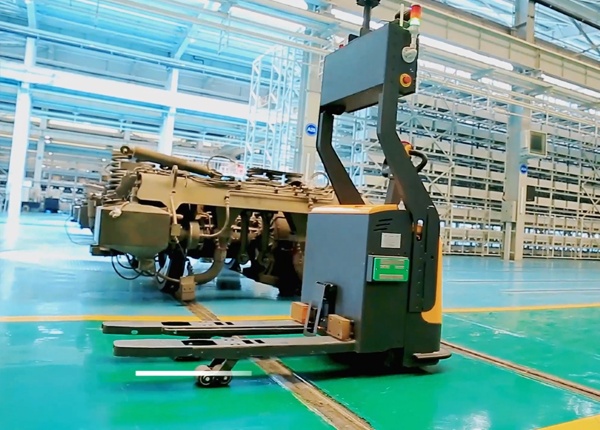
An AGV forklift generally moves a physical load carrier, such as a pallet or dedicated container. The WMS may manage the goods on that pallet using several units of measure, including pieces, cartons, cases, or kilograms.
For example, one pallet may contain multiple cartons, with each carton containing a defined number of individual products. The AGV task moves the pallet as one handling unit, while the inventory system may need to update quantities at a different level.
If these concepts are not separated, warehouse transactions can become inconsistent. A pallet may be physically moved successfully while the inventory record is updated incorrectly.
The warehouse should define how units are converted for each product category. A standard conversion may specify how many pieces are contained in one carton and how many cartons are contained on a full pallet.
However, not every pallet is necessarily full. Partial pallets, mixed cartons, repacked goods, and damaged packaging may create exceptions to standard conversion rules.
The WMS should maintain the actual quantity and packaging structure of each handling unit rather than assuming that every pallet follows the same standard configuration.
A pallet identifier represents a physical handling unit. Product codes and quantities describe the inventory contained within it. These records are related but serve different purposes.
When an AGV forklift retrieves a pallet, the task should reference the correct pallet or handling-unit identifier. The WMS can then update the pallet's location while preserving the product quantities associated with that handling unit.
If cartons are removed or added at a repacking station, the warehouse system should update the pallet contents before another automated task is issued. This prevents the physical pallet and its recorded inventory from gradually becoming inconsistent.
Partial pallets are common in warehouses that support order fulfillment, production supply, or repacking. A pallet may contain fewer cartons than its standard configuration, or several products may share one load carrier.
The AGV forklift still needs to handle the physical load according to its dimensions, weight, and stability. The WMS must separately manage the actual inventory quantity and any product allocation rules.
Mixed pallets may require additional identification and storage rules. If the warehouse cannot reliably determine the contents of a pallet, the system should route it through a verification process rather than treating it as a standard full pallet.
The interface between warehouse software and AGV control should distinguish physical movement instructions from inventory transactions.
A movement task may contain the handling-unit identifier, source location, destination location, and transport priority. Inventory updates should be managed according to the WMS transaction rules, using the task result to confirm that the physical movement has been completed.
The integration should also define how duplicate messages, interrupted tasks, and uncertain task completion are handled. This is important because a repeated message must not cause the same inventory movement to be recorded twice.
Acceptance testing should include full pallets, partial pallets, and mixed-product handling units where these are part of the warehouse process.
For each test, verify that the AGV moves the correct physical pallet, the WMS updates its location, and the product quantities remain accurate. Include cases where goods are added or removed between two automated movements.
Also test interrupted tasks and repeated interface messages to ensure that the warehouse does not create duplicate inventory transactions.
Key Project Checkpoint
Define the relationship between pallet IDs, product quantities, and units of measure. Test full, partial, and mixed pallets to verify that physical AGV movements and WMS inventory updates remain synchronized.
Does the warehouse manage inventory by piece, carton, case, or pallet?
How are standard unit conversion rules maintained?
Are partial pallets and mixed-product pallets permitted?
How are pallet identifiers linked to product quantities?
Which system owns the inventory location update?
How are interrupted or repeated AGV task messages handled?
How are inventory changes recorded after repacking?
A successful AGV project must maintain consistency between the physical handling unit and the inventory records it represents. Clear unit conversion rules, reliable pallet identification, and well-defined software responsibilities help prevent errors during automated movement.
ZCNest Robotics provides AGV and AMR forklift solutions for automated warehouse operations. Project planning can include pallet-level transport, WMS integration, task feedback, and inventory-related interface requirements.
Share your pallet structure, inventory units, and warehouse software requirements to discuss an integrated AGV forklift project.












 Chinese
 English





