


Picking operations depend on having the right inventory available at the right time. AGV forklifts can replenish picking areas automatically, but replenishment rules must reflect actual consumption, station capacity, and warehouse stock availability.
In warehouses with pallet-based picking, operators or automated picking equipment may consume inventory faster than the picking area can be replenished. If a required pallet is not available, order processing can be delayed even when sufficient stock exists elsewhere in the building.
Automated replenishment connects picking demand with pallet transportation. The key decision is when to create a replenishment request, how much inventory to deliver, and which source location should supply it.
This guide explains how to design replenishment triggers for AGV forklift operations.
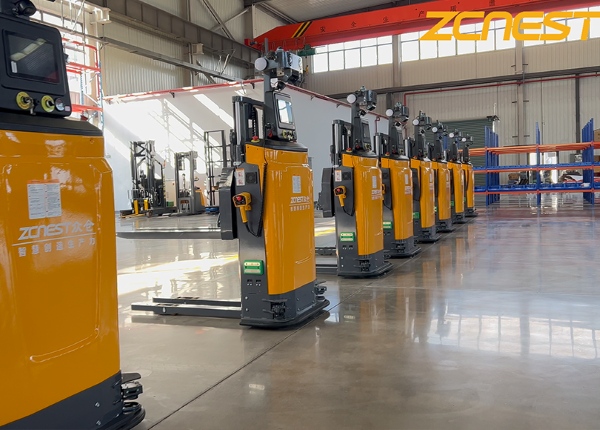
Replenishment requirements vary by SKU, picking method, and station workload. A high-volume item may need frequent replenishment, while a slow-moving product may remain available for several shifts.
Collect consumption information for each picking position. Useful data includes:
Average quantity consumed during a defined operating period.
Peak consumption during high-demand periods.
Number of picking orders using the position.
Time required to transport a replacement pallet.
Maximum quantity that the picking position can hold.
Use actual operating data where available. Estimates based only on total warehouse throughput may not accurately reflect demand at individual picking stations.
A minimum stock level determines when replenishment should begin. A maximum stock level defines how much inventory can be held at the picking position.
The minimum should account for expected consumption during the replenishment lead time. If it is too low, the picking position may run out before the AGV forklift arrives. If it is too high, the station may become crowded with pallets that are not immediately required.
The maximum should reflect the physical capacity of the position and the operational space available around it. In automated areas, station capacity must include safe pallet access and robot maneuvering requirements, not just the number of floor positions.
A practical trigger can compare the current available quantity with the expected consumption during the time needed to replenish the position.
For example, if a picking station has 12 cartons remaining and expected consumption before the next pallet arrives is 8 cartons, the warehouse may decide that replenishment should already be initiated. The exact threshold depends on lead time, demand variability, and the amount of stock that can be held at the station.
Consider these factors when setting the trigger:
Expected consumption during AGV travel and task execution.
Availability of source pallets in reserve storage.
Possible delays caused by traffic or task competition.
Receiving capacity at the picking position.
Whether replenishment can be scheduled in advance of known demand.
A trigger should be tested under both normal and peak picking conditions. One threshold may not be suitable for every SKU or station.
Once the trigger is reached, the system must determine the replenishment quantity. Delivering one pallet may be sufficient for some items, while others may require multiple pallets to cover the expected workload.
Set quantity rules based on station capacity, source inventory, pallet configuration, and anticipated consumption. Do not release more pallets than the picking area can accept.
Where a picking position can hold only one reserve pallet, the replenishment logic should avoid sending another pallet while the existing delivery is still in progress. The system should consider both the confirmed stock and the quantity already assigned to incoming tasks.
Duplicate replenishment can occur when the stock level remains below the trigger while an earlier AGV task is still moving toward the station. If the system checks only the current physical quantity, it may generate repeated requests.
Include pending replenishment quantities in the calculation. The WMS or warehouse execution layer should distinguish between available stock, stock currently being replenished, and stock that has been physically received.
Each replenishment request should have a traceable task reference and a clear completion state. A new task should be created only when the previous request no longer covers the outstanding demand.
Replenishment is not complete simply because a pallet of the correct SKU is available. The selected pallet may also need to satisfy batch, ownership, quantity, quality, or customer-specific requirements.
Define the selection logic in the WMS. The system should identify a valid source pallet and its storage location before sending the task to the robot control system (RCS).
For high-bay warehouses, the source selection should also consider the physical compatibility between the pallet and the storage location. The AGV forklift must be able to retrieve the selected pallet under the specified load and lifting conditions.
Some picking stations experience steady consumption, while others have demand that changes sharply according to order release patterns.
For stable demand, a fixed minimum quantity may be sufficient. For variable demand, the warehouse may use scheduled replenishment, order-based triggers, or a combination of current stock and confirmed upcoming requirements.
Review replenishment settings when product demand changes significantly, picking methods are modified, or the station's physical capacity is adjusted. The objective is to avoid both frequent emergency replenishment and unnecessary pallet deliveries.
Measure consumption by picking position and SKU.
Define minimum and maximum stock levels.
Calculate replenishment lead time.
Set replenishment quantities according to station capacity.
Include pending tasks in stock calculations.
Define source pallet selection rules.
Test duplicate request prevention.
Verify receipt confirmation and inventory updates.
Review thresholds under different demand conditions.
Key checkpoint: Replenishment calculations should include both physical stock and confirmed incoming stock. Otherwise, the system may create multiple AGV tasks for the same shortage.
Can the WMS monitor stock levels at individual picking positions?
Can replenishment triggers vary by SKU or station?
Are pending AGV deliveries included in the replenishment calculation?
Can the system select source pallets based on batch and inventory restrictions?
How does the system respond when the picking position is full?
Can operators review and adjust replenishment parameters?
Ask the supplier to demonstrate replenishment using real warehouse consumption patterns and representative pallet configurations. This provides a more reliable basis for selecting the AGV fleet and defining the software requirements.
Automated picking replenishment works best when stock thresholds, delivery quantities, source selection, and pending tasks are managed together. With these rules in place, AGV forklifts can supply picking positions based on actual requirements rather than relying entirely on manual requests.












 Chinese
 English





