


Automated warehouse movements depend on accurate inventory allocation. Reservation rules determine which pallets belong to which orders, when stock can be assigned, and when an AGV forklift is allowed to execute a transport task.
A warehouse may contain sufficient stock to fulfill several customer orders, but not every pallet is available for every order. Some inventory may already be reserved, assigned to another customer, restricted by batch requirements, or waiting for verification.
If reservation rules are unclear, an AGV forklift may receive a task for a pallet that is physically present but not eligible for the requested operation. This can cause unnecessary movements, allocation conflicts, and order delays.
This guide explains how to define inventory reservation rules for warehouses using AGV forklifts.
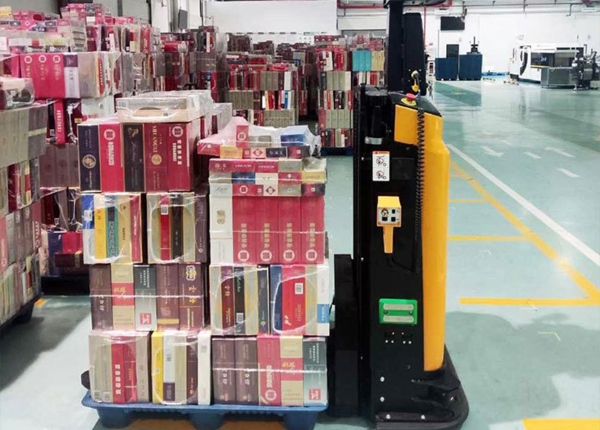
Physical stock represents the goods that exist in the warehouse. Available stock represents the portion that can be allocated to a new requirement under the warehouse's business rules.
These quantities may differ because inventory can be reserved, blocked, under inspection, or assigned to another process.
The WMS should maintain distinct inventory states so that the AGV system does not treat every physically stored pallet as freely available. A pallet may exist at a confirmed rack location but still be ineligible for a new outbound task.
Reservation should be based on the requirements of the order and the attributes of the inventory.
Common reservation conditions include:
SKU and product specification.
Required batch or lot number.
Customer or ownership restrictions.
Quantity and unit of measure.
Quality status and inspection result.
Pallet condition and handling compatibility.
Order priority and delivery requirements.
Define which conditions are mandatory and which can be used as allocation preferences. This prevents the system from selecting a pallet that matches the SKU but violates a more important inventory restriction.
A reservation can be created at different stages of the order process. Some warehouses reserve stock when an order is confirmed, while others reserve it closer to the picking or retrieval stage.
The appropriate approach depends on inventory turnover, order stability, and the possibility of order changes.
Document the event that creates the reservation and ensure that the same inventory cannot be assigned to another order while the reservation is active. The system should also distinguish between a reservation and an actual AGV transport task. Reserving a pallet does not necessarily mean that the robot should move it immediately.
For pallet-based automation, the reservation should be traceable to the actual handling unit. A general reservation for a product quantity may not be sufficient when different pallets have different batches, locations, or handling restrictions.
When the WMS selects a specific pallet, record the relationship between its pallet ID, the order reference, and the required quantity. The AGV task should reference the approved pallet and its current location.
If the selected pallet becomes unavailable, the system should release or revise the reservation according to defined rules before assigning a replacement pallet.
Inventory may be reserved for one order while a separate process is preparing to move it. The warehouse must account for active tasks and pending transactions when determining whether stock can be allocated again.
For example, a pallet may be reserved for an outbound order and already have an AGV retrieval task in progress. A second order should not be able to reserve the same pallet simply because its location record has not yet changed.
Use a consistent inventory locking or reservation mechanism. The WMS should check both current reservation status and relevant active task assignments before making a new allocation.
Reservations should not remain active indefinitely after an order is cancelled, reduced, or otherwise changed.
Define release conditions for the following situations:
The order is cancelled before a transport task is created.
The order quantity is reduced.
The selected pallet fails verification.
The inventory becomes restricted or unavailable.
A replacement pallet is assigned.
The order is completed and the reservation is no longer required.
Where an AGV task is already active, the reservation should not be released in a way that allows another order to use the same pallet before its physical status has been reconciled.
A reserved pallet may be eligible for a particular movement but not for every warehouse operation. For example, stock reserved for an outbound order may be eligible for retrieval to a picking or dispatch area but not for reassignment to another customer.
Define task eligibility separately from general inventory availability. The WMS should validate the business purpose of a movement, while the RCS should receive an executable task with a valid source, destination, and pallet reference.
This separation is particularly important in high-bay warehouses, where retrieving a pallet from a rack creates a physical movement that may be costly to reverse if the original allocation was incorrect.
Separate physical stock from available stock.
Define mandatory reservation attributes.
Specify when reservations are created.
Link reservations to individual pallet IDs where required.
Prevent duplicate allocation of the same pallet.
Define release rules for changed or cancelled orders.
Check active tasks before releasing reservations.
Validate task eligibility before sending instructions to the RCS.
Maintain traceable reservation and release records.
Key checkpoint: A pallet should be assigned to one valid inventory requirement at a time. Reservation, physical movement, and task eligibility must be coordinated to prevent conflicting instructions.
Can the WMS reserve inventory by individual pallet ID?
How does the system prevent one pallet from being allocated to two orders?
Can reservations consider batch, ownership, and quality restrictions?
What happens when a reserved pallet becomes unavailable?
How are reservations coordinated with active AGV tasks?
Can operators review reservation history and release reasons?
Ask the providers to demonstrate competing orders requesting the same inventory. This test can reveal whether the allocation process correctly protects reserved stock before automated movement begins.
Inventory reservation is a foundation of reliable warehouse automation. By separating physical stock, available stock, reserved inventory, and task eligibility, businesses can prevent allocation conflicts and ensure that AGV forklifts move pallets for valid warehouse requirements.












 Chinese
 English





