


Large warehouses often divide operations into separate zones for receiving, storage, picking, inspection, and dispatch. Moving pallets between these areas requires clear transfer rules, reliable handoff points, and accurate inventory records. AGV forklifts can automate these movements when the responsibilities of each zone are properly defined.
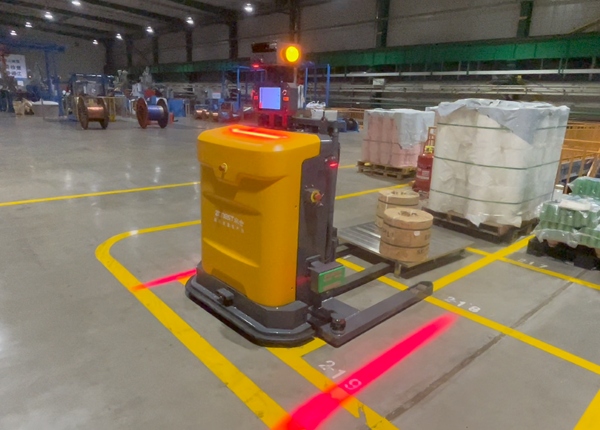
A pallet may pass through several departments before it reaches its final destination. For example, inbound receiving may transfer goods to inspection, inspection may release them to storage, and storage may later supply a picking or dispatch area.
When these movements are handled manually, warehouse staff often coordinate transfers through radio calls, paper instructions, or local operating procedures. An AGV forklift project can replace much of this coordination with structured transport tasks, but only if each department has clearly defined responsibilities.
Start by documenting what each warehouse zone is responsible for and which pallet conditions it can accept.
Receiving zone: Accepts incoming pallets and confirms receipt information.
Inspection zone: Checks goods that require quality, quantity, or packaging verification.
Storage zone: Holds inventory in approved rack positions.
Picking zone: Supplies goods for order preparation.
Dispatch zone: Receives completed outbound pallets for shipment processing.
For each zone, define permitted pallet types, maximum load dimensions, available positions, and the conditions required before a pallet can leave. This prevents the AGV system from delivering loads to areas that cannot process them.
Each inter-zone transfer needs a defined pickup and delivery point. These positions should be identifiable in both the physical warehouse and the WMS or fleet control system.
Review the following requirements:
Position ID and physical location.
Number of pallets that can wait at the position.
Permitted pallet dimensions and weight.
Vehicle access and turning requirements.
Whether the position is shared with manual equipment.
Who confirms that the pallet is ready for collection.
Transfer points should be placed where vehicles can approach and leave without obstructing department work. In narrow-aisle warehouses, keep cross-zone handoff activity outside critical rack aisles wherever possible.
A physical transfer is not complete simply because the pallet reaches another zone. The receiving department must be ready to accept the load, and the system must record the handoff.
Establish a consistent process:
The sending department confirms that the pallet is ready.
The WMS validates the destination and creates a transfer request.
The AGV fleet receives the movement instruction.
The vehicle collects the pallet and transports it to the receiving zone.
The destination position is confirmed as occupied by the correct pallet.
The receiving department or system acknowledges acceptance.
The WMS updates the pallet's location and operational status.
For departments with different operating procedures, define who is responsible for the final confirmation. This avoids situations where the sending team assumes the pallet has been accepted while the receiving team has no record of its arrival.
Some warehouses assign inventory responsibility to individual departments or operating zones. During a transfer, the system must identify whether ownership changes when the pallet leaves the sending zone, arrives at the destination, or is formally accepted.
Define the transaction rules for:
Current inventory location.
Sending department and receiving department.
Transfer task reference.
Actual pickup and delivery confirmation.
Inventory status before and after the transfer.
The WMS should remain the authoritative source for inventory records. The AGV control system reports physical task execution, while the WMS applies the appropriate inventory and departmental status changes.
A destination may be temporarily unavailable because the department is busy, the transfer point is occupied, or the receiving process has not been completed.
Define what the system should do in each situation:
Hold the task before dispatch if the destination is not available.
Reassign an authorized alternative transfer point when permitted.
Keep the pallet in a controlled holding area if the original destination cannot accept it.
Notify the responsible department when a transfer remains pending.
Prevent repeated dispatch attempts that would create unnecessary traffic.
Do not allow an AGV forklift to select an arbitrary empty floor position as a substitute destination. Any alternative location must be recognized by the warehouse system and approved for the pallet type.
Inter-zone movements compete for vehicle capacity with putaway, retrieval, replenishment, and outbound transport. The WMS and fleet control system should apply dispatch rules that reflect actual operational priorities.
Consider:
Whether the transfer is required to release a blocked operating area.
Whether the receiving zone has sufficient capacity.
How long the pallet can remain at the source position.
Whether the route passes through a high-traffic intersection.
Whether the task can be grouped with other movements without delaying urgent work.
Set priorities according to business requirements rather than assigning every zone transfer the same priority. This helps prevent routine movements from interfering with time-sensitive warehouse operations.
Different departments may have different permissions for creating, modifying, or cancelling transfer requests. These permissions should be defined before the system goes live.
For example, a receiving operator may confirm that a pallet is ready for transfer, while only an authorized supervisor can change its destination. An automation engineer may investigate fleet execution problems but should not independently modify inventory quantities.
Clear permissions reduce accidental changes and make it easier to trace decisions when a transfer is disputed.
Test transfers between every major pair of warehouse zones before enabling routine automated operations.
Each zone has defined operating boundaries and accepted load types.
Pickup and delivery points are mapped in the system.
Sending and receiving responsibilities are assigned.
Inventory location changes are confirmed correctly.
Occupied or unavailable destinations have defined responses.
Transfer tasks cannot be duplicated or incorrectly reassigned.
Movement records can be traced from source to destination.
Key checkpoint: A successful zone transfer requires both physical delivery and system acceptance. The pallet's actual destination, receiving department, and inventory record must agree before the transfer is considered complete.
Calculate the expected number of inter-zone pallet movements and the distance between transfer points. These movements should be included in the daily and peak-period workload used to evaluate fleet size.
For high-bay warehouses, distinguish between horizontal transfers across zones and rack putaway or retrieval tasks. The vehicle configuration, lifting requirements, route access, and task frequency may differ significantly.
Review these requirements with the AGV supplier before finalizing vehicle quantities and system configuration.
Automating warehouse zone transfers requires more than connecting two physical locations. Each department needs defined handoff responsibilities, valid transfer positions, inventory update rules, and a process for unavailable destinations.
ZCNest Robotics provides AGV forklift solutions for automated pallet transportation and warehouse operations. Share your warehouse zone layout, pallet specifications, movement volume, and WMS requirements to discuss a suitable solution.












 Chinese
 English





