


Empty pallets are essential operating resources in warehouses. When collection, storage, and redistribution are poorly coordinated, workers may spend significant time searching for pallets or moving them manually. A well-planned AGV forklift workflow can make empty pallet circulation more predictable and easier to manage.
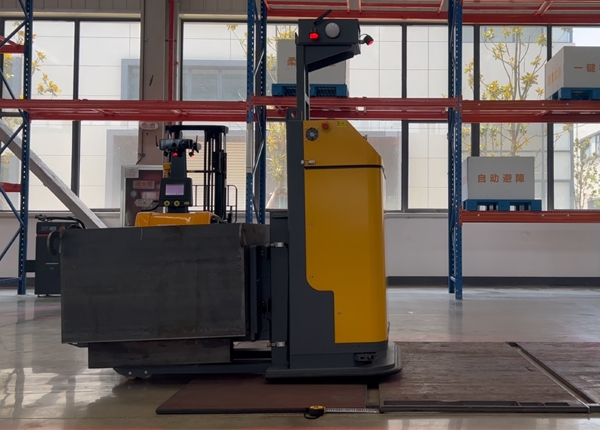
Empty pallets often move through a warehouse more frequently than managers expect. After goods are unloaded, picked, repacked, or dispatched, pallets must be collected and returned to a usable location. If this process depends entirely on manual handling, empty pallets can accumulate in work areas while other departments experience shortages.
Automating empty pallet movement requires more than assigning an AGV forklift to collect pallets. The warehouse must define where empty pallets are accepted, how they are identified, where they can be stored, and which departments have priority when supplies are limited.
Start by mapping every operation that produces empty pallets. Typical sources include:
Inbound receiving areas after goods are unloaded or transferred.
Order picking stations where products are removed from full pallets.
Repacking and inspection areas where loads are transferred to different packaging.
Outbound preparation areas after goods are consolidated or loaded.
Production or warehouse interfaces where reusable pallets are returned.
For each source, record the average number of empty pallets generated per hour, the pallet types involved, and the space available for temporary collection. Peak periods should be considered separately from daily averages.
This information helps determine whether one collection point can serve several departments or whether each area needs a designated pallet return location.
Not every empty pallet should enter the same storage flow. Warehouses may use different pallet dimensions, materials, load ratings, or customer-specific specifications. Mixing incompatible pallets can create problems when they are later assigned to storage, picking, or shipping operations.
Define clear handling categories before configuring automated transport:
| Pallet category | Recommended handling |
|---|---|
| Standard reusable pallets | Return to designated reusable pallet storage. |
| Customer-specific pallets | Keep separated for the relevant customer or order group. |
| Damaged pallets | Send to a manual inspection or repair area. |
| Non-standard pallets | Use a separately defined handling process. |
The classification method can use barcode labels, RFID, operator confirmation, or predefined collection locations. The appropriate method depends on the warehouse's existing identification system and the level of tracking required.
Empty pallet locations should be designed around actual warehouse traffic. A collection point that is too far from the source increases travel distance, while a location placed in a busy aisle may interfere with other forklift movements.
When planning collection points, consider:
Distance from pallet-generating workstations.
Available floor space and permitted stacking height.
Access for AGV forklifts and manual equipment.
Separation between different pallet categories.
Maximum accumulation before collection is required.
Safe access for inspection and manual intervention.
For high-bay warehouses, empty pallet storage should also be evaluated against rack design, load specifications, and the capabilities of the selected forklift AGV. A storage position suitable for full pallets is not automatically suitable for every empty pallet configuration.
Collection is only half of the process. Empty pallets must be available where warehouse operations need them. Without a redistribution plan, a warehouse may have a large empty pallet stock in one area while another department waits for supplies.
Define the receiving departments and their replenishment conditions. For example, a picking area may request a new empty pallet when its available quantity falls below a specified threshold. An outbound preparation area may request pallets according to its planned workload.
Dispatch rules should account for:
Current empty pallet inventory at each receiving point.
Demand from different departments.
Distance and traffic conditions between storage and destination.
Pallet type compatibility with the receiving operation.
Whether the request is urgent or can be grouped with another transport task.
These rules help prevent unnecessary movements while ensuring that critical work areas receive pallets before their supply is exhausted.
When empty pallets are reusable assets, their quantity and location should be visible to the relevant warehouse management processes. Otherwise, the physical pallet stock may differ from the quantity recorded in the system.
Before deployment, determine which system is responsible for each data item:
WMS: Maintains pallet inventory records, storage locations, and department requirements where these functions are included in the warehouse process.
RCS or fleet management system: Coordinates AGV task assignment, vehicle movement, and transport execution.
WCS: Coordinates equipment or material-handling processes where required by the system architecture.
Define when a pallet is considered collected, stored, reserved, or delivered. For example, a delivery task should not be treated as completed simply because an AGV forklift has arrived at the destination. The process should include confirmation that the pallet has been placed at the designated position.
The software interface should also define how failed tasks, missing pallets, and incorrect pallet types are reported. These conditions need clear ownership so that inventory records can be corrected without creating duplicate transport requests.
Fleet planning should consider empty pallet movements as part of the total warehouse workload. Ignoring these movements can lead to an undersized AGV fleet or insufficient transport capacity during busy periods.
Estimate the daily number of empty pallet movements and the time required for each transport cycle. Include pickup, travel, placement, confirmation, and any necessary waiting time.
A basic planning estimate is:
Estimated AGV workload for empty pallet movements
Total workload hours = Daily empty pallet movements × Average cycle time per movement
For example, if a warehouse expects 120 empty pallet movements per day and each movement takes an average of 5 minutes, the estimated transport workload is 600 minutes, or 10 vehicle-hours. This is a workload estimate, not a final fleet-size calculation. Actual capacity must also account for operating hours, charging, traffic, task variation, and vehicle availability.
Measure actual cycle times during a representative operating period before finalizing fleet configuration.
A pilot should cover more than one collection point. Test the complete circulation loop, from the moment an empty pallet becomes available to the moment it is delivered to another department.
Check the following scenarios:
Normal pallet collection and return.
High-volume periods when several departments request pallets simultaneously.
Temporary blockage of a collection or storage location.
Incorrect pallet type presented at a pickup point.
Damaged pallets that must be diverted from normal circulation.
Software task cancellation or destination changes.
Record collection delays, missed requests, unnecessary travel, and manual interventions. These observations help determine whether the issue comes from the physical layout, pallet identification, inventory rules, or AGV dispatch configuration.
List all departments and workstations that generate empty pallets.
Measure average and peak empty pallet volumes.
Classify pallets by size, type, ownership, and condition.
Confirm collection points and storage capacity.
Define replenishment rules for receiving departments.
Clarify WMS, RCS, and WCS responsibilities.
Calculate transport workload using actual cycle-time estimates.
Test abnormal conditions and manual recovery procedures.
Key checkpoint
An effective empty pallet workflow must balance collection, storage, and redistribution. Automating only the collection stage can simply move pallet congestion from one department to another. Plan the complete circulation loop and connect physical movements with clear inventory and dispatch rules.
Empty pallet circulation can be integrated into a broader warehouse automation project involving pallet transport, putaway, retrieval, and interdepartmental material handling. The right configuration depends on pallet specifications, aisle width, travel distance, storage height, traffic conditions, and software requirements.
ZCNest Robotics provides AGV forklift and warehouse automation solutions for B2B warehouse applications. Share your warehouse layout, pallet dimensions, daily movement volume, and operating requirements to discuss suitable equipment and workflow options.












 Chinese
 English





