


A pallet that has been partially picked is no longer identical to the original stored load. Its quantity, weight, packaging, and handling requirements may have changed. Automated transport must reflect the pallet's new physical and inventory status.
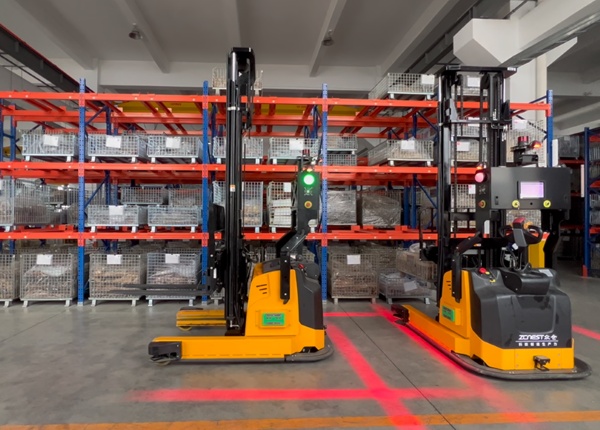
In warehouses that pick individual cases or units from pallet storage, a pallet may be retrieved, partially emptied, and then returned to storage or moved to another processing area. This creates a transport requirement that is different from handling a full pallet.
The remaining load may be lighter, unevenly distributed, or less stable. Its original pallet label may still be valid, but the quantity and inventory status must be updated. If the warehouse system continues to treat it as a full pallet, automated storage and picking processes can make incorrect decisions.
AGV forklifts can handle the physical movement of partially picked pallets, provided that the warehouse defines how the load is identified, inspected, assigned, and released for transport.
The warehouse should maintain a clear status for pallets that have been opened or partially picked. This status may include remaining quantity, packaging condition, picking completion state, and the next permitted operation.
Typical categories include:
Partial pallet ready for return: Picking is complete and the remaining load can be transported.
Partial pallet awaiting verification: The physical quantity or system quantity needs confirmation.
Partial pallet requiring repacking: The remaining products need additional wrapping, strapping, or load stabilization.
Partial pallet assigned to another order: The remaining quantity has a new allocation and destination.
Unusable or damaged remainder: The pallet must be moved to a controlled review area.
These statuses should determine which transport and storage tasks are permitted. A partially picked pallet should not automatically return to its original rack position simply because that was its previous location.
After picking, the warehouse needs to know what remains on the pallet. Depending on the operation, this may be confirmed through scanning, weighing, manual verification, or an integrated picking transaction.
At minimum, the system should preserve the pallet identity and update the remaining quantity. If the load's physical condition has changed, the process should also determine whether it remains suitable for automated fork handling.
Do not assume that a reduced quantity always means a lower handling risk. A pallet with products concentrated on one side can be less stable than a full pallet. Open cartons, loose packaging, or excessive overhang may also affect safe transport.
Partially picked pallets may have several possible destinations. They may return to a designated partial-pallet storage zone, move to a repacking station, proceed to another picking area, or remain at a verification point.
The WMS should select an eligible destination based on product identity, remaining quantity, storage rules, demand, and location availability. The AGV control system should receive a specific pickup and delivery instruction.
For high-bay warehouses, confirm that the remaining pallet meets the rack's storage and handling requirements. If the pallet is no longer suitable for its original storage location, the system should select an approved alternative rather than forcing a return to the previous position.
A partial pallet can create inventory errors when the original full-pallet record is not updated correctly. For example, the warehouse may record the picked quantity as consumed while leaving the original pallet quantity unchanged. The remaining stock can then be counted twice or allocated incorrectly.
Use a consistent transaction sequence: confirm the picking result, update the remaining quantity, confirm the pallet's new status, and then release the next transport task. The exact sequence depends on the WMS architecture, but the business rule should be unambiguous.
Where a pallet is split into multiple handling units, each resulting unit should have a traceable identity. The system should not reuse one pallet ID for several physically separate loads unless the identification design explicitly supports that arrangement.
AGV forklift selection should account for the actual load conditions after picking, not only the original full-pallet specification. Evaluate minimum and maximum load weights, pallet dimensions, load center, fork entry, and the stability of remaining cartons or containers.
For elevated storage, the warehouse should define whether partially picked pallets can be stored at the same lift heights as full pallets. Load stability, packaging integrity, and rack compatibility should be checked before the automated task is approved.
Where partial pallets require wrapping or repacking, the AGV should deliver them to a designated station and wait for a new authorized task after the process is completed.
The WMS should remain the source of truth for inventory quantity, allocation, and storage eligibility. The RCS should manage vehicle dispatch and transport execution according to the task information it receives.
A typical sequence may include:
The picking system reports that a pallet has been partially picked.
The WMS updates the remaining quantity and pallet status.
The WMS identifies an eligible next destination.
A transport task is sent to the RCS.
The AGV forklift picks up and transports the pallet.
The destination is confirmed and the transport task is closed.
The warehouse system records the pallet's new location.
Define how the interface handles duplicate messages, task cancellation, destination changes, communication interruptions, and failed pickup attempts. These rules are especially important when the warehouse operates continuously across multiple shifts.
Confirm the following before automation:
Partial-pallet status is distinct from full-pallet status.
Remaining quantity is confirmed before the next movement.
Each physical handling unit has a traceable identity.
Destination rules account for quantity and product allocation.
Unstable or damaged loads are routed for repacking or inspection.
High-bay storage eligibility is checked before putaway.
WMS inventory transactions and RCS transport tasks are synchronized.
Duplicate, cancelled, and interrupted tasks have defined handling rules.
Key checkpoint: A partially picked pallet must be treated as a newly verified handling unit. Confirm its remaining quantity, physical stability, inventory status, and destination before releasing an AGV forklift task.
To evaluate whether automated handling is improving partial-pallet operations, track the number of partial-pallet movements, average waiting time after picking, return-to-storage time, manual handling frequency, and inventory discrepancies.
Also review how often partial pallets require repacking or manual inspection. These activities can determine the actual capacity needed at return stations and the number of transport tasks generated by each picking cycle.
For warehouses with high storage racks or narrow aisles, assess whether partial-pallet movements compete with full-pallet putaway and retrieval. This helps establish whether the same AGV forklift fleet can support both workflows or whether dedicated task priorities are needed.












 Chinese
 English





