


When two transport tasks are created for the same pallet, an automated warehouse may send multiple vehicles toward one load, move inventory to an incorrect location, or leave unfinished tasks in the control system. Preventing duplicate movements requires coordination between pallet identification, WMS task creation, and AGV dispatch.
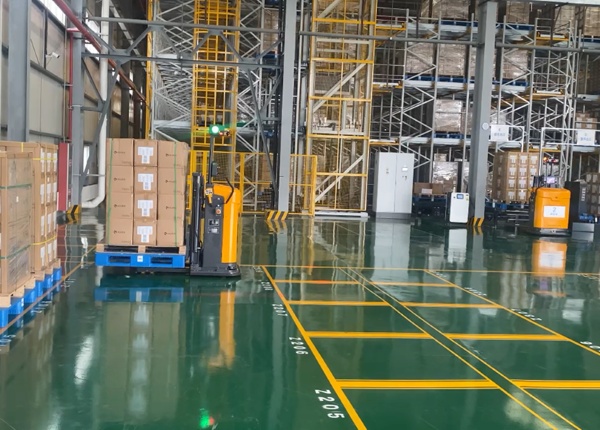
In a warehouse using automated forklifts, one pallet may pass through several business processes: receiving, putaway, replenishment, picking, and outbound preparation. Each process can generate a transport request. If the warehouse system does not control the relationship between these requests, the same pallet may be assigned to more than one movement.
The consequences are not limited to unnecessary vehicle travel. Duplicate tasks can cause incorrect inventory locations, blocked pickup points, conflicting vehicle assignments, and manual recovery work. In a high-bay warehouse, the problem can become more difficult to resolve if one task is completed while another remains active in the control system.
A reliable AGV forklift project should therefore establish one authoritative movement status for each pallet and ensure that new tasks cannot conflict with movements already in progress.
Duplicate movements can be generated at several points in the warehouse process. The first step is to identify which systems and users can create transport requests.
Repeated WMS requests: A message is sent again because the original response was delayed or not received.
Operator resubmission: An operator clicks a task creation button more than once after seeing no immediate confirmation.
Overlapping business rules: Two processes independently identify the same pallet as eligible for movement.
Task recovery: A task is manually recreated while the original task is still active.
Communication interruption: The WMS and RCS temporarily disagree about whether a task has been accepted or completed.
Location status mismatch: The physical pallet has moved, but the warehouse system still shows it at its previous location.
These scenarios require different controls. Simply blocking repeated clicks will not solve duplicate messages from system interfaces, while message deduplication alone will not prevent two separate business processes from assigning the same pallet.
Each transport request should carry a unique task identifier. The identifier allows the WMS and RCS to recognize whether a message represents a new task or a repeated submission of an existing one.
The task record should also contain the pallet ID, pickup location, destination, task type, creation time, and relevant business reference. These fields help the control system determine whether two requests are actually duplicates or represent separate movements that happen to involve the same pallet at different stages.
For example, a repeated message with the same task ID should normally be recognized as an existing request rather than creating a second vehicle assignment. A new task ID for the same pallet should still be checked against the pallet's current movement status before it is accepted.
Task identification and pallet identification solve different problems: the task ID identifies the instruction, while the pallet ID identifies the physical load being moved. Both are necessary for reliable control.
One of the most important controls is to prevent multiple active transport tasks from claiming the same pallet at the same time.
When a transport task is accepted, the system should reserve the pallet for that movement. Other processes should not be allowed to create a conflicting task until the existing movement reaches an approved final state or is formally cancelled.
A pallet movement status may include:
Available: The pallet can be assigned to a new task.
Reserved: A transport task has been accepted, but pickup has not yet been confirmed.
In transit: The vehicle has picked up the pallet and is transporting it.
Delivered: The pallet has reached the destination and delivery has been confirmed.
Exception: The movement requires investigation or manual handling.
The exact status names depend on the software architecture. What matters is that the system has a consistent rule for deciding when a pallet becomes available for another movement.
The WMS typically manages inventory and warehouse business instructions, while the RCS manages AGV dispatch and physical transport execution. If these systems update task status at different times, they may temporarily hold conflicting information.
For example, the RCS may have accepted a task and assigned a vehicle, while the WMS has not yet received the acceptance response. If the WMS immediately sends another request, the system may create a duplicate movement unless the interface has a reliable duplicate-checking mechanism.
Define the communication sequence for task creation, acceptance, vehicle assignment, pickup confirmation, delivery confirmation, completion, cancellation, and failure. Each response should refer to the original task ID so that both systems can update the same transaction.
Also define how the systems recover after network interruptions. A temporary communication failure should not automatically be interpreted as proof that a task was never accepted or completed.
Manual intervention is sometimes necessary when a pallet is damaged, a destination becomes unavailable, or a vehicle cannot complete its assigned task. However, manually creating a replacement task while the original task remains active can cause duplicate movement.
Before allowing a replacement task, the system or operator should verify the original task's current state. If it is still active, the existing task should be cancelled or formally transferred according to the approved recovery procedure.
Cancellation should not be treated as a simple deletion. The system needs to know whether the vehicle has already picked up the pallet, whether the pallet is still at the original location, and whether a physical recovery action is required.
Access permissions should also distinguish between users who can view tasks, users who can request cancellation, and users who can authorize exceptional recovery actions.
Software status alone may not always reflect the pallet's actual position. A pallet can be moved manually, a pickup can fail, or a task can be interrupted after the vehicle has collected the load.
Before creating a new movement after an exception, verify the physical pallet location and compare it with the recorded inventory location. Depending on the project, this may involve barcode scanning, station confirmation, location detection, or an operator verification step.
For high-bay storage, the system should also confirm that the pallet is eligible for the intended rack position. A new task should not be released based only on an outdated location record, particularly when the pallet may have been moved during manual recovery.
Some situations cannot be resolved by simply checking whether a task is marked complete or incomplete. For example, a vehicle may have picked up a pallet but lost communication before reporting the pickup confirmation.
In this case, the system should not immediately release another vehicle to collect the same pallet. The task should enter an exception state until the physical condition and vehicle status have been verified.
Define recovery procedures for the following situations:
The WMS sent a request but did not receive an acceptance response.
The RCS accepted a task but the vehicle has not started moving.
The vehicle picked up a pallet but the pickup event was not reported.
The vehicle delivered a pallet but the WMS did not receive completion confirmation.
An operator manually moved the pallet while the original task was active.
A task was cancelled after the vehicle had already started execution.
Each scenario should have a defined decision process. The objective is to establish the real pallet position and task state before allowing another movement.
Before commissioning, verify that:
Every transport task has a unique identifier.
Every pallet or handling unit has a traceable identity.
Repeated interface messages do not create new task records.
A pallet cannot be assigned to conflicting active movements.
WMS and RCS task states follow an agreed transaction sequence.
Manual task creation checks for existing active tasks.
Cancellation and replacement tasks follow controlled procedures.
Physical pallet location can be verified after an exception.
Uncertain task states are held for investigation rather than automatically repeated.
Key checkpoint: A pallet should not receive a new transport assignment simply because the previous task has no visible completion result. First verify the original task state and the pallet's physical location. This prevents a communication delay from becoming a duplicate movement.
During acceptance testing, deliberately create conditions that may cause duplicate requests. Send the same task message more than once, delay interface responses, interrupt communication, and attempt to create a second task for a pallet that is already reserved or in transit.
Check whether the system recognizes repeated task IDs, prevents conflicting pallet assignments, and maintains consistent records between the WMS and RCS. Also verify that a task can be recovered correctly after an interruption without sending another vehicle to the same pickup point.
Test manual intervention as well. Confirm that an authorized operator can resolve an exception through the approved procedure, while unauthorized users cannot bypass the task-control rules.
For warehouses operating high-bay storage and narrow-aisle AGV forklifts, include realistic scenarios involving occupied locations, unavailable transfer points, and delayed delivery confirmations. These tests help reveal inconsistencies that may not appear during simple point-to-point demonstrations.












 Chinese
 English





