


Industrial drums and intermediate bulk containers (IBCs) create different material-handling challenges from standard palletized goods. Their shape, center of gravity, container base, and filling condition can affect how they should be lifted and transported. When a warehouse wants to automate these movements, selecting a standard AGV forklift based only on rated load capacity is not enough. The load interface and complete handling method must be evaluated.
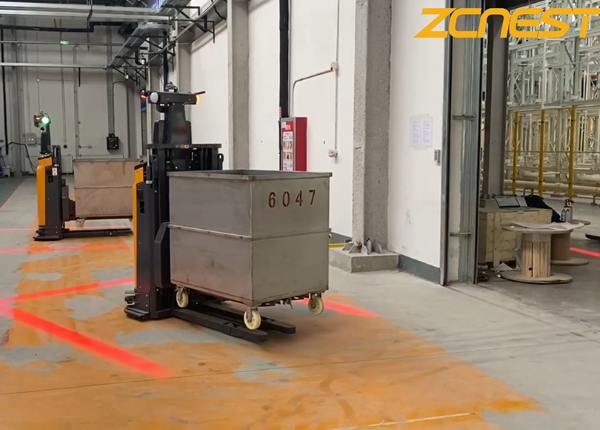
The term industrial drum can describe steel drums, plastic drums, fiber drums, or other cylindrical containers. IBC containers may have different capacities, cage structures, base designs, and lifting interfaces.
The first step is to classify the loads that the AGV will handle. Do not assume that two containers with similar external dimensions can use the same attachment or lifting method.
Drum material, diameter, height, and gross weight.
IBC capacity, cage dimensions, and base structure.
Whether the container is full, partially filled, or empty.
Whether the load is transported individually or on a pallet.
Whether the container has designated forklift pockets or lifting points.
Whether the load requires an upright, horizontal, or fixed orientation.
These details determine whether a standard fork interface is suitable or whether a customized attachment is required.
Cylindrical containers and liquid-filled IBCs can behave differently from rigid palletized loads. A partially filled container may have a changing liquid distribution during movement. The resulting load behavior should be considered when determining acceleration, deceleration, turning speed, and the required support structure.
The project team should evaluate the actual container and its contents rather than relying solely on the container's nominal capacity.
Important design considerations include:
Maximum and minimum gross load.
Load center and center-of-gravity position.
Container movement relative to its support structure.
Permitted acceleration and braking characteristics.
Turning radius and route geometry.
Whether the load requires a defined orientation throughout transportation.
A standard fork attachment may be suitable when the container is placed on a compatible pallet or base. However, direct handling of individual drums may require a dedicated drum attachment, cradle, or transfer fixture.
Possible interfaces include:
Standard fork handling: For drums or IBCs secured on compatible pallets.
Custom support cradle: For loads that require a defined support geometry.
Drum-specific attachment: For containers designed to be gripped or supported through a dedicated interface.
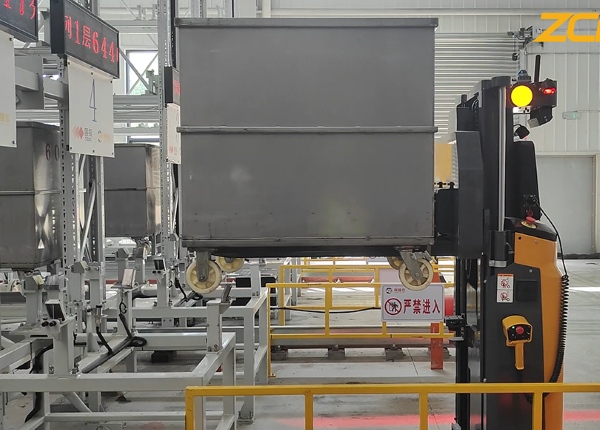
Transfer platform: For moving containers between AGVs and fixed process equipment.
The attachment should be evaluated with the AGV's rated capacity, load center, lifting height, and actual operating envelope. Any customized interface should be tested with representative containers before production deployment.
AGV pickup reliability depends on repeatable physical positioning. A container that is placed slightly differently each time may create difficulties for a fixed fork or cradle interface.
Define the pickup and placement requirements for every transfer point:
Exact pallet, base, or cradle dimensions.
Fork entry direction and available clearance.
Container orientation and positioning tolerance.
Required lifting and lowering clearance.
Floor flatness and station approach conditions.
Space for the AGV to align and complete the transfer.
Where containers arrive from manual handling or another process, a standardized handover position can reduce variation and make automated pickup more repeatable.
The WMS should identify each container or handling unit and specify the correct destination. If different container types require different attachments or storage areas, the movement task should carry the information needed by the fleet control system.
A practical task record may include:
Container or pallet ID.
Container type and handling method.
Gross weight or applicable weight category.
Pickup and destination locations.
Required attachment or transfer interface.
Inventory status and any destination restrictions.
If a container's weight or dimensions exceed the configured handling range, the system should route the task to the appropriate exception process instead of dispatching an unsuitable vehicle.
Testing should use the actual container types, representative load conditions, and intended transfer stations. A successful empty-container demonstration is not sufficient when the production process also handles partially filled or full containers.
Test pickup and placement with each approved container base.
Verify the attachment's compatibility with the container geometry.
Evaluate the maximum intended gross load and load center.
Test representative turning, braking, and acceleration profiles.
Check positioning repeatability at each transfer point.
Verify inventory identification and task completion feedback.
Document the approved container and load configurations.
The acceptance criteria should specify which container types, weights, and operating conditions have actually been validated.
Container photos, drawings, and external dimensions.
Empty and maximum gross weight.
Container base or forklift interface details.
Full, partial, and empty container operating conditions.
Required handling orientation and storage method.
Pickup and destination layout drawings.
Daily movement volume and travel distance.
When container dimensions, lifting interfaces, or transfer positions differ from standard pallet handling, customized AGV engineering may be required. This can involve a modified fork structure, dedicated attachment, customized control logic, or a transfer station designed around the container base.
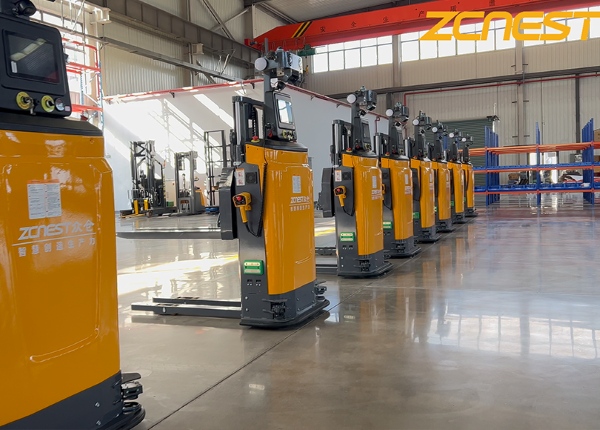
ZCNest develops AGV forklifts and AMR systems with customized hardware and software capabilities. The project evaluation can start with container drawings, load data, and a warehouse layout to determine a suitable handling configuration.
Send us your container dimensions, gross weight, photos, and handling requirements. We can assess whether a standard fork configuration or customized handling interface is more suitable.












 Chinese
 English





