


Quality inspection often interrupts the normal flow of warehouse inventory. A pallet may need to leave its storage location, wait for sampling, move to an inspection station, and then return to storage or proceed to another destination. When these movements are handled manually, warehouse teams must coordinate transport, inspection priorities, and inventory updates. AGV forklifts can automate the physical movement, provided that inspection status and task sequencing are clearly defined.
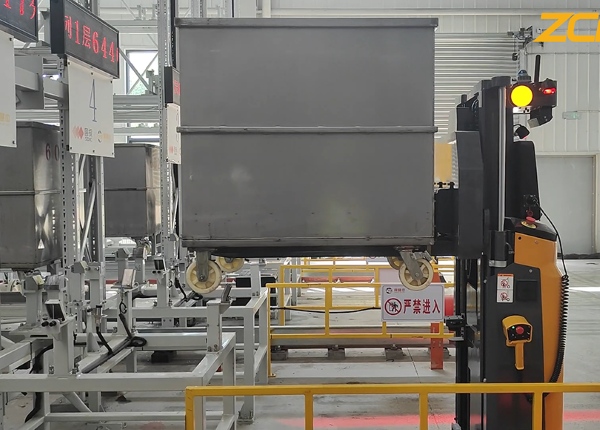
An AGV forklift should transport a pallet according to an authorized warehouse instruction. It should not independently determine whether a product has passed inspection or whether a batch can be released.
The quality management system or WMS should manage the inspection status. The fleet control system then executes the movement instruction to the designated inspection area.
This separation makes responsibilities clearer:
WMS: Identifies the inventory, storage location, and required movement.
Quality system: Manages sampling requirements and inspection outcomes.
Fleet control: Assigns an AGV and coordinates transportation.
AGV forklift: Performs the physical pickup, transport, and placement.
If inspection requests are released without considering station capacity, several pallets may arrive at the same time and block the available staging space. A dedicated queue allows the warehouse to control which pallet should move next.
The queue should consider more than request time. Relevant factors may include inspection priority, product category, sampling requirements, order urgency, and the availability of inspection personnel or equipment.
Define the queue's operating rules in advance:
Maximum number of pallets waiting at the inspection area.
Priority rules for urgent or scheduled inspections.
Whether different product categories require separate waiting positions.
How the system handles a station that becomes unavailable.
How inspection completion releases the next movement task.
The inspection area should provide clearly defined pallet positions. If several pallets are waiting, each position should be identifiable by the warehouse system so that the AGV can place and retrieve the correct load.
Consider the following layout factors:
Number of pallets waiting during normal and peak periods.
Access required by inspection personnel and sampling equipment.
Pickup and placement clearances for the AGV forklift.
Separate positions for waiting, in-progress, and completed inspections.
Space for rejected or restricted inventory, if required by the process.
Traffic separation between AGVs and manual handling activities.
The staging area should be sized according to the actual inspection cycle time and arrival rate rather than an arbitrary number of floor positions.
Once the pallet reaches the inspection area, the system needs to know that the physical transfer is complete. The inspection process can then proceed according to the warehouse's quality procedure.
A typical automated workflow may follow these steps:
The quality or warehouse system identifies a pallet requiring inspection.
The WMS creates a transport task with the pallet ID and inspection destination.
The fleet control system assigns an AGV forklift.
The AGV retrieves the pallet and delivers it to the assigned inspection position.
The system confirms arrival and updates the pallet's location.
Inspection personnel or equipment complete the required inspection.
The quality system records the result and updates the inventory status.
The WMS releases the next movement according to the inspection outcome.
The inspection result should be linked to the same pallet or batch identifier used in the transportation task.
Not every pallet should return to its original storage location after inspection. The next destination depends on the quality result and warehouse rules.
Inspection passed: Return the pallet to its assigned storage location or move it to an authorized outbound staging area.
Inspection pending: Keep the pallet in the designated waiting position until the result is available.
Inspection failed: Move the pallet to the designated restricted or rejected inventory area when authorized.
Additional sampling required: Create another inspection task or retain the pallet in the appropriate queue.
Result unavailable: Keep the inventory status unchanged until the responsible system confirms the result.
These routes should be configured as explicit business rules. The AGV should not infer the inspection result from the pallet's physical position or from an operator's informal instruction.
Inspection queues create a different traffic pattern from ordinary putaway and retrieval. A pallet may remain at the station for several minutes or hours while inspection is underway, even though the AGV completes its delivery quickly.
Estimate the required staging capacity using the expected arrival rate and average inspection waiting time. A simple planning approximation is:
Average queue size ≈ Pallet arrival rate × Average waiting time
For example, if the warehouse sends six pallets per hour for inspection and the average waiting time is half an hour, the average queue may be around three pallets. Actual peak capacity should include variability, scheduled inspection batches, and periods when the station is unavailable.
AGV fleet sizing should also include the return or onward transport after inspection, not just the initial delivery movement.
The project team should validate the full process with realistic inspection scenarios. Testing should include both normal task completion and cases where the quality result or station status changes unexpectedly.
Two or more pallets arriving for inspection at the same time.
An inspection station becoming unavailable after task release.
A pallet waiting longer than the planned inspection duration.
A passed pallet returning to its original storage location.
A rejected pallet moving to a restricted destination.
An inspection result arriving after a communication delay.
A canceled inspection request while the AGV is traveling.
Verification that inventory records match the pallet's actual location.
Inspection triggers and priorities are defined.
Each pallet has a traceable inventory identifier.
Inspection staging positions are mapped in the WMS.
Queue capacity reflects actual inspection waiting time.
Inspection outcomes determine the next authorized destination.
Quality and fleet systems exchange task status correctly.
Exceptions are included in acceptance testing.
The AGV forklift should be selected according to the pallet weight, dimensions, storage height, aisle layout, and transfer-station design. Software integration should connect inspection requests, inventory status, fleet tasks, and completed movement records.
ZCNest provides AGV forklift and AMR solutions with customized hardware and software development. We can evaluate the warehouse layout and inspection workflow to determine how automated pallet transport can fit into the existing operation.
Share your inspection process, pallet specifications, staging layout, and WMS interface requirements. ZCNest can help plan an AGV forklift solution for inspection-related warehouse movements.












 Chinese
 English





