


Automated wrapping and strapping machines are often positioned between warehouse storage and outbound preparation. AGV forklifts can supply pallets to these machines and remove completed loads, provided that the mechanical handover, machine signals, and transport sequence are properly coordinated.
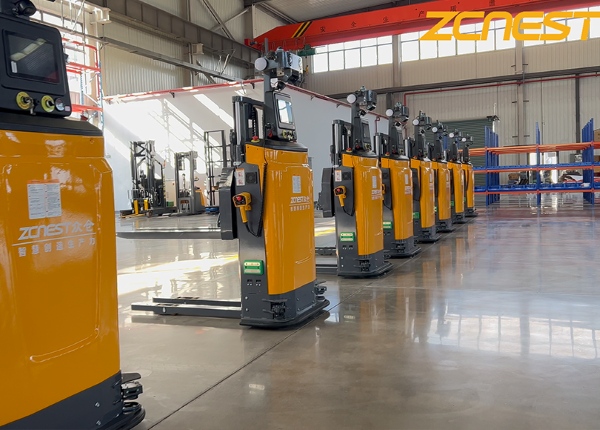
Pallet wrapping and strapping operations are common in distribution centers, manufacturing warehouses, and export facilities. A pallet may need to be wrapped, strapped, or processed by both machines before it can move to the next stage.
When AGV forklifts are introduced, the objective is not simply to replace the manual forklift that delivers pallets. The project must establish a reliable interface between the vehicle and the packaging equipment so that neither system waits unnecessarily or attempts an unsafe transfer.
Start by documenting the actual packaging workflow. Some warehouses use a wrapping machine only, while others combine wrapping, strapping, labeling, and additional inspection steps.
Clarify the following:
Where pallets enter the packaging area.
Whether wrapping and strapping are separate or combined operations.
Whether pallets require a specific orientation.
How completed pallets leave each machine.
Whether different pallet types follow different processing routes.
This process map determines the AGV pickup and drop-off points, the number of transfer positions, and the control signals required from each machine.
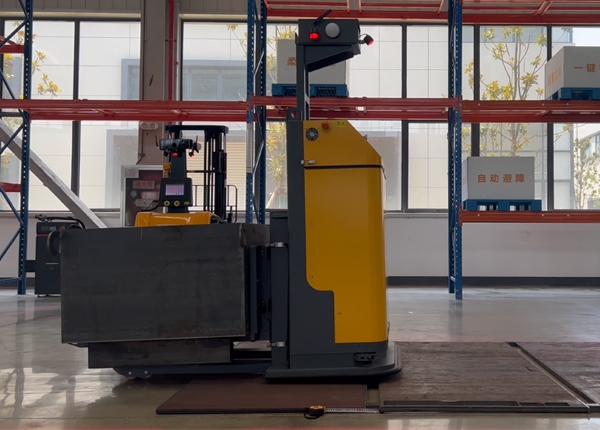
Wrapping and strapping machines are not all designed for direct AGV forklift access. Some use turntables, conveyor sections, roller platforms, or dedicated pallet positioning structures.
The project should confirm whether the AGV places the pallet directly onto the machine platform or transfers it through a separate station.
Important design details include:
Platform height and pallet support structure.
Fork entry and withdrawal clearance.
Maximum pallet dimensions and weight.
Positioning accuracy required by the machine.
Clearance around rotating or moving machine components.
Safe separation between AGV travel paths and operator work areas.
The machine manufacturer and AGV supplier should jointly verify the interface. A transfer point that works for a manual forklift may not provide sufficient clearance for an automated vehicle.
The AGV and packaging machine need to exchange signals so that each system knows when the other is ready.
A typical handshake may include:
Machine available for pallet delivery.
AGV approaching or arriving at the transfer point.
Pallet positioned at the agreed location.
AGV transfer completed and vehicle clear.
Machine processing started and completed.
Completed pallet ready for collection.
AGV collection confirmed.
The exact signals depend on the machine controller and the integration architecture. The project should define signal ownership, timeout behavior, and recovery procedures for incomplete handovers.
Packaging machines may process pallets more slowly than the AGV fleet can deliver them. Without suitable buffer positions, vehicles can accumulate around the machine or block nearby warehouse routes.
Estimate the average machine cycle time, expected pallet arrival rate, and available buffer capacity. The RCS should coordinate delivery according to machine readiness rather than sending every waiting task to the same transfer point.
If several machines are available, the WMS or RCS may distribute pallets according to process requirements and station status. The selection rules should also account for different pallet sizes and packaging recipes where applicable.
An AGV should not collect a pallet simply because a machine cycle has been running for a predefined period. The packaging equipment should provide a completion signal or another agreed confirmation.
The warehouse system should also associate the packaging transaction with the correct pallet. This helps prevent a completed status from being assigned to a pallet that was not actually processed.
Where the packaging process can fail, define the appropriate response. For example, a machine may report a film-feed problem, strap fault, or emergency stop. The pallet should remain at a controlled location until the equipment and warehouse process authorize the next action.
Key Procurement Checkpoint
Request an integrated demonstration covering AGV arrival, pallet placement, vehicle withdrawal, machine processing, completion confirmation, and collection of the finished pallet.
Acceptance testing should include a machine that is busy, a transfer point that is occupied, a packaging cycle that fails, and a communication signal that does not arrive.
Verify that the AGV does not enter an unsafe machine area, that the packaging machine cannot start before the vehicle is clear, and that incomplete transactions are visible to operators.
Also test the workflow when packaging equipment is unavailable for an extended period. The warehouse should have a defined holding or manual recovery procedure rather than allowing transport tasks to accumulate indefinitely.
AGV forklift integration with wrapping and strapping machines depends on a reliable mechanical interface and a clear machine communication sequence. By defining transfer positions, processing signals, buffer capacity, and failure handling in advance, warehouses can automate pallet packaging transport without creating new operational bottlenecks.
Send us your packaging machine layout, pallet specifications, cycle times, and control interface requirements. ZCNest can help assess AGV forklift integration for your packaging workflow.












 Chinese
 English





